
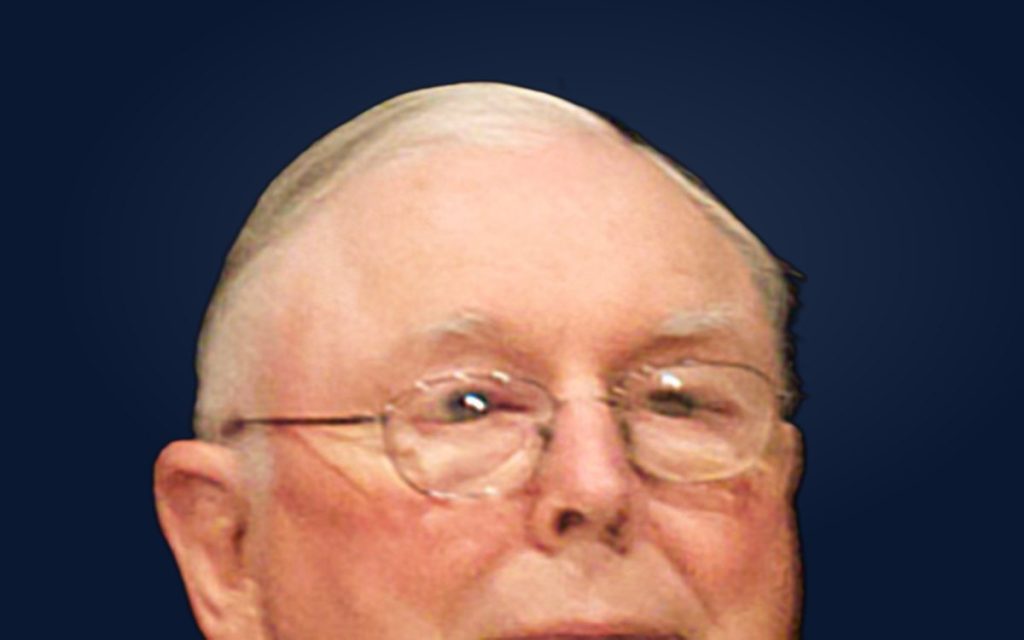
Charlie Munger: The Architect of Berkshire Hathaway
The man who taught Warren Buffett that quality is more important than a cheap price. Master of Mental Models and Vice Chairman of Berkshire Hathaway.
Career & Biography
Charles Thomas Munger was born on January 1, 1924, in Omaha, Nebraska. Ironically, as a boy, he worked in the grocery store owned by Warren Buffett’s grandfather, though the two didn’t meet until decades later. Munger studied mathematics at the University of Michigan, served as a meteorologist in the Army Air Corps during WWII, and eventually graduated from Harvard Law School “magna cum laude” without ever having earned an undergraduate degree.
He co-founded the prestigious law firm Munger, Tolles & Olson but soon turned his focus to investing and real estate. 1959 was a pivotal year in financial history: Buffett and Munger met at a dinner in Omaha. It was the start of the most successful partnership in stock market history. While Buffett was initially a “cigar-butt” investor looking for cheap, mediocre companies, Munger convinced him that “it’s better to buy a wonderful company at a fair price than a fair company at a wonderful price.”
From 1978, Munger served as the Vice Chairman of Berkshire Hathaway. He was Buffett’s closest advisor and his “Abominable No-Man,” rejecting risky or mediocre deals with a dry “I have nothing to add.” Munger passed away in November 2023, just weeks before his 100th birthday, leaving behind an intellectual legacy that extends far beyond finance.
The Munger Philosophy: Mental Models
Munger wasn’t just a numbers person; he was an interdisciplinary thinker. His philosophy was based on a “latticework of mental models.” He believed that you must know the big ideas from all important disciplines – mathematics, biology, psychology, physics – to make smart decisions.
1. Inversion: “Invert, always invert.” Instead of asking how to succeed, Munger asked: “How do I guarantee failure?” By avoiding the paths to failure, success is almost inevitable.
2. The Lollapalooza Effect: This term describes the convergence of multiple psychological tendencies or factors in the same direction, leading to extreme results. Munger used this to identify both great opportunities and dangerous bubbles.
3. Circle of Competence: Munger was brutally honest about his limits. “We have three baskets for investments: Yes, No, and Too Hard.” He never invested in things he didn’t understand deeply, no matter how popular they were.
3 Legendary Investments
See’s Candies (1972): The Paradigm Shift
Munger persuaded Buffett to pay $25 million for the candy maker – three times its book value. Buffett thought it was expensive, but Munger saw the enormous brand strength. Today, See’s has generated over $2 billion in cash flow for Berkshire and is cited as the investment that changed Buffett’s strategy forever.
Costco (Since 1997): Ultimate Loyalty
Munger loved Costco more than almost any other company. He served on its board for decades. He admired the radical business model: extremely low margins driven by membership fees and fanatical customer loyalty. For him, Costco was the ultimate “Moat.”
BYD (2008): The Tech Instinct
Despite Buffett’s initial skepticism, Munger pushed for the investment in the Chinese automaker BYD. He called founder Wang Chuanfu a mix of Thomas Edison and Jack Welch. Berkshire invested $232 million; at its peak, the position was worth over $8 billion.
Wisdom from Charlie Munger
“Invert, always invert: Turn a situation or problem upside down. Look at it backward.”
“The big money is not in the buying and the selling, but in the waiting.”
“I have nothing to add.”
“To a man with only a hammer, every problem looks like a nail.”
“Spend each day trying to be a little wiser than you were when you woke up.”
Recommended Resources
- Poor Charlie’s Almanack: The bible of interdisciplinary thinking. A must-read.
- Daily Journal Meetings: Annual meetings where Munger answered questions for hours.
- Worldly Wisdom: Munger’s famous 1994 speech at USC Business School.
This article is for informational purposes only. Charlie Munger was a proponent of independent thinking – use this as a foundation for your own research.
Try TradingView Free for 30 Days
Plus get a $15 discount on your first subscription through this link.