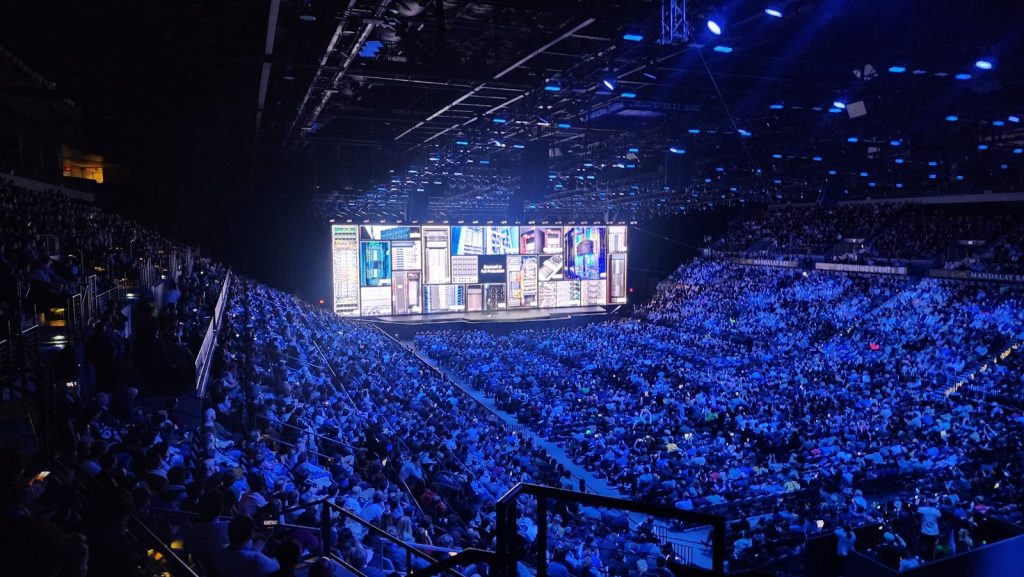
Yesterday evening at 4:20 PM Eastern, Nvidia published Q1 FY2027 earnings. What followed should have been a perfect beat. Revenue 81.62 billion dollars against expected 79.19 billion. EPS 1.87 against expected 1.77. Gross margin 75 percent. Q2 guidance of 89.18 to 92.82 billion dollars, well above consensus estimates of 87.36 billion. Plus an additional 80 billion dollar share buyback program.
That’s not a “good” beat. That’s a blowout quarter in every metric that counts.
Today Thursday midday in New York: Nvidia stock barely moving. S&P 500 down 0.3 percent. Nasdaq 100 down 0.3 percent. Bloomberg summarizes: “Nvidia’s earnings did little to reignite momentum in the artificial-intelligence trade.”
Let that sink in. The best earnings quarter in tech history. And markets yawn.
If you understand this story correctly, you have one of the most important market signals of 2026. Let’s go through it.
What Nvidia Actually Delivered
The numbers aren’t “okay” – they’re extraordinary. Let’s get concrete.
Revenue: 81.62 billion dollars in one quarter. For perspective: the entire German semiconductor industry generates about 45 billion dollars revenue per year. Nvidia generates in 90 days almost double what Germany does in 365 days.
Growth: Plus 78 percent year-over-year. At a company already worth 4.5 trillion dollars. That’s mathematically nearly impossible – large companies can’t maintain such growth rates. Except Nvidia, apparently.
Margins: 75 percent gross margin. Apple has about 45 percent. Microsoft 70 percent. Even “asset-light” software companies rarely reach 75. Nvidia does it with hardware. That’s margin reality normally only achieved by luxury goods brands.
Guidance: Q2 range 89 to 93 billion. That would be another plus 9–14 percent over the current quarter. Sequentially. In an already hyperbolically growing business.
Buyback: Additional 80 billion dollar share buyback authorization, on top of the already approved 40 billion. 120 billion dollars potential buybacks. That’s more than the entire market cap of Volkswagen.
Every single one of these data points is extraordinary. Together they should trigger a 10 percent rally. What did we get? A stock that ticked up after hours and will close today barely moved.
Why the Reaction Is Muted
Let’s be honest about what’s really happening. The explanations are more complex than “markets are irrational.”
First, the expectations spiral. Daniel Newman, CEO of Futurum Group, put it succinctly today: “Wall Street has pulled itself above the company’s own guide for the first time in this cycle, which raises the bar for what counts as a beat.” Over the last 8 quarters, Nvidia always guided, consensus was below, Nvidia delivered and beat. This time: consensus was ABOVE Nvidia’s own guidance. Buy-side investors expected 85–90 billion dollars. Delivering 81.62 was a sell-side beat but a buy-side miss.
Second, hyperscaler concentration risk. Newman mentioned a critical point: “Hyperscaler capex has been revised up to roughly $725 billion for 2026.” Nvidia depends on Microsoft, Amazon, Google, Meta who collectively drive 725 billion dollars AI capex 2026. If just one of these four reduces by 10 percent, Nvidia’s growth immediately falls to 50 percent instead of 78. Markets are now pricing this concentration risk.
Third, the “Sovereign AI” story as hedge. Newman: “Sovereign AI tripled to over 30 billion dollars in fiscal 2026. This matters strategically because it is the cleanest hedge against hyperscaler concentration risk.” If Saudi Arabia, UAE, India and EU build their own “Sovereign AI” programs, Nvidia is less dependent on Big Tech. But 30 billion dollars sovereign AI is 4 percent of hyperscaler capex. That’s hedge in theory, not practice.
Fourth, the macro environment suffocates every bull case. 10-year Treasury at 4.7 percent. 30-year at 5.1 percent. Highest yields since 2007. At these discount rates, future cash flows of all stocks become less valuable. Nvidia can deliver whatever it wants – if the discount rate rises, net present value falls. That’s not sentiment. That’s mathematics.
What Bond Yields Really Do to Nvidia
Let me get concrete. This mathematics barely anyone understands correctly.
Nvidia trades at roughly 39x forward earnings. This valuation implies a specific assumption about future cash flows. If the market assumes 50 percent growth for the next 5 years and 20 percent thereafter, 39x at a risk-free rate of 4 percent is appropriate.
But at 5.1 percent risk-free rate, the mathematics changes dramatically. The same future cash flows are worth less today because you discount them back to today with a higher discount rate.
Mathematically: If the discount rate rises from 4 percent to 5.1 percent, today’s value of cash flows 10 years out falls by about 10 percent. Cash flows 20 years out fall 20 percent. Cash flows 30 years out fall 28 percent.
For a mature stock like Procter & Gamble that’s irrelevant – their cash flows mostly come in the next 5 years. For a growth stock like Nvidia it’s decisive – it’s valued partly for cash flows lying 10–20 years in the future.
Nvidia can slam every quarter. If yields stay at 5.1 percent or rise higher, the stock multiple compresses. That’s not Nvidia’s fault – that’s valuation reality.
What the Bigger Story Is
Here it gets interesting. The muted reaction to Nvidia’s blowout quarter isn’t just a Nvidia story. It’s the most important market observation of the quarter.
Over the last 3 years, markets celebrated every tech beat recovery with a rally. Every Apple beat, Microsoft beat, Google beat brought the stock 3–5 percent higher. Earnings season was bull fuel.
That’s changing now. Nvidia is the bellwether. When the most important AI stock in the world only trades sideways on a perfect beat, that signals a fundamental change. Markets are full of AI hype – everyone has already bought. There are no “marginal buyers” left to step in on good news.
That’s a classic top pattern. Not “crash coming tomorrow” – but “the easy upward move is over.” Smart money starts rotating long before retail recognizes it.
Look at Q1 13F data. Warren Buffett completely out of Visa, Mastercard, Amazon, UnitedHealth. Stan Druckenmiller rotating from tech to energy. Bill Ackman choosing defensive Microsoft over aggressive Nvidia. David Tepper increasing energy allocation 25 percent. These managers together manage over 500 billion dollars. They know what they’re doing.
What the “Tale of Two Earnings” Really Shows
While Nvidia couldn’t convince yesterday evening with perfection, Walmart fell 2 percent this morning despite an earnings beat. Walmart confirmed full-year guidance at 2.75–2.85 dollars EPS, below the 2.91 LSEG estimates. Plus warning about higher fuel costs linked to Iran conflict.
That’s the real story: beats aren’t enough anymore. Both for tech growth (Nvidia) and defensive retail (Walmart), companies now need to deliver PERFECT quarters plus PERFECT guidance, otherwise stocks fall. This is a market that has arrived at maximum valuation tolerance.
Whoever buys in such a market buys an asymmetric risk-reward. Upside is limited (even beats aren’t rewarded anymore), downside is open (misses are punished hard).
What Smart Money Is Doing Now
Let’s look at recent moves.
Warren Buffett: Known for his anti-tech positioning. In Q1 2026 completely out of Visa, Mastercard, Amazon, UnitedHealth. New positions in Macy’s, Delta Air Lines, NY Times. That’s not randomly defensive – that’s capital preservation in an overvalued market.
Bill Ackman: Pershing Square bought Microsoft in Q1. Not Nvidia, not Tesla. Microsoft with enterprise software cash flows independent of AI capex cycle. That’s defensive tech positioning.
Stan Druckenmiller: Has massively built up energy. Built up defense. Reduced tech. Druckenmiller manages about 5 billion dollars family office money. He made the right calls in the 70s, 90s, 2000s and 2008. When he rotates out of tech, that’s a signal.
David Tepper: Known for China bull calls. Has increased energy to 25 percent of portfolio since February. Reduced tech. Tepper historically makes big rotation calls perfectly.
These four managers aren’t all positioned defensively because they randomly had the same idea. They see the same mathematics we’re going through here. Yields high, valuations extreme, market concentration historic.
What You Should Concretely Do
First, avoid the Nvidia trap. If you hold Nvidia, the question isn’t “should I sell?” but “do I have appropriate risk management?” If Nvidia trades at $920 and you haven’t defined what you do at 800, 700, 600 – then you don’t have a system. You have hope. Set mental stop-loss levels now, not when the stock falls.
Second, check position sizing. If Nvidia is more than 10–15 percent of your portfolio, you have concentration risk. If the Magnificent Seven combined are more than 40 percent, also. Smart money positions for a world where these stocks underperform. You should at least think about it.
Third, consider defensive rotation. Energy at 7–8 percent dividend yields. Defense with structural tailwind. Banks benefiting from higher yields. Insurers like Berkshire Hathaway with low valuations and high float income. These aren’t “sexy” stocks. But they’re asymmetrically positively positioned.
Fourth, increase cash allocation. Money market funds pay 5 percent risk-free. Cash was a “losing asset” for 5 years because inflation was higher than yields. Now cash is real income. A position of 15–25 percent cash gives you optionality for the next correction.
Fifth, prepare watchlist for correction. If Nvidia falls to 700, if Microsoft falls to 380, if Apple falls to 250 – which of these do you want to buy? A prepared list prevents panic decisions. Smart money has these lists.
The Honest Bottom Line
Nvidia delivered everything that could be delivered. Top line beat, bottom line beat, margin expansion, guidance beat, massive buyback. Doesn’t get any more.
Markets say: not enough. That’s not because markets hate Nvidia. That’s because markets have realized that even perfection in this valuation environment isn’t enough for higher stock prices anymore. Multiple compression through high yields offsets all operational successes.
That’s the most important market information this quarter. Not Nvidia’s revenue. Not their margins. But the reaction to it.
Bulls will say: “But Nvidia comes back. The stock will be higher in 6 months.” Possible. But that was also the argument for Cisco in 2000. Cisco delivered 5 years of operational excellence after March 2000. The stock needed 18 years to reach its 2000 high again.
Nobody is saying Nvidia becomes Cisco. But the mathematical logic of valuation contraction is the same. Whoever understands this can prepare. Whoever ignores learns it the hard way.
Smart money has already decided. Buffett, Druckenmiller, Ackman, Tepper. Over 500 billion dollars AUM. All defensively positioned. They can be wrong – but they rarely err simultaneously.
The question isn’t whether Nvidia is a good company. It’s excellent. The question is whether 4.5 trillion dollars market cap is sustainable in a higher-yields environment. Mathematics says: difficult. Today’s market reaction says: markets are starting to recognize this.
Try TradingView Free for 30 Days
Plus get a $15 discount on your first subscription through this link.
Read more in our topic hub: Topic Hub: AI Stocks Investing 2026