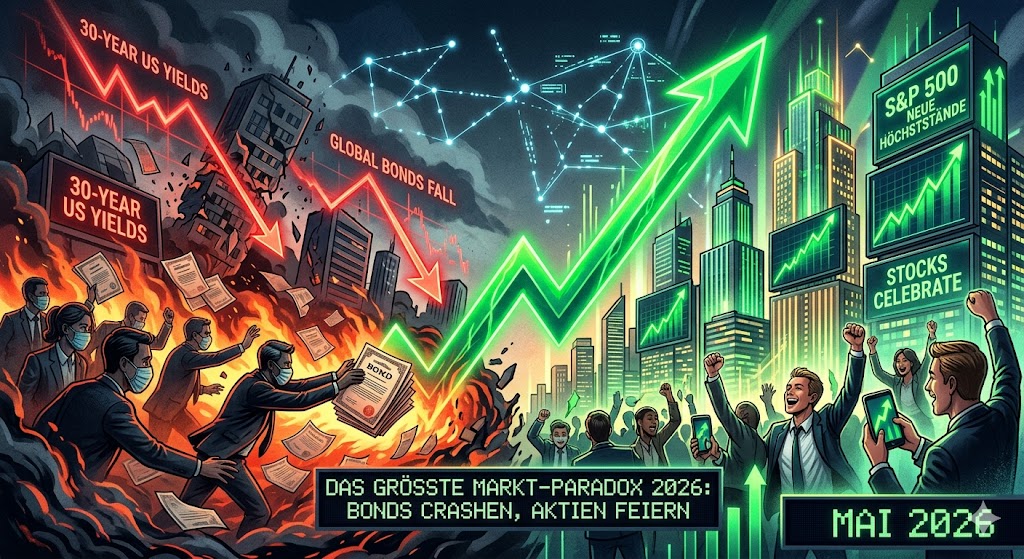
Today Friday midday in New York, something happens that makes no economic sense: The S&P 500 is heading for its 8th consecutive winning week. Polymarket traders bet 78% probability the index opens higher today. Yesterday S&P 500 closed at 7,445.72 – near all-time highs.
Simultaneously: The 30-year US Treasury jumped to 5.19% this week – highest level since before the 2007 financial crisis. Bloomberg formulated it soberly: “Investors shed government bonds around the world, propelling borrowing costs to multi-year highs from Japan to the US.”
Let that sink in. Bond yields have been destroying classical valuation models for months. Stock markets ignore this completely. This isn’t “slight divergence” – this is a historically unusual paradox that should force every investor to concrete action.
If you understand this story correctly, you have one of the most important market signals of 2026. Let’s go through honestly what’s happening here.
The Concrete Numbers Defining the Paradox
Let’s get specific because most mainstream headlines miss the true magnitude.
Bonds (the crash picture):
- 30-year US Treasury: 5.19% this week, highest since November 2007
- 10-year US Treasury: near 4.7% midweek
- Japanese 10-year: 2.79% (highest in 30 years)
- UK 10-year Gilts: above 5%
- German 10-year Bunds: 3.2% (highest since 2008)
This isn’t regional movement. This is global bond crash. Every major market in the world sees bond sellers.
Stocks (the rally picture):
- S&P 500: near all-time high, 8 weeks winning streak likely
- Nasdaq: at all-time highs
- DAX: also all-time high region
- Nikkei: higher despite yen strength
- Magnificent 7: 36% of S&P 500 (historical concentration)
Mathematically this should be impossible. When the risk-free rate explodes, risky assets must either offer more return or fall in price. Both sides of this equation are currently violated.
Why This Shouldn’t Work Mathematically
The basis of all stock valuation is discounting future cash flows with the risk-free rate plus risk premium. If I receive 100 dollars today or promise 100 dollars in 10 years, the value today is different.
- At 3% discount rate: 100 dollars in 10 years worth 74 dollars today
- At 4% discount rate: 100 dollars in 10 years worth 68 dollars today
- At 5.1% discount rate: 100 dollars in 10 years worth 61 dollars today
At 30 years (relevant for growth stocks) the differences are dramatic:
- At 3% discount rate: 100 dollars in 30 years worth 41 dollars today
- At 5.1% discount rate: 100 dollars in 30 years worth 22 dollars today
That means: at same expected cash flows, growth stocks should be worth 46% less today than they would be at 3% yields. That’s not theory – that’s DCF mathematics every investment banker and hedge fund quant uses.
But markets do the opposite. Growth stocks are at or near all-time highs.
Three Possible Explanations
There are three realistic explanations for this paradox. Let’s go through each honestly.
Explanation 1: Markets believe yields go back down
If markets think the 30-year yields are only temporarily at 5.19% and will fall back to 4% in 6-12 months, stock resilience would be explained. Valuations are based on long-term discount rates, not current ones.
Argument for: Fed could cut if economy slows. Iran war could end, oil could fall, inflation could decline.
Argument against: Fed hike probability 2026 is 45% per CME FedWatch. Cut probability is 0%. Markets aren’t pricing in “yields-fall-soon” scenario – they’re pricing in the opposite.
Explanation 2: Earnings grow faster than discount rates rise
If earnings 2026 grow 15-20% while discount rates “only” rise 100-200 basis points, both could mathematically happen without multiple contraction.
Argument for: Nvidia delivers +78% YoY growth. Microsoft, Google, Meta similarly strong. These top 7 pull the whole index up.
Argument against: Earnings growth is concentrated on Magnificent 7. The rest of the S&P 500 (493 stocks) grows only 5-7%. The average stock is significantly overvalued when yields are high.
Explanation 3: Markets are irrational – classic top pattern
That’s the uncomfortable possibility. When markets ignore fundamental valuation mathematics, it’s often a late-cycle top pattern.
Argument for: Historically this happens before bear markets. 1999/2000 markets ignored rising yields until Dotcom crash. 2007 markets ignored the US housing problem until financial crisis. 2021 markets ignored inflation until 2022 tech crash.
Argument against: “This time is different” because of AI productivity revolution. Possible, but historically a dangerous sentence.
What Bond Vigilantes Are Really Doing
A concept that was dead for 15 years comes back: bond vigilantes. These are institutional bond investors who discipline governments through selling sovereign bonds when those act fiscally irresponsibly.
Why now? The US runs deficits of 1.8-2 trillion dollars per year (6-7% of GDP). UK similar. Germany takes on historically large debt for defense spending. Japan has 260% debt-to-GDP ratio.
Bond investors react with the only lever they have: higher demanded yields. They tell governments: “If you issue this much we want more return.”
This isn’t trader phenomenon but structural. Pension funds, insurers, sovereign wealth funds, endowments – all reducing government bond exposure or demanding higher yields. These players have combined roughly 50 trillion dollars AUM. When they change allocations, they move global yields.
What Smart Money Does in This Paradox
Let’s look at recent actions of the world’s largest investors:
Warren Buffett in Q1 2026 completely sold out of Visa, Mastercard, Amazon, UnitedHealth. Rotates into Macy’s, Delta Air Lines, NY Times. Classic defensive value positioning that benefits from bond underperformance. Plus: Berkshire Hathaway has 380 billion dollars cash position – the largest cash quota relative to market cap in 25 years.
Bill Ackman bought Microsoft as defensive tech position. Not Nvidia, not Tesla. Microsoft with enterprise cash flows independent of discount rate volatility.
Stan Druckenmiller rotates completely out of tech into energy, defense, banks. Reminder: Druckenmiller had the right calls 1999/2000, 2007/2008, and 2021. When he goes defensive, that’s a signal.
David Tepper has increased his energy allocation 25%. Plus banks. Classic higher-for-longer trades.
Jamie Dimon (JP Morgan CEO) has been warning for months about “risk in risk-free assets”. His own money is mostly in money market funds at 5% yield.
These five together manage over one trillion dollars AUM. They see the same mathematics we’re going through here. They react rationally. Markets as a whole react irrationally. One of these sides is wrong.
Which Scenario Is Most Likely
Let’s honestly assign probabilities:
Scenario A: Bonds normalize, stocks stay high (30% probability)
Iran conflict resolves, oil falls to 70 dollars, inflation normalizes to 2.5%, Fed cuts 2-3 times in 2026. 30-year yields fall back to 4-4.5%. Stocks rally further because discount rates become friendly again.
That’s the bull case scenario. Requires multiple positive developments simultaneously.
Scenario B: Stocks fall to bond levels (40% probability)
Yields stay high or rise further. Markets realize multiple contraction is mathematically necessary. S&P 500 corrects 15-25% over 6-12 months. Magnificent 7 most affected, fall 25-40%.
That’s the mathematically most probable scenario based on valuation mechanics.
Scenario C: Painful sector rotation without index crash (30% probability)
Tech sector corrects 20-30%, but energy, defense, financials, healthcare rise 15-25%. S&P 500 as index moves only 5-10% down because sectors compensate each other.
That’s the stealth bear market scenario. Index looks okay, but individual stock pain is considerable.
What BMI Readers Should Concretely Do
First, do reality check on your portfolio. If your top 10 holdings are predominantly tech (Nvidia, Microsoft, Apple, Google, Meta, Tesla, etc.), you’re exposed in Scenario B. Stress test: what happens to your portfolio at -20% S&P 500?
Second, use cash at 5%. Money market funds currently pay 4.8-5.0% in US, 3-3.5% in EU. Cash is no longer “dead” – it’s real income. A cash position of 15-25% gives you optionality when correction comes.
Third, consider defensive rotation. Energy at 7-8% dividend yields. Banks benefiting from higher yields. Insurers with float income. Defense with structural tailwind. These sectors are asymmetrically positively positioned.
Fourth, reactivate bond allocation. At 5% yields on 10-year Treasuries or Bunds, bond allocation makes sense again. A 60/40 portfolio structure dead during the low-rate phase lives again.
Fifth, stop-loss discipline. If you hold highly valued AI stocks, set mental sell stops. At -15% from current levels: sell 30%. At -25%: sell another 30%. Discipline protects from panic decisions.
The Honest Bottom Line
The paradox of 5.19% 30-year yields and simultaneous S&P 500 all-time high will resolve. The only question is: in which direction.
Bull argument: Markets see ahead that yields will fall. Stocks are already pricing in future recovery.
Bear argument: Markets ignore mathematical reality. Multiple contraction is inevitable, only timing uncertain.
Smart money positions defensively. Buffett, Druckenmiller, Ackman, Tepper, Dimon – all moving in the same direction. These managers together manage more than one trillion dollars. They can be wrong – but rarely all simultaneously in the same direction.
Sam Stovall of CFRA put it succinctly this week: bull markets don’t die from geopolitics but from mispriced risk perception. When markets trade 5.19% 30-year yields, 50% Fed hike probability, Iran risk and simultaneously all-time highs, risk perception is structurally mispriced.
Which strategy is superior shows not today or next week. It shows in 6-12 months. But the mathematics of valuation contraction through high yields is stable for 100 years. It always works. The only question is when.
Whoever understands can prepare. Whoever ignores learns it the hard way when the paradox resolves. Smart money has placed its bet. You must place yours.
Try TradingView Free for 30 Days
Plus get a $15 discount on your first subscription through this link.