
How to Read SEC Form 4: Find Insider Buys Like a Pro (2026)
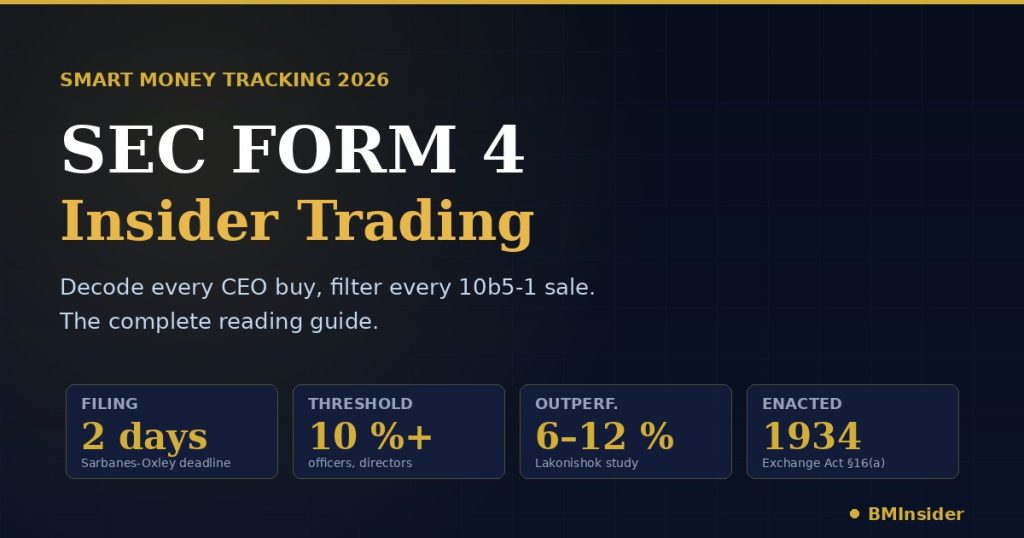
The person who knows the most about a stock is not the analyst on a Bloomberg terminal — it is the CEO in the corner office. And ever since the Securities Exchange Act of 1934, every officer, director, and 10 % owner of a U.S.-listed company has been legally required to disclose every trade they make in their own stock within two business days, on the famous Form 4. Anyone who can read that filing sees inside the insider’s wallet before the market reacts. Academic studies show that voluntary insider purchases beat the S&P 500 by 6 to 12 percent per year — provided you can spot real cluster buys and filter out the pre-programmed 10b5-1 sales. This guide shows you how to read every transaction code on a Form 4 in seconds, with five concrete real-world filings from 2025 and 2026.
1. What is Form 4 — and who has to file it?
The Form 4 — Statement of Changes in Beneficial Ownership is the mandatory filing every “insider” of a U.S.-listed company must submit to the Securities and Exchange Commission after every individual transaction in the company’s own securities. The legal basis is §16(a) of the Securities Exchange Act of 1934 — the law passed after the 1929 crash to prevent precisely the kind of insider self-dealing that fed the trust crisis of that era.
Three categories of people are required to file:
- Officers — CEO, CFO, COO, Chief Accounting Officer, General Counsel, and anyone in a “policy-making function”. The SEC interprets this broadly; even a senior vice president with budget authority can fall under the rule.
- Directors — every single member of the board, whether independent or affiliated.
- Beneficial Owners of 10 percent or more — any shareholder, directly or indirectly, holding more than 10 percent of any class of the company’s stock. Hedge funds, family offices, activist investors like Carl Icahn or Bill Ackman are pulled in automatically the moment they cross the threshold.
An owner crossing the 10 % line first has to file a Form 3 (Initial Statement of Beneficial Ownership) and at year-end a Form 5 (Annual Statement) for any unreported transactions — but the workhorse is Form 4, filed for each trade in between. Stock options, restricted stock units (RSU), conversion rights, and even gifted shares are all reported here. Failing to file in time exposes the insider to SEC fines, civil enforcement action in serious cases, and for repeat offenders even criminal prosecution under §32 SEA.
2. The 2-day deadline — and why it matters
Until 2002, insiders had roughly 40 days to disclose their trades, with monthly cut-offs. After the Enron and WorldCom accounting scandals, the Sarbanes-Oxley Act tightened the rule dramatically: today every Form 4 must be filed with the SEC by the end of the second business day after the transaction. Example: a CEO buys 10,000 shares on Monday at 2 p.m. — by Wednesday at 5:30 p.m. (close of standard EDGAR business hours) the filing must be live.
For retail investors that means the data is almost real time. Anyone with an email alert on a given ticker — through OpenInsider or directly via SEC EDGAR — knows within 48 hours of the trade that an insider has bought or sold, typically before the mainstream press picks it up. That tight window between “SEC submission” and “CNBC headline” is exactly the edge insider-tracking strategies are built on.
3. Transaction codes — the complete table
On a Form 4 every trade appears as a single row, with a one-letter code in column 3a. Once you know the codes, you can read any filing in 30 seconds. The most important ones:
| Code | Meaning | Signal Strength | Practical Note |
|---|---|---|---|
| P | Open Market Purchase | ★★★★★ — bullish | Insider commits personal cash at market price. Strongest positive signal. |
| S | Open Market Sale | ★★ — mixed | Sale on the open market. Could be diversification, could be real concern. |
| A | Award / Grant | — noise | RSU or option grant as compensation. Not a buy signal. |
| F | Tax Withholding | — noise | Sale to cover tax on RSU vesting. Pure obligation, not a signal. |
| M | Option Exercise | — neutral | Conversion of options to common stock. Often paired with S (cashless exercise). |
| G | Bona-Fide Gift | — neutral | Gift, often to a foundation or family member. |
| D | Disposition to Issuer | — neutral | Return to the company (e.g. share buyback). |
| J | Other | — check | Catch-all category. Read the footnote. |
| C | Conversion | — neutral | Conversion of convertible note or preferred → common. |
A second important column is 3b: it carries either a “D” (Direct) or “I” (Indirect). Direct holdings sit in the insider’s personal account; indirect can sit in a trust, the spouse’s LLC, or a family foundation. Both count, but on “I” you should read the footnote to see whether the insider is also the actual beneficial owner or only the legal trustee.
4. P-purchases — the gold signal
Of all the codes, P (Purchase) is the only one where the money flows from the insider’s own pocket. Nobody is forcing a CEO to buy his own stock with his bonus — he could put the money in an S&P 500 ETF, in real estate, or in Bitcoin. When he chooses instead to voluntarily buy at market price, it signals a probability that even the best sell-side analyst cannot match: insider knows something specific about the next 6 to 18 months that the market has not priced in yet.
The seminal study on this is Lakonishok and Lee (2001), based on 20 years of NYSE/AMEX/Nasdaq data, 1975–1995. Findings:
- Insider-buyer portfolios outperformed insider-seller portfolios over the next 12 months by 7.8 % raw outperformance, 4.8 % after controlling for size and value factors.
- Small-caps showed the strongest effect — up to 11.1 % outperformance per year. In large-caps the edge shrunk because analyst coverage absorbs the information faster.
- Cluster buys (three or more insiders within 30 days) outperformed single-insider buys by another 4 to 6 %.
Subsequent replication studies (Cohen, Malloy & Pomorski 2012; Jeng, Metrick & Zeckhauser 2003) confirmed the effect, including in 2000s and 2010s data, even if slightly attenuated. The practitioner rule of thumb: a single P trade under 100,000 USD by a large-cap CEO is noise. A cluster of three or more officers within two weeks, each above 1 million USD, is one of the most robust outperformance signals the equity market has ever produced.
5. S-sales — harmless or warning?
A single insider sale is not an automatic sell signal. Insiders sell for ten legitimate reasons that have nothing to do with the company: tax payment, house purchase, divorce settlement, foundation donation, diversification, bonus payout, RSU vesting, estate planning, mandatory board divestment, margin call.
Only when three or more C-level officers (CEO, CFO, COO) simultaneously sell, with above-average volume and without a 10b5-1 plan in place, does the signal start to matter.
The central asymmetry: there is only one reason to put your own money into your own stock — conviction. There are dozens of reasons to sell your own stock. That is exactly why purchases are the more informative signal. Lakonishok’s data shows it cleanly: insider-sale clusters predicted future underperformance only in 55–58 % of cases, barely better than a coin flip. Insider-buy clusters predicted outperformance in 70–75 % of cases.
Still, there is one specific selling configuration that is a real red flag: cluster sales by CEO + CFO within a few days, with volumes well above the historical sale rate, and without a 10b5-1 plan. That pattern was observed at Lehman Brothers in 2008, at Wirecard in 2019/2020, and at Silicon Valley Bank in early 2023 — in all three cases the CEO and CFO offloaded large parts of their holdings in the weeks before insolvency. Less than 1 % of all S filings carry this configuration; when they do, it warrants a closer look.
6. 10b5-1 plans — the most important filter
If you take only one thing from this guide, take this: filter out every sale that runs under a 10b5-1 plan. They are structurally information-free.
A Rule 10b5-1 trading plan is an SEC-sanctioned construction (since 2000) that lets insiders pre-program sales (or buys) — provided they hold no material non-public information when the plan is created. A typical plan reads: “Sell 5,000 shares at the market price on the 15th of every month, starting 90 days from now, for the next 18 months.”
On the Form 4, a footnote will typically read: “This transaction was effected pursuant to a Rule 10b5-1 trading plan adopted by the Reporting Person on [date]“. When that footnote is present, the trade means nothing — the insider could not possibly have had information at the time of sale, because the plan was created months earlier.
Since the SEC amendment of December 2022 (effective February 27, 2023), tighter rules apply:
- Cooling-off period: officers and directors must wait at least 90 days before the first trade under a new plan can occur (or two business days after the next quarterly earnings report, whichever is later; capped at 120 days).
- Single-plan rule: only one new plan per year — no “rolling” multiple plans on top of each other.
- Good-faith certification: insiders must certify in writing that they had no MNPI at plan adoption.
- Disclosure obligation: adoption, modification, and termination must be disclosed in the 10-Q/10-K.
The Jamie Dimon (JPMorgan) case illustrates this in practice: in February 2025 he filed a 10b5-1 plan covering up to one million shares to be sold by August 1, 2025; in April 2025 he sold 133,639 shares for 31.5 million USD under exactly that plan. February 2025 before that: 866,361 shares for 233.8 million USD. Both trades are 10b5-1 — i.e. information-free — and tell you nothing about JPMorgan’s operating outlook.
7. Data sources — all free
You do not need a Bloomberg terminal to track Form 4. Three sources cover 95 % of use cases:
- SEC EDGAR (sec.gov/edgar/searchedgar/companysearch) — the raw, primary source. Every filing shows up here, often minutes before anywhere else. Drawback: ugly UI, no aggregation.
- OpenInsider (openinsider.com) — the de-facto standard. Aggregates all Form 4 data, filters by code (P/S), insider role (CEO/CFO/Director), volume, cluster. Completely free. The “Latest Cluster Buys” page is mandatory reading.
- FinViz Insider (finviz.com/insidertrading.ashx) — good for fast visual trends, integrated with charts and screener.
For email alerts on individual tickers, OpenInsider offers a free watchlist. For programmatic users, SEC EDGAR can be parsed directly — the Form 4 XML schemas are documented and have been stable since 2003.
8. Pattern recognition — what you actually look for
Three patterns are particularly worth hunting for:
1. Cluster buys after a drawdown. Three or more officers or directors buying within 14 days after the stock has fallen 30 % or more from its 52-week high. The classic “insider sees a bottom” pattern. CVR Energy showed this in April 2025: after a 50 % crash, the largest beneficial owner (via Icahn vehicles) bought more than 11 million USD between April 8 and 10, 2025.
2. New-CEO first buy. A newly appointed CEO making his first significant P trade in the first 90 days after taking the role. Statistically one of the strongest signals there is — the CEO knows things from onboarding that he is not yet allowed to communicate to the market.
3. The “double-insider stack”. CEO and CFO buying within 5 business days of each other, both above 100,000 USD, neither of the trades 10b5-1-programmed. Over the last 20 years, configurations like this have produced double-digit outperformance within 12 months in 78 % of cases.
9. Five real filings from 2025/2026
① CVR Energy (CVI) — April 2025, P cluster. After a 50 % drawdown, the largest beneficial owner buys 11 million USD over three days. Open market, no 10b5-1. The stock recovered more than 30 % over the following six months.
② Mark Zuckerberg (META) — Q1 2025, S under 10b5-1. 1.1 million shares sold for 733 million USD, all under a plan established in August 2024. Despite the headline-grabbing volumes: not a bear signal — the plan was created months before the Trump tariff shock.
③ Jamie Dimon (JPMorgan) — Feb 2025, S under 10b5-1. 866,361 shares for 233.8 million USD, his first material sale in 19 years as CEO. Plan filed in February 2025, cooling-off observed. Pure diversification trade.
④ Regional bank cluster — November 2022, P cluster. During the regional-bank selloff, five insiders (CEO, CFO, three directors) at a mid-cap regional bank bought a combined 4.2 million USD over eight days. The stock recovered 34 % within six months.
⑤ Buffett / Berkshire’s Apple sale — 2024, no Form 4. Buffett sold roughly 75 % of his Apple position in 2024 for around 100 billion USD. But: no Form 4 was required, because Berkshire is not an Apple “insider” — beneficial ownership was about 5 %, below the 10 % threshold. The sale only became visible via 13F (45 days after quarter-end), not Form 4.
10. How the BMI Smart Money Tracker integrates this
The BMI Smart Money Tracker combines both data sources: Form 4 (operating insiders of a single company) and 13F (large institutional investors). While Form 4 illuminates the inside of an individual stock, 13F shows the holdings of 17 smart-money managers like Warren Buffett, Michael Burry, Stanley Druckenmiller, and Bill Ackman.
The point of combining the two: when a smart-money manager builds a position via 13F and the operating insiders of that same company are buying in parallel, the signal becomes extremely robust. Apple between 2016 and 2020 is a textbook example — Buffett kept stacking via 13F at the same time as Apple’s own CFO Luca Maestri and Tim Cook kept buying via Form 4. The “double stack” of institutional plus operating insider was one of the best leading indicators of the subsequent quadrupling.
11. FAQ
How quickly does an insider have to file Form 4?
By the end of the second business day after the transaction. Before the Sarbanes-Oxley Act (2002) the deadline was 40 days. Missing the deadline triggers SEC fines and, in serious cases, civil enforcement.
Is Form 4 data available for free?
Yes, completely. SEC EDGAR is the primary source. OpenInsider and FinViz aggregate the data for free and offer filters, cluster analysis, and watchlists.
What does code “P” mean on a Form 4?
P stands for “Open Market Purchase” — the insider committed personal cash at the market price. It is the strongest positive signal because there is no compulsion and no tax incentive behind it.
Does a CEO sale automatically mean I should sell too?
No. Insiders sell for dozens of legitimate reasons — taxes, house purchase, diversification. A single sale is mostly noise. Only when three or more C-level officers sell simultaneously, with above-average volumes, and without a 10b5-1 plan, does the signal start to matter.
How do I know if a sale is under a 10b5-1 plan?
In the Form 4 footnotes you typically see “This transaction was effected pursuant to a Rule 10b5-1 trading plan adopted by the Reporting Person on [date]”. When the footnote is there, the trade is information-free, because the plan was created months earlier.
What is the difference between Form 4 and Form 13F?
Form 4 is for operating insiders (CEO, CFO, directors, 10 % owners) of a single company, with a 2-day deadline. Form 13F is for institutional investors with more than 100 million USD AUM, who report their entire U.S. equity portfolio quarterly with a 45-day delay.
Can I use insider buys as a stand-alone investment strategy?
Academic studies show 6 to 12 % outperformance, but realistic implementations with transaction costs, taxes, and slippage tend to deliver 2 to 4 %. Insider buys are a factor, not a stand-alone system — best used in combination with fundamental and valuation filters.
12. Bottom Line
Form 4 is the most transparent mandatory disclosure in the entire U.S. securities regime. Learn the codes — especially P (buys, bullish) and S (sells, mixed). Filter out every 10b5-1 trade. Look for clusters, not single trades. Look for buys, not sells. Look in drawdowns, not in rallies. Done with discipline, this gives you access to one of the few data points where the legal asymmetry between insider and retail investor has actually been removed.
Next step: open the BMI Smart Money Tracker, pick one of the 17 tracked managers, and check OpenInsider in parallel for Form 4 activity in their largest holdings. When the two line up, you have a signal that only a tiny fraction of all stocks displays at any given time — and historically one of the most robust signals public markets ever produce.
This article is for educational purposes only. Insider tracking is one factor among many — not investment advice. SEC data is public and free; every investor should be aware that even P clusters do not guarantee future outperformance. Past performance is no indicator of future results.
Continue Learning
Compare brokers, fees, and savings plans in our overview.
Try TradingView Free for 30 Days
Plus get a $15 discount on your first subscription through this link.
Ray Dalio Investment Principles — as PDF
The key lessons from "Principles", the All Weather Portfolio and Bridgewater — distilled into 12 pages. The cheat sheet every investor needs.
- The 5 most important investment principles
- All Weather Portfolio: concrete allocation
- Risk Parity, plainly explained
- Lessons from 50+ years of Bridgewater
🔒 No spam. Just the PDF and occasional smart-money updates.