
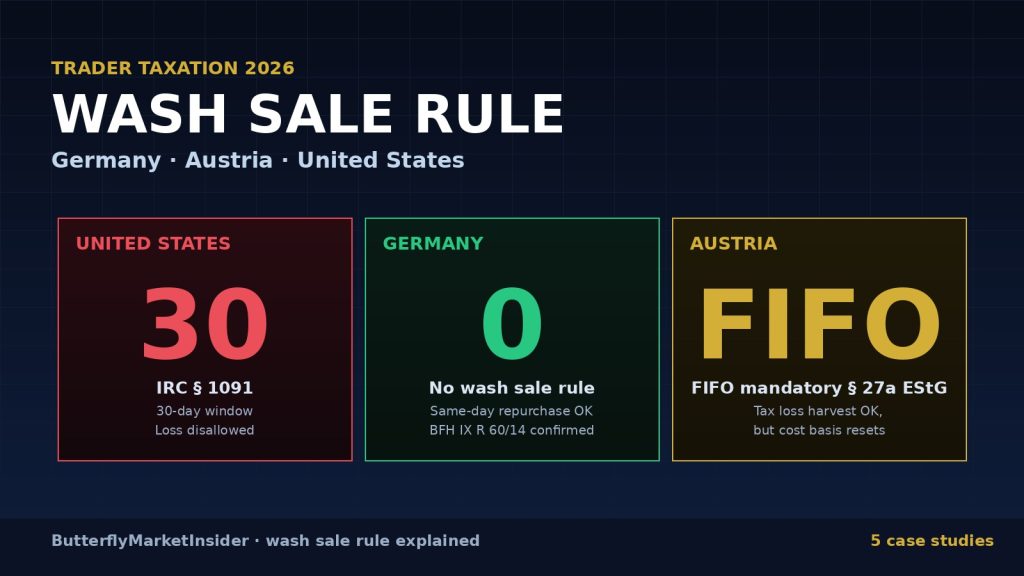
You are sitting on 12,000 euros of unrealized losses on Nvidia and want to harvest the loss for tax purposes — without giving up the position. In a trading forum you read that US traders face a 30-day blocker for exactly this maneuver, the wash sale rule. The interesting question for any DACH investor: does that rule apply in Germany or Austria? Short answer: no. Long answer: much more interesting — because instead of a waiting period, both countries have other, far subtler traps: the FIFO rule in Austria and the 20,000 euro loss-offset cap in Germany. This guide shows what an active trader really needs to know in 2026.
1. US Wash Sale Rule — what the 30-day trap really means
The wash sale rule lives in IRC § 1091 and has been on the books since the 1921 tax reform. The logic is simple: the IRS wants to stop traders from manufacturing artificial losses by selling securities at a loss only to buy them back hours later at essentially the same price. The position is unchanged in substance, yet the loss would otherwise be deductible.
Concretely: if a US trader buys “substantially identical” securities (the same stock or a near-equivalent) within 30 days before or 30 days after the loss-making sale, the loss is disallowed. It does not vanish, however — it is added to the cost basis of the replacement security (“disallowed loss carries to basis”). In other words, the loss is deferred, not destroyed; it resurfaces at the next genuine sale.
The rule reaches further than many think. If the spouse buys the same stock, or the trader’s own IRA picks it up within the 60-day window, that also triggers a wash sale (Rev. Rul. 2008-5 made the IRA cross-trade case explicit). Ironically, § 1091 does not currently apply to crypto — the IRS has not classified it as “stocks or securities,” so Bitcoin traders can side-step the rule using their old BTC position. That may change in 2026/2027 if a Build Back Better-style proposal is revived, but as of May 2026 crypto remains free.
2. Germany — no wash sale rule, but three other traps
German investors and traders have it much easier than their American counterparts: no 30-day blocker, no “substantially identical” rule, no disallowance of the loss. You can sell your Nvidia position with a 10,000 euro loss at 09:31 and buy back the exact same number of Nvidia shares at 09:32. The loss is recognized for tax purposes, you receive the matching credit in your stock-loss bucket, and your Trade Republic or Comdirect tax certificate will show it.
That is no oversight by the legislator — it is settled by Germany’s highest tax court. The Bundesfinanzhof confirmed it most clearly in BFH IX R 60/14, decided 12 May 2015: if a person sells stocks at a loss and buys them back the same day at essentially the same price, that is not abusive structuring under § 42 AO. The court’s reasoning: there is a real, legally effective disposal — the loss is realized, the position is given up and rebuilt. Even if the economic effect is minimal, it is not abuse. The tax office cannot simply strike the loss.
Three traps still exist for German traders, however, and they are often confused with the wash sale rule:
- Loss buckets under § 20 (6) EStG: losses on stocks may only be netted against gains on stocks (the stock bucket). Losses on other securities (ETFs, bonds) flow into the general bucket. Derivative losses have their own bucket with the infamous 20,000 euro per-year cap.
- New cost basis on repurchase: the immediate repurchase establishes a new acquisition cost (market price on the day of repurchase). Any later sale will be calculated on that higher base — but in Germany this is irrelevant because we have no minimum holding period since 2009.
- Tax-deferral upside: realized losses immediately reduce the tax base. Anyone holding loss-making positions before year-end can flip them — recover cash via offsetting against earlier-realized gains, repurchase immediately, position barely changes.
3. Austria — § 27a EStG and the FIFO trap
Austria also has no wash sale rule. Selling a loss-making stock and buying it back immediately is recognized for tax purposes — loss harvesting works. But Austria has a technical quirk that matters more in practice than the US 30-day rule: the FIFO obligation under § 27a (4) (3) EStG.
FIFO means First In, First Out. If you have bought several tranches of the same stock at different times, on sale Austrian law mandates that the earliest-acquired shares are sold first — you have no choice over which tranche you unwind. The broker (Trade Republic, Flatex, easybank, DADAT) does this automatically by acquisition date.
Example: 100 Apple shares at 100 € in January 2020 (book gain 15,000 €). In April 2026 another 50 Apple shares at 250 € (book loss after correction: 1,500 €). You want to harvest the 1,500 € loss and buy 50 Apple back immediately. Problem: the broker sells FIFO — meaning 50 of your old 100-€ shares. Instead of a 1,500 € loss you have realized a gain of 7,500 € (50 × (250 − 100)) and 27.5 % KESt on top. The intended loss never materialized. Solution: hold the second tranche at a different broker or restructure ahead of any tax move.
That is the real tax trap for Austrian traders — and a strong reason to keep more than one brokerage account if you trade actively. FIFO applies per account, per security. If you hold Apple at DADAT and at easybank, those are two separate FIFO tracks.
Austria’s KESt rate of 27.5 % is materially above Germany’s flat tax (25 % plus solidarity surcharge plus optional church tax = 26.375 %). Stock losses can only be offset against stock gains of the same tax category, and a private-investor loss carry-forward into following years is not available — losses lapse on 31 December if there are no offsetting gains. That is stricter than Germany, where loss-bucket balances roll forward automatically.
4. What technically happens during an instant repurchase
Mechanically a “wash” is a mini-chain of two independent trades: a sale at the current market price and a repurchase at the current market price. Both trades are fully settled, both go through the exchange, both incur spread and possibly order fees. Broker tax engines treat them as two separate events.
At Trade Republic, for instance, the sale appears on the tax certificate with the realized loss, and the repurchase receives a fresh acquisition entry at the day’s price. Flatex / Comdirect behave the same way. Interactive Brokers too — although IBKR also runs wash-sale logic for US-resident customers, which does not apply to EU customers.
One thing many traders overlook: spread can cost real money on large trades. On a 100,000 euro Apple position with a 0.1 % spread that is 100 euros per round-trip. Anyone running tax-loss harvesting at scale should know the all-in trading cost at their broker.
5. Loss offsetting in Germany — the 20,000 euro cap in 2026
The real German trap of 2026 concerns derivatives and worthless stocks. § 20 (6) sentences 5 and 6 EStG cap annual loss netting at 20,000 euros — both for losses on premium-writer trades, options, CFDs and futures, and for losses from total stock write-offs (insolvency, delisting). A trader with 50,000 euros of options losses may still only deduct 20,000 euros in the current year. The remaining 30,000 euros are carried forward — and capped again at 20,000 euros next year.
That regime was introduced with the 2020 “trader tax reform” and is constitutionally contested. In June 2024 the BFH expressed serious doubts about its constitutionality in an Aussetzung-der-Vollziehung (suspension-of-enforcement) ruling and referred the matter to the Federal Constitutional Court (file ref. VIII R 11/24). The likely outcome: the Bundesverfassungsgericht decides against the regime in 2026/2027. As of May 2026 the cap is still on the books, but investors can lodge an appeal against their tax assessment citing the pending case — and enforcement is generally suspended.
For clarity: this 20,000 euro cap does not apply to plain stock losses. A 50,000 euro Apple loss is fully deductible inside the stock bucket — no cap.
6. Tax-loss harvesting — allowed in Germany and Austria
The most important practical takeaway: tax-loss harvesting is fully legal in both Germany and Austria. There is no waiting period, no wash-sale disallowance, no penalty tax. In late November and December many DACH investors run the playbook:
- Inventory: list all unrealized losses and realized gains for the year.
- Strategy: realize enough losses to net out the gains booked during the year, or deliberately produce losses to offset future gains (Germany: loss carry-forward into next year).
- Execution: sell the loss-making position, buy it back immediately. Position essentially unchanged but the loss has landed in the bucket.
- Cash effect: for German investors, the flat tax already paid on realized gains is partly refunded (attach the loss certificate to the annual tax return).
One special case: with accumulating ETFs, the German Vorabpauschale (advance lump-sum) acts like a running tax charge. December loss-harvesting improves the tax base and can fully or partly offset the Vorabpauschale.
7. Comparison table — wash sale, FIFO, loss offsetting
| Aspect | United States | Germany | Austria |
|---|---|---|---|
| Wash sale rule | Yes, 30/30 days | No | No |
| Same-day repurchase | Loss disallowed | Allowed, loss recognized | Allowed, watch FIFO |
| Lot selection on sale | Free (Spec ID, FIFO, LIFO, HIFO) | FIFO default, “first cost” allowed | FIFO mandatory (§ 27a EStG) |
| Loss offsetting on stocks | Capital gains, $ 3,000 ord. income | Stock bucket, no cap | Stock bucket, no private carry |
| Derivative losses | Mixed with capital gains | € 20,000 cap p.a. (contested) | No cap, separate bucket |
| Private loss carry-forward | Unlimited | Unlimited | No, lapses on 31 Dec |
8. Five practical scenarios with numbers
You hold 200 Nvidia shares at 950 $, currently 730 $ — book loss 44,000 €. You want to realize the loss in 2026, keep the position. Action: sell 200 shares at 14:00, buy 200 back at 14:01. Effect: 44,000 € hit the stock-loss bucket. If you have 44,000 € of stock gains in 2026, those would have been taxed at 26.375 % — the loss cancels the bill. Tax saving: ~ 11,605 € in cash refund. Position essentially unchanged. Fully legal.
100 AAPL @ 100 € (2020) plus 50 AAPL @ 250 € (April 2026, currently 220 €). Book loss on the second tranche: 1,500 €. You want to harvest and sell 50 shares. FIFO kicks in: 50 of your old 100-€ shares are sold — realized gain 6,000 € (50 × (220 − 100)). KESt at 27.5 %: 1,650 €. Instead of a loss you paid tax. Solution: keep the second tranche at a separate broker, or skip harvesting where FIFO would bite.
You posted a 50,000 € loss on SPY short strangles in 2026. Stock gains from regular trading: 40,000 €. Problem: derivative losses in 2026 are capped at 20,000 € per year. Effect: only 20,000 € of the 50,000 € can be netted. The 40,000 € of stock gains are taxed separately (stock bucket): 26.375 % × 40,000 € = 10,550 €. The remaining 30,000 € of derivative losses carry forward — capped at 20,000 € again. Tip: appeal the assessment, cite BFH VIII R 11/24, request suspension of enforcement.
You want to realize losses but keep your sector exposure. Instead of selling Apple and buying it back (allowed but psychologically unsatisfying), you swap Apple for Microsoft. Effect in Germany: the Apple loss lands fully in the bucket; Microsoft is a fresh acquisition at today’s price. Sector exposure (big tech) stays virtually identical. Unlike the US, “substantially identical” is irrelevant — that concept does not exist in German or Austrian tax law.
Bitcoin loss 8,000 €, Apple gain 8,000 €. Can they be netted? No. Crypto disposal income falls under § 23 EStG (private sales transactions); stocks fall under § 20 EStG (capital income). The buckets are separate. The Bitcoin loss can only offset other § 23 gains (other crypto sales, or gold). The Apple gain is taxed in full at 26.375 %. Lesson: check the bucket layout before the trade — otherwise the loss realization does not help.
9. Active-trader checklist
For DACH traders rotating positions regularly, a compact checklist:
- Bucket awareness: stock, general and derivative buckets are separate. Losses go into the right bucket automatically, but only same-bucket gains can be netted against them.
- Multi-broker strategy in Austria: if you harvest losses regularly, hold parallel tranches of the same stock at different brokers (DADAT plus flatex.at plus Interactive Brokers). FIFO is per account.
- The 20,000 € cap in Germany: if you trade derivatives, file a formal appeal against the assessment citing BFH VIII R 11/24. Suspension of enforcement is granted as a matter of routine.
- Spread and order fees: for large tax-loss round-trips, trading costs can eat the tax benefit. Trade Republic, Scalable and Comdirect tend to run 5–15 basis points wider on spread than Interactive Brokers.
- December cut-off: avoid year-end-day tax moves — many brokers post 30 and 31 December trades only in the new year. Get it done by 20 December.
10. FAQ — the most common questions
Is there a wash sale rule in Germany or Austria?
No. Neither country has a wash sale rule like the US. You can sell a stock at a loss and immediately buy it back; the loss is recognized for tax purposes. The German Federal Fiscal Court confirmed this in BFH IX R 60/14 (2015).
What is the FIFO obligation in Austria?
§ 27a (4) (3) EStG mandates that on sales of identical securities the earliest acquired shares (First In, First Out) are sold first. Brokers apply this automatically. As a result, with multiple tranches tax-loss harvesting can unintentionally trigger a gain on older shares.
Is tax-loss harvesting legal in Germany and Austria?
Yes, fully. There is no waiting period and no loss disallowance for an immediate repurchase. The only constraints are the separate loss buckets and, in Germany, the 20,000 € cap for derivative losses (which the BFH itself considers unconstitutional).
What happens to the 20,000 € cap on derivative losses?
It is still on the statute (§ 20 (6) EStG) but the BFH has held it likely unconstitutional and referred the question to the Bundesverfassungsgericht (file ref. VIII R 11/24). For now, file an appeal against the assessment and request suspension of enforcement — typically granted. A final BVerfG ruling is expected in 2026/2027.
Can I net stock losses against crypto gains?
No. In Germany stock gains live under § 20 EStG (flat tax) while crypto gains live under § 23 EStG (private sales transactions). The buckets are separate. In Austria crypto income has been part of capital-income KESt since 2022, but offsetting against stock gains is only partially possible.
Will the tax office treat instant repurchases as abusive structuring?
No. The BFH stated explicitly in IX R 60/14 that selling a stock at a loss and immediately repurchasing at the same price is not abusive structuring under § 42 AO. There is a real disposal — the loss is fully recognized. The Federal Ministry of Finance follows that line.
What about US-listed stocks held by DACH investors?
If you are a German or Austrian tax resident, German or Austrian rules apply — the US wash sale rule does not reach you, even when you trade Apple or Tesla on NASDAQ. Tax liability sits with your country of residence. Only after relocating to the US and becoming a US tax resident would § 1091 IRC apply.
Bottom Line
The wash sale rule is a US construct — a tax fence that holds American traders back for 30 days when they want to rebuild a loss-making position immediately. Germany and Austria have no such rule. Tax-loss harvesting via instant repurchase is legal, judicially blessed (BFH IX R 60/14) and a useful instrument for active traders to optimize their tax bill.
The real traps are different. In Austria, the FIFO rule under § 27a EStG can trigger unwanted gains on older tranches when you try to harvest losses on a newer tranche — solution: multi-broker strategy. In Germany, the 20,000 € cap on derivative-loss offsetting, which the Federal Fiscal Court itself considers unconstitutional — solution: appeal and suspension of enforcement.
DACH traders who understand the tax mechanics in 2026 have a direct return advantage. Realize losses on time, neutralize gains via offsetting, collect the cash refund — all without giving up the position. The US system is materially stricter. Use the edge.
Related topics: Tax Optimizer · Capital Gains Tax Germany · Securities Tax Austria · ETF Tax Guide 2026 · Stocks Living Abroad Tax Guide