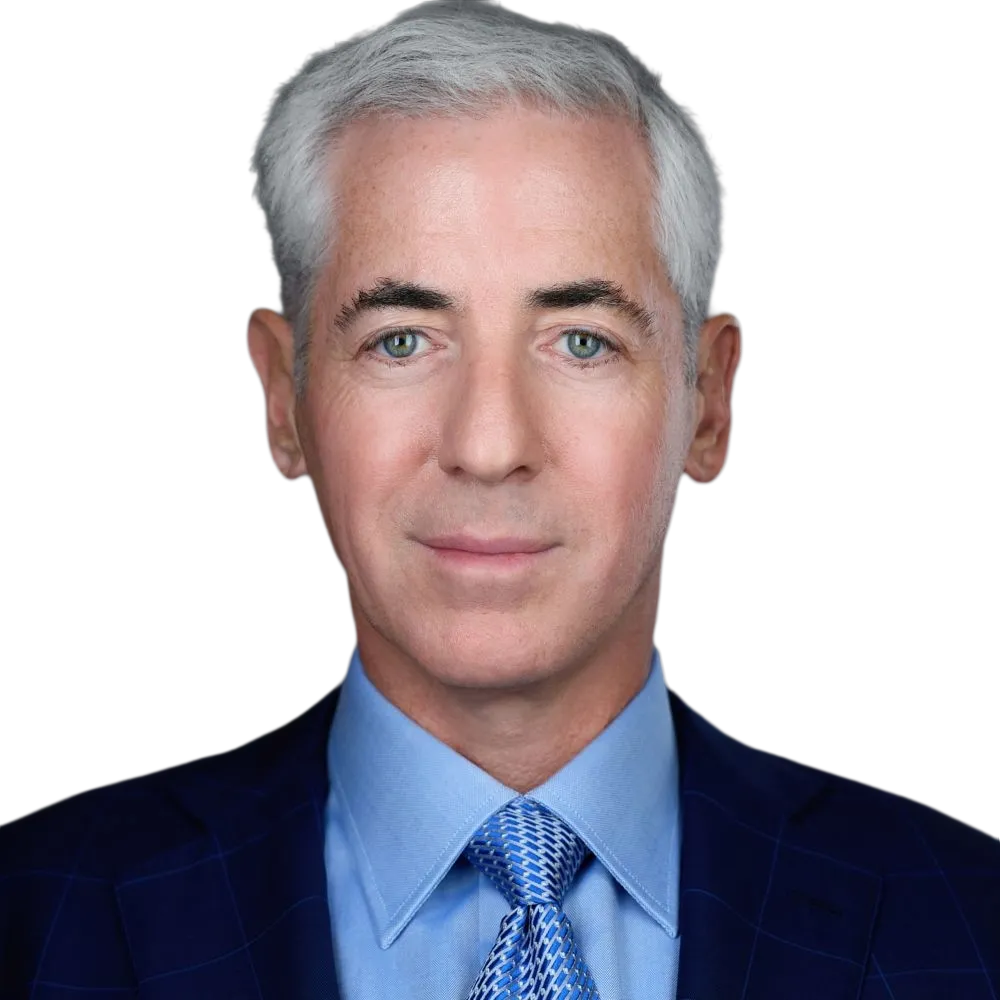
Bill Ackman
Pershing Square, the COVID hedge and 20 years of activist value investing — life, philosophy and lessons of one of the loudest investors on Wall Street
IntroductionThe Loudest Activist on Wall Street
In March 2020, as the COVID pandemic threw global markets into freefall, one man earned roughly 2.6 billion US dollars on a single trade — a multiple of about 100 times his original outlay. His name: Bill Ackman, founder and CEO of Pershing Square Capital Management. Ackman had bought 27 million USD worth of credit default swaps on investment-grade bond indices, betting that the pandemic risk was being underpriced. The trade was later described as “the largest single-trade asymmetry in modern hedge-fund history”.
William Albert Ackman (born 1966 in Chappaqua, New York) is one of the most polarising figures on Wall Street: highly concentrated value investor, vocal activist, hedge fund manager who once nearly imploded, comeback star of the 2020s. He has made billions on activist bets — and lost billions on others. His track record over two decades is impressive (~17 % net p. a. since 2004), but it has been bought with drawdowns that would crush most retail investors.
This deep dive traces Ackman’s path from Harvard MBA student to the head of an 18-billion-dollar hedge fund, explains his activist approach, dissects his most famous trades — from MBIA through Herbalife and Valeant to Universal Music Group and the COVID hedge — and distils concrete lessons for retail investors.
Chapter 1From Harvard Student to Activist
Bill Ackman grew up the son of a real-estate financier in Chappaqua, an affluent New York suburb. He earned his undergraduate degree from Harvard University in 1988 (history, magna cum laude) and his MBA from Harvard Business School in 1992. While still in business school, he co-founded his first investment fund, Gotham Partners, with classmate David Berkowitz. Initial capital: 250,000 USD from Ackman’s father. Strategy: concentrated value investing with activist elements.
Gotham initially performed well — until Ackman ran into a series of illiquid holdings (Gotham Golf, Hallwood Realty) in the late 1990s that produced massive losses during the dot-com bubble. The fund was wound down in 2003. It was Ackman’s first big lesson: concentration without liquidity is lethal. Even so, just one year later, in 2004, he convinced new investors and founded Pershing Square Capital Management, named after Pershing Square Park opposite Grand Central Terminal in New York. Starting capital: 54 million USD.
Ackman’s self-conception from 2004 onward was not as a passive value investor but as an activist. When he identified an undervalued stock, he didn’t just buy a position — he pushed management publicly, with letters, investor presentations, board slates and sometimes year-long battles, to change the structure: spin-offs, divestitures, capital returns, management changes. That stage became his trademark.
Chapter 2Pershing Square Capital Management
As of early 2026 Pershing Square is one of the largest activist hedge funds in the world. Assets under management: roughly 18 billion USD (Pershing Square Holdings + onshore funds + Pershing Square USA, the listed closed-end fund). Strategically, Pershing Square differs from typical hedge funds in three key ways:
- Concentration: Typically 8–12 positions making up 95+ % of the portfolio. Unlike most hedge funds, there is no hundred-stock diversification.
- Buy-and-Hold with leverage: Ackman sees himself not as a trader but as a long-term owner. The average holding period is 4–7 years. But he uses total-return swaps, options and leverage structures to scale returns.
- Public activism: Detailed investor presentations (often 50–150 slides), CNBC appearances, Twitter/X campaigns, and sometimes proxy fights against boards.
Performance: Since 2004 Pershing Square Holdings (the listed vehicle) has produced an average net return of roughly 17 % p. a. — versus about 11 % for the S&P 500 incl. dividends over the same period. That sounds outstanding — but the volatility is significant. Between 2015 and 2017 Pershing Square lost almost 50 % of its value through the Valeant and Herbalife trades. Three full years of underperformance versus the index — most LPs could not have stomached it. Those who held on were rewarded from 2018 onwards.
Chapter 3Famous Trades and Strategy
Ackman’s track record is a tutorial in asymmetry — both positive and negative. The key trades:
MBIA (2002–2008): Ackman’s first big public bet. He argued for years that the bond insurers MBIA and Ambac were structurally undercapitalised and would fail in any housing crisis. The SEC investigated him for market manipulation — the inquiry went nowhere. In 2008 MBIA collapsed, Ackman pocketed roughly 1.1 billion USD. Lesson: structurally undercapitalised vehicles are rewarding short targets in real crises.
Wendy’s, McDonald’s, Target (2005–2008): Early activist bets with mixed outcomes. At McDonald’s he forced the Chipotle spin-off (Pershing took the upside). At Target his proposal to spin off the real-estate operation was clearly defeated in the proxy vote. Lesson: activism only works when the owner majority can be convinced.
Herbalife (2012–2018): Ackman’s most painful defeat. In 2012 he publicly declared that Herbalife was a “pyramid scheme” that would go to zero — and shorted it with over a billion USD. Carl Icahn went long at the same time and pushed Ackman onto the defensive in a famous live CNBC confrontation. The FTC eventually fined Herbalife 200 m USD for misleading marketing but explicitly refused to classify it as a pyramid scheme. Ackman closed the short in 2018 with roughly a billion USD in losses. Lesson: even a substantively correct thesis can be crushed by market psychology and liquidity pressure.
Valeant Pharmaceuticals (2015–2017): Ackman’s largest single loss. He invested roughly 4 billion USD in the pharma roll-up Valeant — which in 2015 turned out to be an aggressive acquisition machine reliant on questionable price hikes. The stock fell from 263 USD (August 2015) to under 12 USD (April 2017). Pershing Square lost about 4 billion USD — close to 25 % of fund assets at the time. Lesson: concentration without thorough due diligence on business ethics can break the entire fund.
COVID hedge (Feb–Mar 2020): Ackman’s comeback trade. In February 2020 he bought 27 m USD worth of CDS on investment-grade credit indices (CDX IG). When spreads exploded during the pandemic, the positions were closed for around 2.6 billion USD. Multiplier: ~96×. Ackman immediately reinvested most of the proceeds in high-quality equities (Hilton, Berkshire, Lowe’s, Restaurant Brands) which were unusually cheap after the crash. Lesson: a few highly asymmetric hedges can save an entire fund’s track record — if you are willing to pay the carrying cost between events.
Universal Music Group (2021): Ackman had originally planned to take UMG public via his SPAC “Pershing Square Tontine Holdings” (PSTH, the largest SPAC in history at 4 bn USD). The SEC blocked the structure, Ackman wound the SPAC down — but bought UMG shares directly for Pershing Square. UMG performed strongly in subsequent years.
Top current positions (as of 2025/26, per the 13F): Restaurant Brands International (Tim Hortons, Burger King), Chipotle Mexican Grill, Hilton Worldwide, Lowe’s, Howard Hughes Holdings, Universal Music Group, Alphabet, Brookfield Corporation, Nike, Uber.
Chapter 4Investment Philosophy — Concentrated Activist Value
Ackman’s style can be summarised in five pillars, distilled across countless investor letters and lectures (notably at Harvard Business School and Columbia):
- Quality before price: Ackman looks for businesses with high predictability, fat margins, low capital requirements, pricing power and durable competitive advantages. Pershing Square typically holds “capital-light, cash-flow-rich” companies — close to what Buffett calls “wonderful businesses”.
- Concentration on 8–12 positions: Ackman is convinced that there are not more than two dozen genuinely first-class businesses worldwide. More positions dilute performance, fewer aren’t sufficiently diversified.
- Active engagement: When the business is good but management is mediocre or capital allocation suboptimal, Ackman pushes actively for change — capital returns, focus, spin-offs, divestitures.
- Asymmetric hedges: Ackman accepts continuous small hedge costs to insure against tail risks (pandemics, inflation shocks, rate shocks). The COVID trade was no fluke — it was structurally pre-positioned.
- Honesty about own mistakes: Ackman’s investor letters discuss losses (Valeant, Herbalife, Target) at length. That kind of transparency is unusual in the hedge fund industry.
Ackman is a vocal Buffett admirer and has held Berkshire Hathaway shares in his portfolio multiple times. The main difference from Buffett: Ackman is significantly more active, leverages more and is loud in public, where Buffett is famously quiet.
Chapter 5Current Portfolio Highlights
Pershing Square publishes a 13F filing with the SEC each quarter. Top US long positions as of late 2025/early 2026 (descending by market value):
- Brookfield Corporation — alternative asset management platform with over 900 bn USD AuM; thesis: market underestimates the sum-of-parts.
- Chipotle Mexican Grill — long-standing position since 2016; Ackman was the architect of the 2018 CEO change (appointment of Brian Niccol).
- Restaurant Brands International — Tim Hortons, Burger King, Popeyes, Firehouse Subs; Ackman pushed the original 2014 merger and has been an anchor shareholder ever since.
- Hilton Worldwide — capital-light hotel asset-management model, beneficiary of the post-2021 travel boom.
- Howard Hughes Holdings — master-planned community developer; Ackman is chairman and largest shareholder.
- Universal Music Group — world’s largest music label; thesis: streaming royalties keep growing double-digits structurally.
- Alphabet — one of Ackman’s rare big-tech bets; thesis: AI capex closes the valuation gap over 5–10 years.
- Nike — new position 2024, comeback thesis after margin weakness.
If you’d like to follow Ackman’s portfolio in real time, take a look at our Smart Money Tracker — it processes the 13F filings of the most prominent hedge funds, including Pershing Square, automatically.
Chapter 6What Retail Investors CANNOT Copy from Ackman
As with every hedge fund legend: much of what makes Ackman’s success is not reproducible at retail scale.
- Activist leverage: When Ackman writes a letter to the board, hundreds of institutional investors are watching. You cannot build a 5 % position in a mid-cap and realistically force a strategy change.
- Access to specialist instruments: The COVID CDS trade would have been neither buyable nor pricable for a retail investor. Retail has no access to investment-grade credit-default-swap indices.
- Patience on hedge-fund scale: Ackman holds positions 4–7 years — and his investors accept that because of lock-ups. Retail investors get nervous on a 30 % drawdown, read forums and sell.
- Operational depth: Pershing Square has roughly 30 investment professionals working for months on a position before it is built up. You have a newsletter and a Trade Republic app.
Chapter 7Lessons for Retail Investors
Three concrete, applicable lessons from Ackman’s work:
1. Concentration is allowed — when the quality really is there. Ackman’s style shows: a concentrated portfolio of 8–15 first-class, durable businesses can beat the index for decades — provided the selection is disciplined. Retail translation: a core ETF (60–70 %) plus 5–8 single names with high conviction (max 5 % each) is a valid alternative to thirty-stock diversification. Important: first-class quality, not speculation.
2. Asymmetric hedges pay — as insurance, not as a trade. Ackman’s COVID hedge was no stroke of genius but part of a continuous hedging practice: Pershing Square had bought cheap tail hedges repeatedly in prior years, most of which expired worthless. In 2020 one paid in full. Retail translation: a small allocation (1–3 % of liquid wealth) to gold, cash reserves or defensive structures isn’t a return drag — it is the insurance that makes the difference in 1-in-10-year crises.
3. Be radically honest about your own mistakes. Ackman’s investor letters following the Valeant and Herbalife losses are among the most instructive texts in hedge-fund literature. He explains in detail what he got wrong — and what he is structurally changing. Retail translation: keep an investment journal. Write down before each significant position why you are buying it. And write down at every sale — gain or loss — what you’ve learned. This single practice measurably improves performance over a decade.
An investor who applies these three Ackman principles — disciplined concentration on quality, asymmetric hedges, honest self-reflection — over the next 20 years will very likely outperform the average. Not because they are Ackman, but because they have extracted the essence of his work.