Spotting Pump and Dump: 12 Warning Signs That Save Your Stocks (2026)
A Telegram contact sends you a “secret tip”, the stock rallies 200 percent in three days, and 48 hours later you are 90 percent underwater. Welcome to the world of pump and dump schemes — the oldest form of market manipulation, now in its crypto era and bigger than ever. The SEC estimates the annual U.S. damage at roughly $2 billion; for memecoins, Chainalysis data shows that around 90 percent of newly launched coins lose more than 90 percent of their value within 30 days. This guide gives you the 12 warning signs, the historical classics from Stratton Oakmont to SafeMoon, and the concrete protection checklist — so your portfolio does not become the next victim.
1. What is a Pump and Dump?
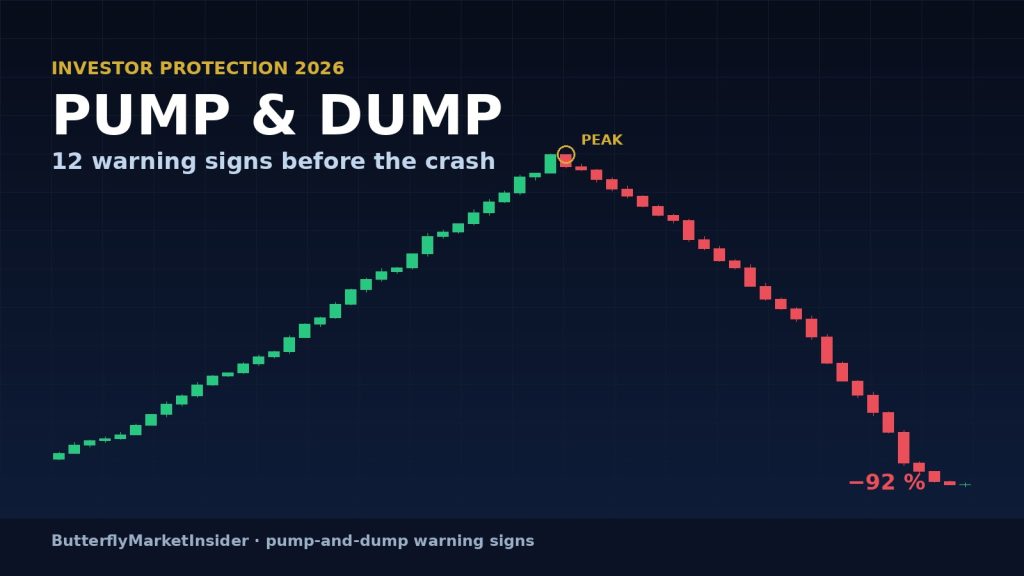
A pump-and-dump scheme is a classic two-phase market manipulation. In the pump phase, insiders accumulate an illiquid stock or small token at very low prices, drive the price up artificially through coordinated buying and aggressive promotion, and lure retail investors via social media, Telegram groups, YouTube influencers, and spam mailers. Once enough “dumb money” has piled in, the dump phase hits: insiders unload their pre-purchased shares into a thin order book at peak prices, the price collapses 80 to 99 percent — and what is left behind is a herd of trapped investors and a chart that looks like a fever thermometer.
The concept is more than 300 years old. Back in 1720, the South Sea Company in London sold shares with inflated earnings promises before the price crashed and ruined a third of the British nobility. The mechanism back then was identical to today: artificial scarcity, exaggerated story, coordinated pumping, cold-blooded dumping. The difference: in 1720 it took weeks to spread — today four hours on Telegram, X (formerly Twitter), and TikTok are enough.
In the U.S., pump and dump falls under Section 9(a)(2) of the Securities Exchange Act and has been explicitly illegal since 1934. In the EU, the Market Abuse Regulation (MAR) has applied since 2014, supported in Germany by Section 20a of the Securities Trading Act (WpHG) and the Securities Trading Act in general. Yet thousands of such schemes still run every year — because law enforcement struggles to keep up with anonymous Telegram groups, and because in crypto the legal grey zone in many jurisdictions remains wide open.
2. Top historical schemes — the classics
Pump and dump is not a modern invention of the memecoin scene. It runs like a red thread through almost every market crisis of the past 100 years. Here are the most iconic cases — the ones to study the pattern from:
Jordan Belfort’s brokerage systematically pumped penny stocks for three years via boiler-room cold-calling. $200M investor damage, Belfort served 22 months, Stratton Oakmont was forcibly closed in 1996. The DiCaprio film made the scheme globally famous in 2013 — and the SEC fed the lessons directly into its penny-stock disclosure reform (Rule 15g-9).
Not a classic penny-stock pump but structurally identical: Enron hid losses in special-purpose vehicles, top executives pumped the share price via aggressive earnings calls and analyst briefings up to $90 — and sold their personal holdings worth $1.1 billion before the stock crashed to 26 cents in 2001. Sarbanes-Oxley (2002) is the direct regulatory response.
Wirecard pumped its share price to €199 (DAX member!) for years, on the back of fabricated Asian revenues. Insider Markus Braun sold stock; Jan Marsalek fled before the bankruptcy. Damage to investors: €22 billion. BaFin and auditor EY both failed. Lesson: even DAX members are not automatically clean — skepticism is mandatory.
Elizabeth Holmes pumped her blood-testing startup to a private valuation of $9 billion via press campaigns featuring Henry Kissinger and James Mattis on the board. WSJ whistleblower John Carreyrou revealed in 2015 that the technology simply never worked. Holmes was sentenced to 11 years in 2022. Lesson: pre-IPO pumps exist too — and they are practically invisible to retail investors.
Strictly speaking GameStop was not a pump-and-dump but a Reddit-driven short squeeze (r/wallstreetbets). But the FOMO pattern, coordinated social wave, and crash of around −90 % from peak are nearly identical. Important lesson: even “anti-establishment hype” can become a dump — anyone who bought at the peak ($483 intraday) is still deeply underwater today.
3. The crypto era — it has gotten worse
Crypto has industrialized pump and dump. Three factors make it the perfect playing field: (1) no listing barrier (anyone can launch a token on Solana or BSC in 5 minutes), (2) no central oversight for many DEX tokens, (3) global reach via Telegram, X, TikTok, and Discord. The result: instead of a few hundred pump schemes per year on stock markets, we see thousands per month on crypto.
Price up 20,000 % in 3 months, marketing strategy on TikTok under the slogan “Safely to the moon.” In 2023 the SEC sued the founders for pump and dump and unregistered securities sales. Damage: hundreds of millions of dollars. The token is essentially worthless today.
Inspired by the Netflix series. Price pumped from $0.01 to $2,861 in 7 days — then the developers performed a so-called “rug pull” and disappeared with about $3.4 million. The token lost 99.9999 % of its value within minutes. Textbook example: when nobody else can sell (the smart contract blocked sales), it is no longer an investment but a trap.
YouTube star Logan Paul marketed CryptoZoo as an NFT game. Buyers waited a year for the promised game — which never arrived. Investigative journalist Coffeezilla exposed the scheme; Logan Paul announced a $2.3 million buyback in 2023, only partly executed. Textbook example of an influencer-promo pump: a single YouTube video can generate enough FOMO to push a substanceless token to 8-figure market caps.
And there are hundreds more: HAWK Tuah Coin (Hailey Welch, December 2024, −90 % in 2 hours), Hat Trick Coin (-93 % after 4 days), and countless anonymous pumps on pump.fun — the Solana-based platform where roughly 30,000 new memecoins are created daily, of which (per Chainalysis) less than 0.1 percent stay relevant longer than 30 days.
4. The 12 warning signs — red flags in detail
If you spot one of the following 12 signals, raise your guard. If you spot three or more at the same time, it is almost certainly a pump scheme:
A stock that normally trades 10,000 shares per day suddenly has 5 million in volume — without news, without earnings. Classic pump signal: the operator manufactures demand to kick off the move. Real fundamental news would also be on the wire services in parallel.
“My insider told me XYZ goes up 500 % tomorrow.” Anyone who really has an insider tip keeps it to themselves or goes to jail. Anyone broadcasting a “secret tip” wants you as exit liquidity.
YouTube, TikTok, or X personalities suddenly promote an unknown token without an #ad or #sponsored hashtag. In the U.S. this is a clear violation of Section 17(b) of the Securities Act. The promo was almost always paid — the influencer is part of the pump machinery.
Pump schemes need low liquidity, otherwise they don’t work. Once a stock is above $5 or a microcap exceeds $100M market cap, the order-book depth is usually too large to manipulate. This is exactly why the SEC keeps penny stocks in a separate category with stricter disclosure rules (Rule 15g).
Serious investments promise nothing. Anyone marketing “100× in 30 days”, “guaranteed yield”, or “the next Bitcoin” is either running a pump or another scam (Ponzi scheme). The mandatory Plus500 retail-warning is not there for nothing: “75 % of retail investors lose money.”
If the founders are not using their real names, there is no technical whitepaper, or there is no smart-contract audit by CertiK / Quantstamp / Trail of Bits, the risk is 50× higher than for a blue chip. Anonymity is no longer a “crypto virtue” — it is a red flag.
On Etherscan or BSCScan you can read the top-10 wallet concentration in 30 seconds. If 50 % or more of a token sits in 10 wallets, pump insiders own the float — and can dump it in seconds. For serious coins (BTC, ETH) this concentration is generally below 15 %.
Pump schemes often run through paid “newsroom” wires (e.g., APN, Newsfile, GlobeNewswire without an official Form 8-K hook). One click on SEC EDGAR (US) or the German Bundesanzeiger database shows quickly whether the news is officially filed. If not: ignore.
“Microcap-XYZ is the secret tip of the year — buy now!” If you receive such an email, it is 99 % part of a pump. SEC data shows: spam emails push the promoted stock up roughly +5 % short term, after which it averages -7 % over the next two weeks.
When the SEC or an exchange halts trading in a stock, that is rarely a good sign. With pump schemes the halt typically comes after the dump, when the damage is already done. Anyone still holding then often cannot sell for weeks — and at reopen the price is halved again.
In crypto: some smart contracts are coded so that only the founder wallet can sell — every other sale fails or pays 99 % “tax”. Tools like tokensniffer.com or honeypot.is verify this in seconds. Never buy an unknown token without first running it through these tools.
If a stock or token 10× in 7 days without a single red day, that is never organic. Real bull markets correct 10–20 % regularly. A 90-degree parabola is always the work of coordinated buyers — and those exact buyers will be selling within days.
5. Pump groups: Telegram, WhatsApp, Discord
The infrastructure of modern pump-and-dump schemes nearly always runs through messengers. Three platforms dominate:
- Telegram groups with 50,000+ members announce a “pump target” at a specific time (e.g., “Sunday 18:00 UTC, coin: $XYZ”). The organizers bought the coin hours earlier. As the members pump, the organizers dump — the last 80 % of buyers are the victims.
- Discord trading servers with a paywall (“just 199 €/month for VIP signals”) are often the same mechanism plus a 199 €/month subscription fee on top. The service typically dries up 3–6 months after onboarding with an empty Discord channel.
- WhatsApp broadcast lists — sometimes personalized (“Hi Daniel, I have a hot tip for you”) — are pure cold-outreach campaigns running on purchased mailing lists.
The simple rule: anyone who actively sends you a stock or crypto tip — whether on Telegram, WhatsApp, Discord, X DMs, or LinkedIn — is a pumper until proven otherwise. Real pros invest quietly and share trade ideas only after the fact, once they are out themselves.
6. Penny stocks and microcaps — the favorite target
SEC statistics are unambiguous: roughly 9 out of 10 classic pump-and-dump enforcement actions involve penny stocks — equities priced below $5 with market caps below $250M. The reason is mathematically trivial: in a stock with $50,000 daily turnover, a single buyer with $200,000 can quadruple the price in minutes. To do the same with Apple or Microsoft, a manipulator would need to move billions — technically impossible and financially suicidal.
That is why FINRA and the SEC put penny stocks under a heap of special obligations: ban on cold-calling without a written suitability test (Rule 15g-9), additional risk disclosures before every trade (Rule 15g-2), and mandatory disclosure of OTC compensation. In Germany, equities outside the regulated market (Open Market / Quotation Board) follow a similar logic — BaFin warns publicly and regularly about “boiler-room” methods.
Practical tip: when filtering in the BMI Smart-Money tracker or the stock screener, restrict yourself to market cap > $1B. That eliminates 95 % of pump candidates without meaningful return loss — long-term outperformance comes from quality stocks, not microcaps.
7. How BMI protects you
ButterflyMarketInsider is deliberately built so the system never funnels you into pump candidates in the first place:
- The Smart Money Tracker shows only 20 established managers. Buffett, Ackman, Klarman, Marks, Burry & co. — none of them holds penny stocks or memecoins. Following their trades automatically lands you in blue chips.
- Stock screener filters out ETFs and trusts. No microcap below $1B shows up in the screener. The platform is deliberately blind to classic pump candidates.
- AI Stock Analysis explicitly warns about pump patterns. If you analyze a known pump stock, Claude flags volume anomalies and insider sales in the report.
- No Telegram VIP service. BMI does not sell “secret tips”. Whatever we publish is public — and never time-critical.
- Crypto Picks 2026 is restricted to top-30 market cap. Memecoins and new tokens below $100M are not listed at all.
So anyone working through BMInsider is structurally kept out of the zone where pump-and-dump can even occur. The bias of the platform is quality over hype.
8. What to do if you have been scammed
If you have already fallen victim to a pump, four concrete steps:
- Secure all evidence immediately. Screenshots of the Telegram/Discord channel, email headers, ad posts on X / TikTok, your order confirmations, and bank statements. Save everything as PDF on an external drive — many channels are deleted within hours of the dump.
- File a complaint with the relevant supervisor. In Germany: BaFin complaint form. In Austria: FMA consumer complaint. In the U.S.: SEC Tips, Complaints, Referrals. Regulators follow up on tips even when individual damages are small — they aggregate hundreds of reports into a single case.
- Criminal complaint to the prosecutor. Pump and dump satisfies Section 119 WpHG in Germany (market manipulation, up to 5 years prison) and Section 48a BörseG in Austria. Prosecutors will open a case even on small damages — and if successful you are entitled to restitution.
- Tax-optimize the loss. Realize the loss in the same tax year and offset it against other equity gains. In Germany use § 20 Abs. 6 EStG (loss-offset pots), in Austria § 27 Abs. 8 EStG. A tax advisor or our tax-optimizer calculator helps quantify it.
Unlike in the U.S., there is no effective class-action regime for pump victims in DACH. Germany’s Musterfeststellungsklage (since 2018) does cover mass damages but has so far been used mainly in consumer cases. Realistically, do not expect a class action to recover your money — in the FTX bankruptcy, U.S. investors received 118 % of their claim, but German investors had to accept the same pro-rata liquidation quota only because U.S. bankruptcy law applied.
9. Self-check — are you exposed?
Answer honestly:
- Have you bought a stock or token in the last 12 months because an influencer or Telegram group recommended it?
- Have you ever opened a position without reading the 10-K / annual report / whitepaper?
- Have you ever forwarded a tip that someone sent you “in confidence”?
- Are you a member of more than one trading group on Telegram or Discord?
- Have you ever bought a coin that was not in the top 30 by market cap?
More than two “yes”? Then you are in the risk group. The good news: a single structural change — restricting yourself to blue chips with market cap > $10B and a single serious information channel — eliminates the pump risk almost entirely.
Invest safely with Smart Money
The world’s 20 most successful managers hold only established blue chips. See where Buffett, Ackman, Klarman, and Marks are positioned right now — pump candidates are by definition not on their books.
10. FAQ — the most common questions
Are pump-and-dump schemes illegal?
Yes — in the U.S. since 1934 (Securities Exchange Act, Section 9(a)(2)), and in the EU since 2014 (Market Abuse Regulation, MAR). In Germany you face up to 5 years in prison under Section 119 WpHG; in Austria Section 48a BörseG. For crypto, the EU MiCA regulation has applied since 2024. Enforcement is hard in practice, especially with anonymous Telegram groups whose servers sit in offshore jurisdictions.
How do I spot a pump in real time?
Three immediately checkable markers: (1) today’s volume > 10× the 30-day average, (2) price > +50 % vs. yesterday on a stock or token with market cap < $500M, (3) noticeable social-media wave with no fundamental news. If all three appear together, the probability of a pump is > 80 %.
Can I get any money back after a pump?
In rare cases, yes. If the SEC, BaFin, or FMA pursues the scheme and confiscates funds, there is a distribution process — but it takes years and usually ends below 30 cents on the dollar. More realistic: tax-loss harvesting. Realize the loss in the same year and offset it against other capital gains, saving up to 26.375 % in tax (DE) or 27.5 % (AT).
Are stocks on German exchanges safe from pump schemes?
In the regulated market (Prime Standard, General Standard) the risk is small — BaFin and the Deutsche Börse market surveillance unit watch for volume and price anomalies. In the Open Market / Quotation Board there is no equivalent ad-hoc disclosure obligation and little active oversight. Wirecard also showed that even a DAX member is not automatically clean. Rule of thumb: market cap > €1B, regulated market, audited annual report — and pump risk is near zero.
How many pump coins are out there right now?
On the Solana platform pump.fun, around 30,000 new memecoins are launched daily. Chainalysis data shows that fewer than 0.1 % still have > $1M volume after 30 days — the rest are pure pump-and-dump or rug-pull schemes. On Ethereum and BSC the rate is somewhat lower because gas fees are higher, but the pattern is identical.
Are memecoins automatically pump schemes?
No, but the risk is extreme. Doge and Shiba Inu are the rare exceptions with multi-year stable volume and market caps > $5B. 99.9 % of all other memecoins are short-lived pump vehicles with lifespans of days to weeks. If you invest in memecoins, accept that this is more gambling than investing — and only with money whose total loss you can absorb.
Bottom Line
Pump and dump is 300 years old, but it has never been more modern. Telegram groups, influencers, and memecoin platforms like pump.fun have scaled what used to be a niche stock-market phenomenon into a multi-billion-dollar industry. The mechanics are unchanged: thin liquidity, coordinated buy, hype, dump.
The good news: you don’t need to be a detective to protect yourself. Three simple filters eliminate 99 percent of all pump risk — market cap > $1B, regulated market, no “hot tip” from a Telegram group. Anyone sticking to blue chips, smart-money positions, and established ETFs sees pump schemes only on the evening news.
Concrete actions for today: (1) leave every Telegram pump group. (2) delete the pump-sniper tool from your phone. (3) check the BMI Smart-Money tracker for where pros are positioned right now. (4) if you are already a victim, secure evidence and file a complaint with BaFin / FMA / SEC — even if the money is gone, every report helps stop the next scheme.
Related: Smart Money Tracker · Stock Graveyard: 12 Bankruptcies · Case: Wirecard · Case: FTX · Case: Theranos · Broker Bankruptcy · Tax Optimizer
Continue Learning
Compare brokers, fees, and savings plans in our overview.
Try TradingView Free for 30 Days
Plus get a $15 discount on your first subscription through this link.
Ray Dalio Investment Principles — as PDF
The key lessons from "Principles", the All Weather Portfolio and Bridgewater — distilled into 12 pages. The cheat sheet every investor needs.
- The 5 most important investment principles
- All Weather Portfolio: concrete allocation
- Risk Parity, plainly explained
- Lessons from 50+ years of Bridgewater
🔒 No spam. Just the PDF and occasional smart-money updates.