One number is making the rounds in the market this week, and it’s big enough to overshadow even the Iran conflict. The five largest hyperscalers — Amazon, Google, Meta, Microsoft, and Oracle — are expected to spend $751 billion in capital expenditures in 2026. That’s growth of 83 percent versus 2025 and well above the $673 billion expected at the start of the current earnings season. In January 2026, the estimate was still $546 billion. Capex expectations are exploding in real time, from earnings report to earnings report. This capex wave is not just a technical question — it’s the largest investment bet in tech history, and it defines who wins and loses in the Magnificent Seven over the next decade.
How We Got Here
In January 2026, the aggregate hyperscaler capex expectation was $546 billion. By the start of Q1 earnings season in late April, that number had risen to $673 billion. After earnings from Microsoft, Alphabet, Meta, and Amazon, it reached $751 billion. That’s $205 billion in capex escalation over four months — more than the entire GDP of the Czech Republic.
Who’s driving the escalation? Microsoft has raised its capex guidance and projected an annual capex run rate of about $130 billion for FY2026 (Microsoft fiscal year). Alphabet raised its 2026 guidance from $175 to $180-185 billion. Meta from $115-135 billion to $125-145 billion. Oracle has reinforced its cloud backlog story through the massive OpenAI contract — $250 billion over five years.
Aggregated, that adds up to $751 billion in capex for 2026 alone. If you add what hyperscalers have already spent in 2024 and 2025, you arrive at a three-year capex block of approximately $1.4 trillion. That’s more than Spain’s GDP.
Where Does the Money Go?
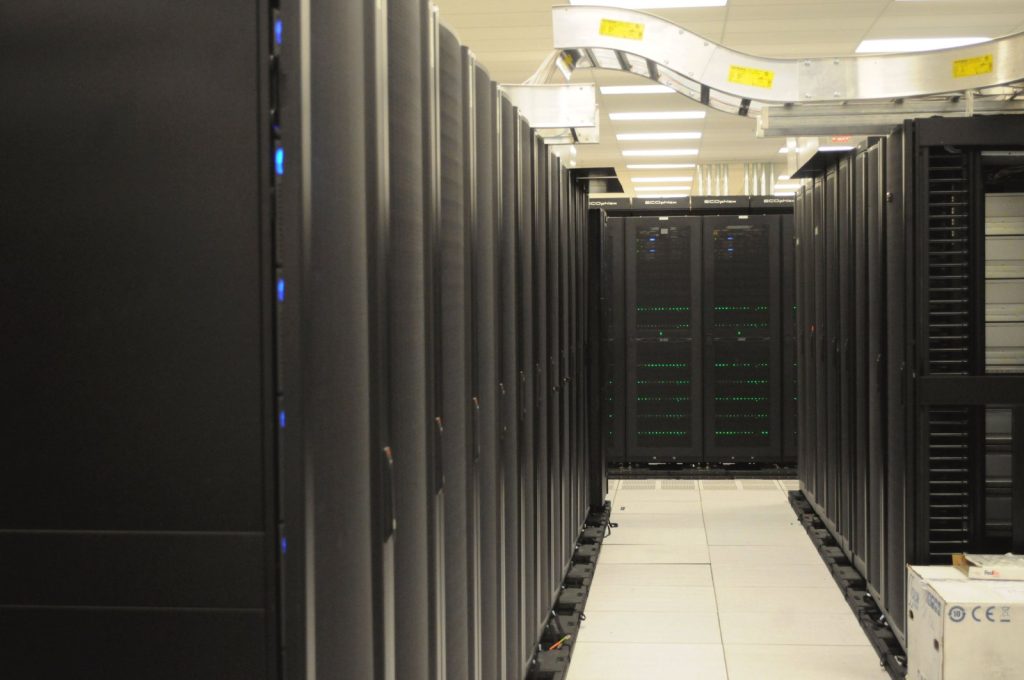
The largest recipient category is clear: data center construction and data center hardware. Estimates suggest 60-70 percent of hyperscaler capex flows into physical data center infrastructure — buildings, power supply, cooling, networking. Roughly 25-30 percent flows into semiconductors, primarily Nvidia GPUs (H100, H200, B100, B200) and competing solutions like AMD MI300X, Google TPU, AWS Trainium.
This distribution explains why Nvidia has been the primary winner of the capex wave so far. With a hyperscaler hardware share of 25 percent of $751 billion, $188 billion would flow into semiconductor purchases. If Nvidia wins 60 percent of that — historically the case — that’s $113 billion in potential revenue from hyperscaler purchases alone. Nvidia’s total revenue for FY2026 is estimated at around $240 billion. Hyperscalers thus carry nearly half.
This concentration explains why the PHLX Semiconductor index (^SOX) ended Monday’s session as the 22nd winning day of its last 23 trading days and reached its 15th all-time high of 2026. Semiconductors have literally become the heartbeat of the bull market.
The Backlog Defense Against Capex Risks
Who would finance these $751 billion if demand collapsed? The answer lies in the cloud backlogs of the hyperscalers. Microsoft reported a commercial Remaining Performance Obligations value of $392 billion last quarter — that’s money Microsoft has already received via signed cloud contracts but has not yet booked as revenue. Alphabet reached $462 billion in cloud backlog. Both values have risen massively — Alphabet even doubled from the prior quarter.
This is the bulls’ argument: the capex wave is not speculative. It responds to concretely signed contracts. $392 billion plus $462 billion plus the backlogs of AWS and Oracle together represent over a trillion dollars in binding cloud commitments that need to be served over the next 5-10 years. Capex of $751 billion per year is justified if these backlogs are taken as the measure.
The OpenAI Question
But this bull case has a weak point, and it’s called OpenAI. The Wall Street Journal reported in late April that OpenAI is missing internal revenue targets and that CFO Sarah Friar has expressed concerns about servicing compute contracts. OpenAI has $250 billion contracts with Oracle, more than $50 billion with Microsoft, additional double-digit billions with CoreWeave. If OpenAI cannot maintain its growth trajectory, these contracts would either need to be restructured (loss for hyperscalers) or OpenAI would fail due to cash shortage (massive trust loss for the entire AI sector).
What would not be lost immediately in this scenario: the capex itself. Data centers, once built, also generate revenue when the original end customer falls away — they can be rented to other cloud customers. But the multiple valuation of hyperscaler stocks would reset sharply, because the implicitly priced-in AI growth wouldn’t materialize.
Implications for Non-AI Stocks
An often underestimated consequence of the capex wave: it competes for capital. When Microsoft puts $130 billion into data centers, that money is no longer available for buybacks or dividends. Microsoft has raised its dividend rate less aggressively in the last two years than before the AI wave. The same pattern at Alphabet, Meta, Amazon. Only Apple — which invests significantly less in proprietary AI infrastructure — has maintained its buybacks and dividends at high levels.
This is a remarkable market dynamic: hyperscalers are becoming investment vehicles that reinvest their cash flows. They partially lose their character as cash-cow stocks they had between 2018 and 2023. Investors who bought the Mag 7 for buybacks and rising dividends must rethink — the story is now AI capex growth, not capital return.
Who Benefits Beyond the Hyperscalers?
The capex wave creates an entire supply chain of winners. First: Nvidia, AMD, Broadcom, Marvell, TSMC, ASML — the chips and their manufacturers. Second: Vertiv, Eaton, Schneider Electric — power supply and cooling for data centers. Third: Quanta Services, Emcor, Powell Industries — the construction companies that physically build data centers. Fourth: Energy operators like Constellation Energy, Vistra, Talen — hyperscalers have signed long-term Power Purchase Agreements that have placed these names in multi-year uptrends.
Constellation Energy has more than tripled its share price over the last two years — almost exclusively driven by data center power contracts. Vistra has shown similar moves. Quanta Services has gained 80 percent. These “picks and shovels” stocks have often outperformed the direct AI stocks because their valuations started lower and their business models are less volatile.
The Risk Scenario
What goes wrong if the capex thesis is wrong? Three primary risks. First: A recession could force cloud customers to cancel or reduce their contracts. Backlog numbers look fantastic in retrospect, but contract terms often allow reductions or postponements.
Second: The AI efficiency paradox. If new models (DeepSeek-style) require dramatically less compute than currently assumed, hardware demand would collapse. The DeepSeek shock of February 2025 was a foretaste — Nvidia lost $600 billion in market capitalization in a few hours that day. A similar or larger efficiency surprise would be devastating.
Third: Geopolitics. Most high-performance semiconductors are produced at TSMC in Taiwan. A Taiwan conflict would stop the AI capex wave in seconds. The U.S. is building capacity in Arizona with CHIPS Act subsidies, but that will take years.
What Retail Investors Should Watch
Three concrete data points for the coming weeks. First: Nvidia’s report on May 20. If Jensen Huang portrays data center demand as unbroken and delivers Q2 guidance above expectations, the capex thesis is stabilized for at least another quarter. Second: AMD’s report Tuesday this week. AMD is the most important secondary semiconductor beneficiary. If AMD reports hyperscaler-competitor orders, the capex recipient base diversifies — good for the story. Third: cloud growth rates. Azure 40 percent, Google Cloud 63 percent. If these rates continue accelerating in Q2, the backlog story is intact. If they slow, the first crack appears.
Bottom Line
$751 billion in hyperscaler capex for 2026 is a number that has few peers in economic history. It represents the largest single bet by a small group of corporations on a technological transformation in history. If the bet pays off, these corporations will be even more valuable in ten years than today. If it doesn’t, a multiple compression is coming that would relativize the entire 2024-2026 rally. For retail investors, this means diversification matters. Mag 7 plus picks-and-shovels stocks plus classic defensives form a more robust portfolio than pure Mag 7 concentration. The capex wave is real and largely good. But concentration risk is simultaneously greater than before.
Try TradingView Free for 30 Days
Plus get a $15 discount on your first subscription through this link.