
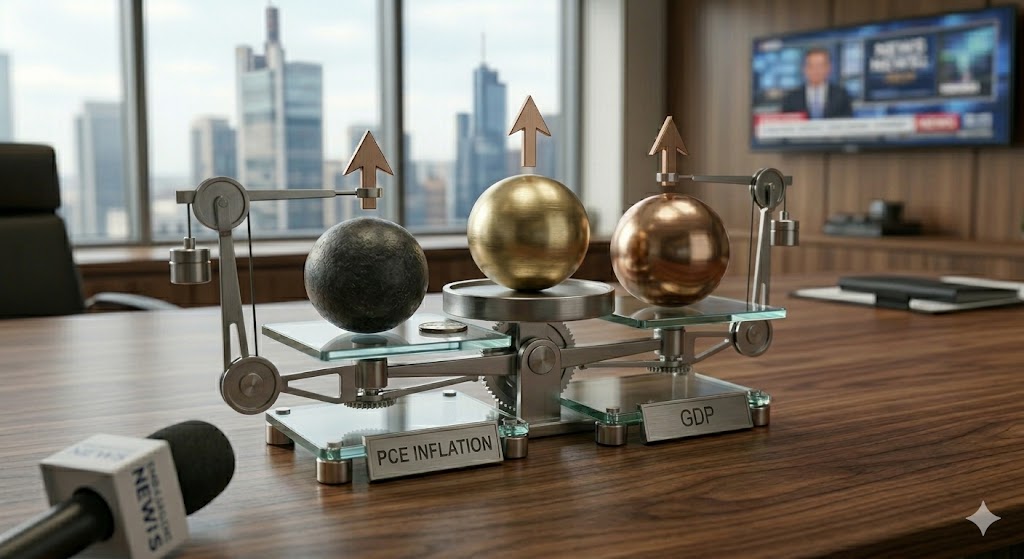
At 8:30 AM ET the data point the entire week had been building toward landed. The April PCE price index – the Fed’s preferred inflation gauge – climbed to 3.8 % year-over-year, the highest reading since May 2023. Three years. And yet today both sides of the table found something to defend their position with. That is exactly what makes this report dangerous.
What the numbers actually say
Let’s break the four numbers apart cleanly, because this is precisely where the confusion starts:
- Headline PCE MoM: +0.4 % (expected: +0.5 %) – below forecast
- Headline PCE YoY: 3.8 % (expected: 3.8 %) – exactly on target, 3-year high
- Core PCE MoM: +0.2 % (expected: +0.3 %) – notably below forecast
- Core PCE YoY: 3.3 % (expected: 3.3 %) – on target, highest since October 2023
Buried in the same release was a sobering footnote: Q1 GDP was revised down from 2.0 % to 1.6 %. The U.S. economy is growing slower than thought – while prices sit at a three-year high.
Why this feeds both camps
This is the crux. Here is why nobody is really right today:
The dovish camp (for cuts) points to the monthly figures. Both headline and core came in softer than expected. Monthly momentum is cooling. March headline was +0.7 %, now +0.4 %. The cut crowd says: “The Iran-war inflation surge is fading, the worst is behind us.” Add the weak GDP – the economy needs support, not higher rates.
The hawkish camp (for hikes) points to the annual figures. Headline 3.8 % and core 3.3 % are both at multi-year highs and miles from the Fed’s 2 % target. The direction is wrong: core rose from 3.2 % in March to 3.3 % in April. The hike crowd says: “Inflation isn’t anchored, one soft month doesn’t change the trend.”
Both have ammunition. That’s exactly the problem.
The Warsh factor
Here it gets politically delicate. Kevin Warsh was sworn in as the new Fed chair on May 22 – Powell has been history since May 15. Warsh has publicly signaled he thinks the policy rate can be lowered. That aligns with Trump’s open desire for cheaper borrowing costs.
The problem: the rest of the FOMC disagrees. Several Fed officials – including Kashkari, who dissented against the easing-bias language in April – stress that inflation risks have risen. Even the famously dovish Governor Waller shifted his tone last week, saying he wouldn’t hesitate to support a rate increase if inflation expectations became unanchored.
The result: a new Fed chair who wants to cut, against a committee that leans toward hiking. The first FOMC under Warsh is June 17–18. Today’s report didn’t resolve the conflict – it sharpened it.
What this means mathematically
The Fed targets 2 %. We’re at 3.8 % headline and 3.3 % core. To get core back to 2 %, monthly readings would need to fall to roughly 0.17 % MoM and stay there. April’s 0.2 % core is close – but a single month isn’t a trend.
The real issue is the energy component. The Hormuz shock is driving the headline number. Iran has committed to normalizing commercial shipping through the Strait of Hormuz within a month – oil dropped 5.5 % this week to around $88. If that normalization holds, headline inflation falls mechanically over the coming months. If it doesn’t (and sources already reported fresh Kuwait missiles today), it stays sticky.
Three scenarios into the June FOMC
Scenario 1 – Hold, bias open (~55 % probability): Warsh can’t win the committee for a cut, but can’t get a hike either. The Fed stays put, the messaging stays vague. Markets like that short-term.
Scenario 2 – Hawkish pivot (~30 % probability): If the Hormuz peace breaks and oil climbs back above $100, the committee tilts toward hike-prep. Bonds suffer, the 30-year Treasury (currently 5.19 %) tests new highs.
Scenario 3 – Surprise cut (~15 % probability): If GDP keeps weakening and the labor market cracks, Warsh prevails. Risk-on rally, but risky with sticky inflation.
What smart money is doing right now
Institutional positioning from Q1 tells a consistent story: caution. Jamie Dimon warns of “fat tail risks” and parks his own money in money-market funds. Stanley Druckenmiller is 100 % out of tech with 30 % of his portfolio in energy. David Tepper raised his energy position by 25 %. Warren Buffett sits on a 25-year record $380 billion cash pile.
The pattern: the most experienced investors are positioning for volatility and inflation, not a soft landing.
What investors should concretely do
- Consider energy as an inflation hedge: Smart money isn’t buying energy by accident. In a Hormuz break, it’s the first beneficiary.
- Watch bond duration: At 5.19 % on the 30-year U.S. Treasury, you get real yield for the first time since 2007 – but beware a hawkish pivot.
- Cash is not shameful: When Buffett parks $380B, patience is a position. Money-market funds pay handsomely at these rates.
- Don’t bet on the cut: Markets currently price roughly a 50 % chance of at least one move by year-end – and the tilt leans toward a hike, not a cut.
- Mind your taxes: Bond income and energy dividends are taxable. Calculate net, not gross.
The honest bottom line
Today’s PCE report wasn’t a breakthrough and wasn’t a shock – it was a Rorschach test. Doves see cooling monthly prints, hawks see three-year highs. Both are right, and that’s exactly why nobody is.
The real variable isn’t in Washington – it’s in the Strait of Hormuz. As long as the energy question is open, the inflation question is open, and as long as that’s open, the Fed is paralyzed. The market is celebrating all-time highs – but it’s celebrating them on a foundation a single geopolitical headline could knock over.
Try TradingView Free for 30 Days
Plus get a $15 discount on your first subscription through this link.