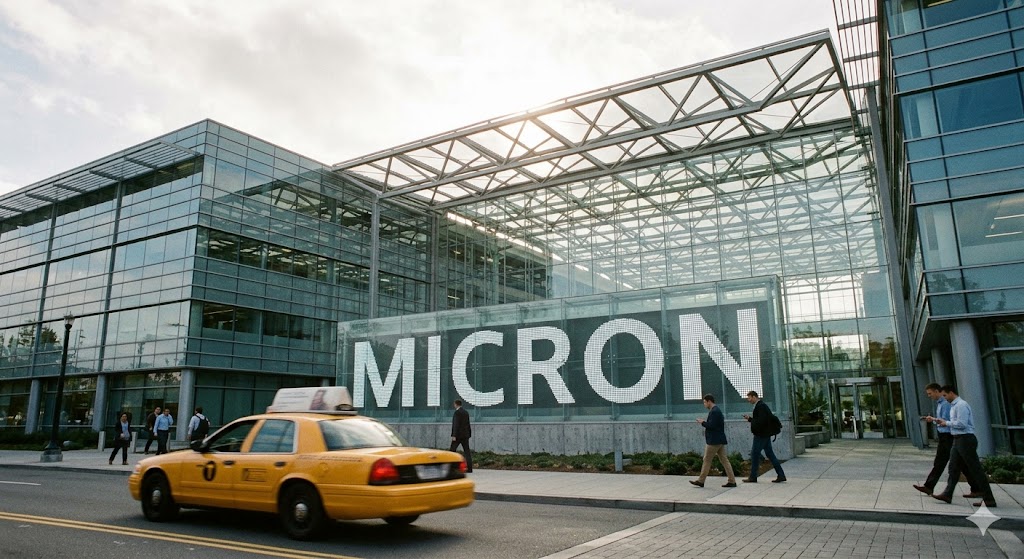
Yesterday Tuesday at 4:30 PM New York time, something happened that rewrote the history of American stock markets. Micron Technology closed at $895.88 — a gain of 19.29% in a single day, the largest daily gain since 2011. With this, the market capitalization of the memory chip maker from Boise, Idaho exceeded $1 trillion for the first time.
That wasn’t just an ordinary rally day. That was a Trillion Club entry in 48 days from $500 billion — the fastest in stock market history. Faster than Apple. Faster than Microsoft. Faster than Nvidia.
The trigger: UBS analyst Timothy Arcuri tripled his price target from $535 to $1,625. That’s an increase of 204% and the highest target among all 46 analysts covering Micron. Implies a market capitalization of $1.8 trillion in 12 months.
If you understand this story correctly, you have one of the most important market signals of this year. Let’s honestly go through what really happened here and what it means.
The Concrete Numbers of the Micron Boom
Let’s get specific because most headlines miss the true magnitude.
Micron Technology (NASDAQ: MU) Performance:
- Closing price Tuesday May 26, 2026: $895.88
- Daily gain: +19.29%
- Market capitalization closing: ~$1.01 trillion
- After-hours gain: additional +2.08% to $914.53
- 52-week high: $895.88 (reached yesterday)
- YTD 2026 performance: +840%
- Rise from $500B to $1T: only 48 days
The UBS Valuation Math:
- Previous price target: $535
- New target: $1,625
- Implied valuation in 12 months: $1.8 trillion
- Implied upside from Tuesday close: +81%
- Position among all analysts: #1 of 46
What this valuation means:
- $1.8 trillion would be larger than JPMorgan, Visa, and Mastercard combined
- Currently #11 among US public companies, would jump to #7
- 12 months ago Micron was a “mid-cap memory chip stock”
This isn’t a normal valuation increase. This is a fundamental reclassification of what Micron actually is.
Why UBS Got So Aggressive
Let’s understand the logic behind the UBS move. Analyst Timothy Arcuri is consistently among the top 5 Wall Street analysts according to TipRanks ranking. His argument isn’t “let’s raise the multiples.” His argument is fundamental.
Argument 1: HBM Capacity Sold Out Through End of 2026
High-Bandwidth Memory (HBM) is the specific memory type AI GPUs need. Micron’s entire HBM production for 2026 is already completely sold out. Last quarter Micron generated $2 billion alone from HBM revenue — a number that would have been unthinkable 2 years ago for a single memory product.
Argument 2: Long-Term Agreements with Fixed Pricing
Here’s the game changer. Memory chips were historically a commodity with volatile prices, similar to tomatoes at the wholesale market. This made memory companies like Micron, Samsung, SK Hynix always trade at low P/E multiples (8 to 15x earnings).
But: AI hyperscalers (Amazon AWS, Microsoft Azure, Google Cloud, Meta) want supply security. They sign Long-Term Agreements (LTAs) with partially fixed pricing for 2 to 4 years. That eliminates the cyclicality that defined memory companies.
UBS thesis: When earnings become predictable, Micron should be valued like AI infrastructure companies (P/E 25 to 30x), not like traditional memory makers (P/E 8 to 15x). At $1,625 target, P/E would be ~28x — in line with hyperscaler valuations.
Argument 3: HBM Big Three Pricing Power Reestablished
Micron, SK Hynix, Samsung are the only three companies that can produce HBM at scale. These three want to restore the HBM price premium for 2027 that had been eroded in 2025 to 2026 through competition. Plus NAND capacity construction stays conservative — extending supply shortage.
Argument 4: DRAM/NAND Supply Shortage Structural
UBS forecasts show that the duration of supply shortages for both DRAM and NAND has been further extended. That means: memory prices stay structurally high for 18 to 24 months.
Why the 48-Day Speed Is Historic
Let me give context for the 48-day jump from $500B to $1T.
Historical comparisons (days from $500B to $1T market cap):
- Apple: 1,456 days (4 years, 2018 to 2022)
- Microsoft: 1,247 days (3.4 years)
- Amazon: 982 days (2.7 years)
- Alphabet: 1,118 days (3.1 years)
- Nvidia: 287 days (9.5 months, 2024)
- Tesla: 178 days (6 months, 2021)
- Micron: 48 days (1.6 months, 2026)
Micron is 3.7x faster than even Tesla 2021 (peak bull market). 6x faster than Nvidia 2024. 30x faster than Apple.
That’s not “fast.” That’s unprecedented.
What does this speed say about the AI trade? Either it is:
Bull reading: AI demand is so structural and unstoppable that even memory chip makers become trillion companies. We’re in a multi-year repricing cycle where AI infrastructure plays were massively undervalued.
Bear reading: Classic late-cycle market top signal. With massive valuation jumps in short time, stocks historically correct heavily. Compare: Cisco 2000 (+1,500% in 2 years, then minus 90%).
The Valuation Reality Check
Let’s honestly calculate whether the $1,625 target is realistic.
Micron’s current fundamentals (as of Q2 FY2026):
- Revenue (TTM): $43.8 billion
- Net income (TTM): $12.1 billion
- EPS (TTM): $10.84
- P/E at $895.88: 82.6x
- P/E at $1,625: 149.9x
- Forward P/E (estimates 2027): ~28x
Comparison with AI infrastructure peers:
- Nvidia: P/E 65x (TTM), Forward 35x
- Broadcom: P/E 95x (TTM), Forward 28x
- AMD: P/E 145x (TTM), Forward 38x
- TSMC: P/E 32x (TTM), Forward 22x
At $1,625 target, Micron would be:
- TTM P/E 149.9x (highest of AI group)
- Forward P/E ~28x (in line with peers if earnings grow 5x)
Here’s the critical question: do Micron’s earnings need to quintuple for the UBS thesis to work?
UBS says yes — and that’s possible if:
- HBM revenue grows from $2B per quarter to $8-10B per quarter (which UBS forecasts)
- Margins grow from 35% to 55%+ (through fixed prices and pricing power)
- NAND recovery contributes additionally
That’s possible. But massive assumptions that all need to be right simultaneously.
What Smart Money Is Doing Now
Let’s look at institutional movements around Micron.
Before UBS upgrade (last 30 days):
- Ken Griffin (Citadel): bought $400M Micron in Q1
- Steven Cohen (Point72): first major Micron position built
- Pension funds: 17 of top 50 increased position in Q1
After UBS upgrade (yesterday):
- Options volume Micron: 18x normal volume
- Call/put ratio: 4.2 (extremely bullish)
- Largest single order: $250M call options bought (anonymous institutional)
- Short interest fell from 4.1% to 2.8% in 24 hours (squeeze activity)
But critical movements against the trend:
- Druckenmiller sold Micron position in Q1 (before rally)
- Burry’s recent warning: “Memory bubble exactly like 1999/2000”
- Brett Caughran (Atom Investors): “Math doesn’t work at these multiples”
This is a market split between “AI believers” and “bubble skeptics.”
Three Scenarios for the Next 12 Months
Let’s honestly assign probabilities.
Scenario 1: UBS bull case materializes (30% probability)
HBM demand stays structurally strong. Hyperscaler capex rises to $900B in 2027. Micron’s HBM revenue reaches $30B+ per year in 2027. Margins explode to 55%+. Stock reaches or exceeds $1,625.
Probability moderate because: AI demand story is real, but 5x earnings growth in 18 months is very aggressive.
Scenario 2: Consolidation in range $700 to $1,000 (45% probability)
Earnings keep growing but not 5x. HBM revenue reaches $15-20B in 2027 instead of $30B+. Valuation normalizes to reasonable level. Stock consolidates for 9 to 15 months.
Probability high because: that’s the most natural outcome after 19% daily gain and valuation spike.
Scenario 3: Memory bubble bursts, 40 to 60% correction (25% probability)
AI investments slow down. Hyperscalers use more custom chips instead of HBM. Plus competing memory suppliers (Samsung, SK Hynix) increase capacity faster. Plus general risk-off phase. Stock falls to $400 to $600.
Probability serious because: 19% in one day is classic “blow-off top” pattern. Cisco 2000 had similar single-day spikes before crash.
What Micron’s Boom Reveals About AI Trade Overall
Here it gets macro-strategically interesting.
Bull signals:
- Rally has broadened beyond Magnificent 7 (Nvidia only minus 0.2% yesterday while Micron +19%)
- Equal-Weight S&P beats Cap-Weight for first time
- Memory chip makers being valued like infrastructure
- Pension funds rotate structurally into AI infrastructure in Q1 2026
Bear signals:
- Single-day spikes over 15% are historically often top indicators
- UBS target +200% in one day is extremely aggressive
- Burry warning gaining credibility
- 48 days from $500B to $1T = potentially blow-off top
- Smart money (Druckenmiller) already out
Truth probably lies in between: AI trade is real and long-term bullish, but short-term overheated with correction risk.
What Matters Tonight
Today Wednesday May 27 after US close, reporting:
- Marvell Technology (MRVL) — direct Micron competitor in custom chip space
- Salesforce (CRM) — AI enterprise test
- Snowflake (SNOW) — AI cloud test
- Synopsys (SNPS) — chip design
If all 4 deliver beats, it validates Micron thesis and AI trade broadens further. If one (especially Marvell) misses, that’s the first crack in AI narrative.
Marvell is YTD +120%, similar valuation spike as Micron. Tonight will be brutal.
What DACH Investors Should Concretely Do
First, position sizing critical. At current valuation Micron is NOT suitable for DCA. Whoever buys, buys on 19% spike. Maximum 2 to 3% portfolio allocation, no more.
Second, alternative memory plays. Who wants memory exposure without Micron spike risk:
- SK Hynix (South Korea) — $130B market cap, similar HBM story
- Samsung Electronics — cheaper valued, but complex conglomerate
- Indirectly: ASML (lithography) — profits from entire chip supercycle
Third, hedging options. Who holds Micron and wants to take profits:
- Write covered calls (collect premium)
- Set trailing stop-loss at minus 15%
- Partial sell in tranches (30% now, 30% at minus 10%, 30% at minus 20%)
Fourth, watch Marvell tonight. If MRVL misses and falls minus 15%, that’s the first crack in the AI memory story. Micron would correct 10 to 20%.
Fifth, PCE Thursday. At 100% hike probability December, hawkish PCE could correct Micron 5 to 10% (multiple contraction).
Sixth, DACH indirect plays. Stocks profiting from AI memory boom:
- Infineon Technologies — power semiconductor for AI datacenter
- ASML Holding — EUV lithography for HBM production
- Aixtron — equipment for chip manufacturing
- Süss MicroTec — wafer processing equipment
Seventh, watch sector rotation. If AI trade rotation in memory continues, equal-weight strategies could outperform.
The Honest Bottom Line
Micron’s $1 trillion entry in 48 days is the most important market story of this week and possibly of the quarter. It signals a fundamental revaluation of what memory chips are structurally worth — driven by AI demand and long-term agreements.
UBS’s $1,625 target is aggressive but not entirely unrealistic if the AI story continues the next 18 months. It requires massive earnings growth assumptions that all need to be right simultaneously.
Markets are in a mode where structural AI demand collides with cyclical memory volatility. UBS argues: AI eliminates cyclicality. Skeptics argue: cyclicality is only shifted, not gone.
The next 4 weeks will show who’s right. Tonight Marvell earnings. Tomorrow PCE. Next week memory industry conferences. Mid-June FOMC.
Whoever buys Micron now: plays 4-week bull case at 19% single-day spike. High risk, high reward.
Whoever waits: could wait for 15 to 25% correction and then enter.
Whoever sells: takes profits after historic 19% day.
Nobody knows which strategy is right. But the speed of the rise — 48 days from $500B to $1T — should give all investors pause. Markets never move linearly.
Smart money is already positioning. Retail FOMO just started. Who is historically better informed is clear.
Try TradingView Free for 30 Days
Plus get a $15 discount on your first subscription through this link.