
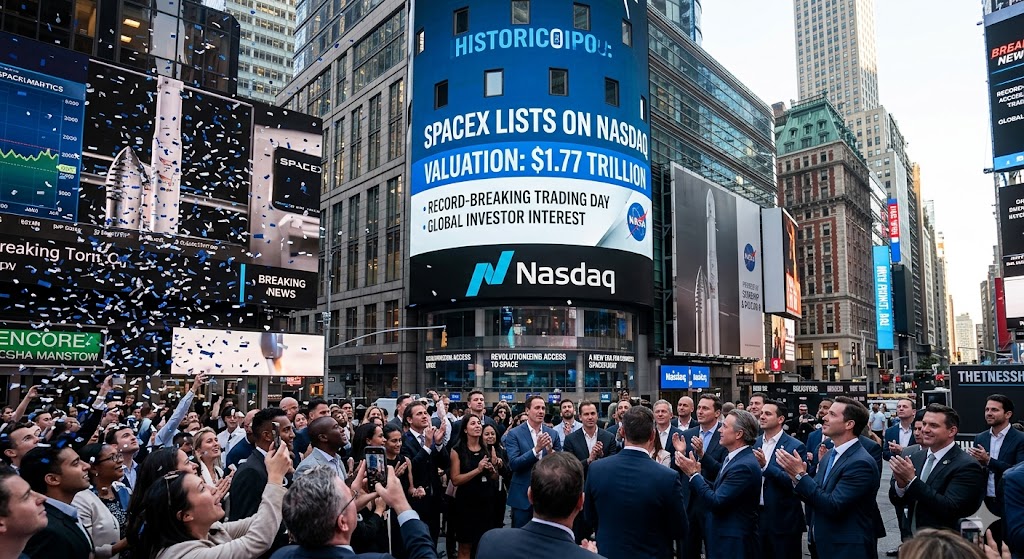
The largest IPO in history arrives this week
There are initial public offerings, and then there are events that move the goalposts themselves. What SpaceX is bringing to the Nasdaq this week belongs firmly in the second category. Elon Musk’s rocket and satellite company is set to trade publicly for the first time on Thursday, June 12, under the ticker SPCX — and it is doing so with numbers that make every prior record look like a rounding error. At a fixed offer price of $135 per share and roughly 555.6 million shares on offer, the company will raise about $75 billion in fresh capital. This is not merely a big IPO. It is, by a wide margin, the biggest the world has ever seen.
For context, the previous global record belonged to Saudi Aramco, the Saudi oil giant that raised around $25.6 billion in December 2019. SpaceX nearly triples that figure. It also more than triples the largest U.S. listing to date, Alibaba’s 2014 debut. At a valuation of $1.77 trillion, SpaceX would rank among the most valuable companies on Earth from its very first trading day — larger than Tesla, the automaker Musk also runs, which currently sits near $1.6 trillion. A company that began two decades ago as a mocked rocket startup would, overnight, be worth more than almost every established industrial or technology giant.
The raw numbers: $135, $1.77 trillion, $75 billion
Behind the headline sits a carefully staged feat. The roadshow, on which management pitches the stock to institutional investors, kicked off on June 4 — earlier than originally expected, because the Securities and Exchange Commission completed its review faster than anticipated. Final pricing is set for after the close on June 11, with the first trading day slated for June 12. Rather than a price range that emerges through bookbuilding, SpaceX has set a fixed price of $135 — an unusually confident move meant to signal that demand already exceeds supply.
The scale is hard to grasp. A $75 billion raise is comparable to the entire annual revenue of a major blue-chip corporation. A $1.77 trillion valuation would catapult SpaceX into the top tier of global companies by market capitalization, placing it shoulder to shoulder with the most valuable technology firms in the world. For a company that has yet to close a single fiscal year in profit, that is a remarkable bet on the future.
What investors are really buying: Starlink is the engine
Anyone subscribing to SPCX is not primarily buying spectacular rocket launches but a subscription business in the sky. The company’s true profit center is Starlink, the satellite-internet service that now delivers broadband to the most remote corners of the planet. In fiscal 2025, Starlink generated roughly $11.4 billion in revenue, accounting for about 61 percent of total group sales. More importantly, unlike the deeply loss-making launch business, Starlink already threw off an operating profit of around $4.4 billion. In February 2026 the service crossed five million subscribers and has been pushing toward ten million ever since.
That makes the investment story clearer than the spacefaring image suggests. At its core, SpaceX is a telecommunications company with a rocket as its distribution channel: because it builds and launches its own vehicles, it can put satellites into orbit at marginal costs no rival can match. This closed loop of in-house rocket, in-house satellite network, and in-house consumer business is the company’s real moat — and it is precisely this recurring, predictable revenue stream that, in the eyes of its champions, justifies the astronomical valuation at all. Total group revenue climbed to $18.7 billion in 2025, a 33 percent jump over the prior year.
Starship: the moonshot that burns billions
The other half of the story is Starship, the fully reusable super-heavy launch system with which Musk aims to slash the cost of putting mass into orbit and, eventually, to carry cargo and crew to the Moon and Mars. Starship is the visionary narrative that draws many investors to the stock in the first place — and at the same time the largest hole in the balance sheet. SpaceX has poured more than $15 billion cumulatively into its development, and that line item is the main reason the company reported a net loss of roughly $4.9 billion in 2025. The first quarter of 2026 added another $4.3 billion in losses.
Here lies the central tension of the offering: investors are paying a premium price for a company that is burning cash today, on the expectation that Starship becomes the next profit machine a few years out. If the bet works, SpaceX could dominate the market for heavy-lift transport to orbit as thoroughly as it already dominates commercial satellite launches today. If it fails or slips by years, capital keeps flowing into a project with no certain return — and the lofty valuation rests on thin ice. A substantial share of the IPO proceeds is likely to flow into exactly this development.
The Musk question: control with no way to fire him
No SpaceX investment can be separated from the figure of Elon Musk — and the IPO is engineered to keep it that way. SpaceX is going public with a dual-class share structure: low-vote Class A shares for the public and super-voting Class B shares carrying ten votes apiece that stay in Musk’s hands. According to the company, he controls 93.6 percent of those Class B shares. While issuing new stock nudges his voting power down from around 85 percent, it remains comfortably above 50 percent. In plain terms: Musk retains sole control of the company, can appoint the board as he sees fit, and is effectively impossible to fire.
For investors this is a double-edged sword. On one hand, Musk’s vision and his access to talent, capital, and political attention are a key driver of SpaceX’s success. On the other, such a structure means public shareholders have virtually no say. Several institutional investors have voiced concerns openly; Denmark’s AkademikerPension, for instance, said it would not invest at all because of governance. Buying SPCX means trusting not a board or an annual meeting, but a single person.
Is $1.77 trillion justified? The valuation debate
Few IPOs divide opinion as sharply as this one does on valuation. At roughly $1.77 trillion, investors are paying about 110 times annual revenue — a multiple higher than Tesla, Palantir, or virtually any large listed technology company. Multiples like that make sense only if you assume extremely high growth sustained over many years, and that Starlink and later Starship conquer vast new markets almost single-handedly.
The skeptics are accordingly vocal. Analysts at Morningstar, using a discounted-cash-flow approach, arrive at a fair value of just around $780 billion — roughly 48 percent below the level at which the shares last changed hands in private markets. In other words, even a charitable modeler considers the IPO price roughly double the intrinsic value. Supporters counter that classic cash-flow models systematically undervalue a company like SpaceX because they simply cannot capture disruptive technological leaps and entirely new markets — point-to-point transport on Earth, say, or the commercialization of the Moon. Both camps will soon get to test their arguments in the open market.
How U.S. retail investors can take part
The most striking feature for ordinary investors: SpaceX is opening its IPO unusually wide to retail. Up to 30 percent of the shares are reserved for individuals — many times the five to ten percent that is standard in most offerings. In the United States, major brokerages are giving everyday clients direct access to the deal, a sharp break from the era when hot IPOs were reserved almost exclusively for institutions and insiders. The catch: each platform will impose its own allocation limits, and demand is likely to dwarf the available supply. Anyone subscribing should expect to receive only a fraction of the shares requested — or none at all, leaving them to buy in the open market once trading begins on June 12.
For investors who cannot get an allocation, or who balk at the concentration risk of a single, richly valued growth stock, the listed space sector offers ways to participate in the theme without owning SPCX directly. Names such as Rocket Lab, a launch and space-systems company, AST SpaceMobile in satellite-to-phone connectivity, and Intuitive Machines in lunar services all trade publicly and move with the broader space narrative. Defense-and-aerospace heavyweights with space exposure, and exchange-traded funds that bundle a basket of space suppliers and competitors, spread the risk across many tickers rather than betting everything on one. Whatever the route, the same discipline applies: size the position so that a 30 or 40 percent drawdown remains survivable.
The risks — and the counterarguments
As seductive as the narrative is, the list of risks is long and deserves a sober read before any subscription. First, the sheer valuation: at 110 times revenue, almost any growth disappointment is already priced in, meaning even a slowdown could hit the stock hard. Second, the corporate structure that locks control with Musk and strips minority holders of influence. Third, the recently absorbed AI unit tied to Musk’s xAI activities, which analysts flag as an added cost burden and even a potential source of value destruction with an indeterminate economic moat. And fourth, the sobering historical pattern that the very largest IPOs underperform the broad market more often than not in the months after their debut.
Weighing against all that are serious counterpoints. SpaceX is not a vague promise but an operationally dominant player: it leads the global market for commercial rocket launches by a wide margin, Starlink is growing fast and profitably, and revenue just rose by a third. Heavy retail participation could create a broad, loyal shareholder base. And Musk’s track record — from the mass-market electric car to the reusable rocket — gives even hardened skeptics pause before betting against him. The honest answer, then: SPCX is no widows-and-orphans stock but a highly concentrated wager on a single, visionary, but so far loss-making growth story. Anyone stepping in should size the position so that even a 30 or 40 percent setback remains bearable.
Outlook: June 11 and 12 are the acid test
The coming days will answer the most gripping question: will the market actually support a $1.77 trillion valuation? Final pricing is locked in on the evening of June 11; June 12 puts the immediate credibility of the mega-deal to the test on its first trading day. A sharp pop would retroactively vindicate Musk’s confident fixed price and throw the door wide open for further multibillion-dollar technology listings. A weak start, by contrast — or a slide below the offer price — would hand the skeptics their proof and rattle the entire euphoria around richly valued growth names.
For investors everywhere, this is more than a distant Wall Street spectacle. It is a rare chance to own a piece of one of the most ambitious companies of our era — bundled with every risk that a highly valued, single-person-controlled growth company carries. The sober lesson from past mega-IPOs is that the most exciting story and the best stock are not always the same thing. Anyone who wants in should bring enthusiasm for the vision but discipline in the portfolio. On June 12, the public phase of an experiment begins — one that, once again, pushes the limits of what the stock market is thought capable of.
Try TradingView Free for 30 Days
Plus get a $15 discount on your first subscription through this link.