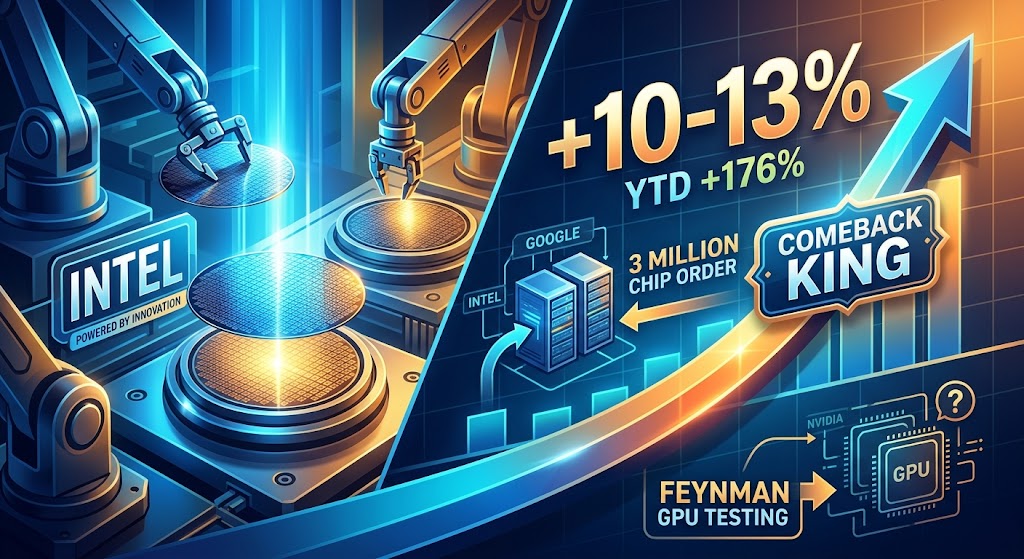
Exactly one week ago, Intel was the big loser. When Nvidia declared war on the PC market at Computex, Intel’s stock fell over six percent — the x86 veteran looked like a dinosaur the AI revolution was passing by. Today, a week later, everything is different. Intel jumps ten to thirteen percent, making it one of the big winners of a rebound Monday. The reason: an order that puts the former chip king’s comeback narrative on an entirely new foundation.
According to a report by the industry outlet The Information, Google’s parent company Alphabet has placed an order with Intel for more than three million chips — specifically its in-house AI accelerators, the so-called Tensor Processing Units (TPUs), to be manufactured starting in 2028. And it gets better: Nvidia, the undisputed king of AI chips, is also evaluating Intel as a manufacturing partner. Let’s walk through what happened, why it’s so significant — and why the real story isn’t about Intel at all, but about a bottleneck in Taiwan.
What actually happened
Let’s start with the facts as far as they’re known. The Information reports, citing four people with direct insight into the talks, that Google has placed an order with Intel for more than three million TPUs for production in 2028. This followed months of testing Intel’s advanced packaging technology — the art of combining multiple chip components into one high-performance package.
TPUs are Google’s own AI chips, used to train and run its models. Until now, Google had these chips manufactured mostly by others. That Intel is now in play is a massive vote of confidence. Morgan Stanley estimates Google will produce more than six million TPUs combined across 2027 and 2028 — so the three-million order may be just the beginning.
In parallel, it emerged that Nvidia is evaluating whether Intel’s technology is suitable to manufacture a processor that combines four graphics chips into a single unit. This work relates to Nvidia’s upcoming Feynman GPU architecture, also planned for 2028. Nvidia hasn’t placed a firm order yet — but the mere fact that the world’s most valuable chip company is evaluating Intel as a possible manufacturer is a signal.
The market reaction was unambiguous: Intel jumped ten to thirteen percent on Monday. The stock thus extends its already spectacular run — since the start of the year, it has recovered around 176 percent.
The historical context: the fallen giant
To understand why this news is so powerful, you need to know Intel’s collapse. For decades, Intel was synonymous with computer chips — “Intel Inside” was stuck on practically every PC in the world. But in recent years the company lost its technological lead. A series of management blunders allowed the Taiwanese contract manufacturer TSMC to overtake Intel in manufacturing technology. Intel, once the undisputed market leader, became a symbol of missed opportunities and sluggish innovation.
Under new CEO Lip-Bu Tan, the tide has begun to turn. At Computex in Taipei, Tan had already spoken last week of a sharp increase in demand for Intel’s data-center processors. The Google order is now the strongest proof yet that the turnaround is real — not just wishful thinking. A company like Google doesn’t hand a three-million-chip order to a manufacturer it doesn’t trust to play in the top league.
The real story: TSMC at its limit
Here’s the core most headlines miss. Intel’s comeback isn’t primarily Intel’s doing — it’s the consequence of a problem at the competition. TSMC, by far the largest contract manufacturer in the world and the factory behind nearly every top-tier AI chip, simply can’t keep up with the exploding demand anymore.
The AI wave we’ve reported on extensively in recent weeks — Anthropic’s $965 billion valuation, Dell’s $60 billion AI server business, the ten-gigawatt compute hunger — generates demand for cutting-edge chips that a single manufacturer can no longer serve alone. This very bottleneck suddenly makes alternatives valuable. When the only reliable supplier is booked out, you look for a second. And the only other provider with its own advanced manufacturing in the West is Intel.
Elon Musk captured it at an appearance: the real bottleneck lies in chip manufacturing capacity. That’s exactly Intel’s opportunity. Not because Intel got better overnight, but because demand is so large that even the second-best manufacturer is suddenly urgently needed.
Foundry explained: why “who manufactures” matters so much
A brief aside for anyone wondering why a manufacturing order moves a stock ten percent. In the chip industry there are two roles. Some design chips (like Nvidia, Google, AMD) — they’re called “fabless” because they have no factories of their own. Others manufacture these designs in factories costing billions (“fabs”) — these are the foundries like TSMC or Intel.
A modern chip factory costs tens of billions of dollars and requires years of lead time. There are only a handful of companies worldwide that can manufacture top-tier chips. So whoever wins a large manufacturing order secures years of plannable billion-dollar revenue and simultaneously proves its technology is competitive. That’s exactly why the Google order is doubly valuable for Intel: it brings money and it brings credibility.
What this means mathematically
Let’s calculate roughly. If Google wants to produce more than six million TPUs by 2028 and a significant portion of that were manufactured at Intel, we’re talking about a multi-year order in the potential double-digit billions for Intel’s foundry division. For a company whose manufacturing business was viewed for years as an expensive ball and chain, that’s a fundamental shift.
But the +176 percent since the start of the year also shows the other side: much of this expectation is already priced into the stock. Anyone buying today at +10 percent is buying a stock that has nearly tripled in half a year. That’s no guarantee it continues — on the contrary, the higher the expectation, the harder the disappointment if orders are delayed or manufacturing shows quality problems. And that’s exactly Intel’s historical weakness: the reliable, flawless mass production of cutting-edge chips.
Three scenarios
Scenario 1 — The turnaround is real (~45%): Intel delivers the Google order cleanly, Nvidia follows with its own order, and the TSMC bottleneck makes Intel a sought-after second manufacturer for years. The +176 percent was just the beginning of a genuine trend reversal.
Scenario 2 — Justified but expensive hope (~35%): The orders are real, but the market has already generously priced in the comeback. Intel delivers solidly, the stock consolidates at a high level. Good for the company, less spectacular for new investors.
Scenario 3 — The old weakness returns (~20%): Intel stumbles in manufacturing — delays, yield problems, the historical Achilles heel. Google or Nvidia pull back, and the high valuation corrects hard. The skeptics who never saw Intel in the top league again are proven right.
What smart money is doing
Today’s move is itself a smart-money signal, but a cautious one. The market isn’t rewarding Intel as a company, but the realization that the manufacturing bottleneck is structural and won’t disappear overnight. That’s exactly why it’s not only Intel rising: Micron jumped seven percent, Marvell almost nine (also due to its upcoming S&P 500 inclusion), the whole memory and chip chain is recovering from Friday’s crash.
Elon Musk publicly praised Micron and emphasized the manufacturing bottleneck — a sign that the smarter minds aren’t betting on individual AI models, but on the physical infrastructure behind them: the factories, the capacity, the power. It’s the same logic as the “shovel stock”: in a gold rush, whoever supplies the tools earns reliably — and manufacturing capacity is the scarcest tool of all.
What investors should concretely do
- Understand the bottleneck, not just the stock: The real insight isn’t “Intel is good,” but “manufacturing capacity is scarce.” That lifts not only Intel, but the whole manufacturing chain — including Samsung (which, as we saw with the Anthropic article, runs its own foundry) and equipment makers like ASML.
- Be cautious at +176 percent: A stock that has nearly tripled in half a year is no longer a cheap entry. The easy part of the move is over. Anyone buying now is buying high expectations.
- Watch the delivery: An announced order is not yet a manufactured chip. Intel’s historical weakness is precisely mass production. Only when clean deliveries arrive in 2027/28 is the turnaround proven.
- See the big picture: Intel, Marvell, Micron, Samsung, ASML — it’s all the same story. AI demand exceeds manufacturing capacity, and that redistributes power and revenue across the whole chip supply chain.
- Plan for taxes: Gains from U.S. stocks like Intel are subject to Austrian 27.5 percent capital gains tax plus possible U.S. withholding. Calculate net.
The honest bottom line
A week ago, Intel was the dinosaur the AI revolution was passing by. Today it’s the comeback king Google gives a three-million-chip order and Nvidia evaluates. This speed of sentiment reversal should itself be a warning: what flips from despair to euphoria in a week can flip back just as fast.
But what can’t be argued away: the manufacturing bottleneck is real, it’s structural, and it suddenly makes the world’s second-best manufacturer indispensable. Intel’s fate now hangs on a single, very old question — can the company do what it failed at for years: manufacture cutting-edge chips reliably, in mass, and flawlessly? If yes, today’s rally is just the beginning. If no, it was an expensive hope. The market has placed its bet. It will only be proven in 2028 — on the factory floor, not on the price chart.
Try TradingView Free for 30 Days
Plus get a $15 discount on your first subscription through this link.