
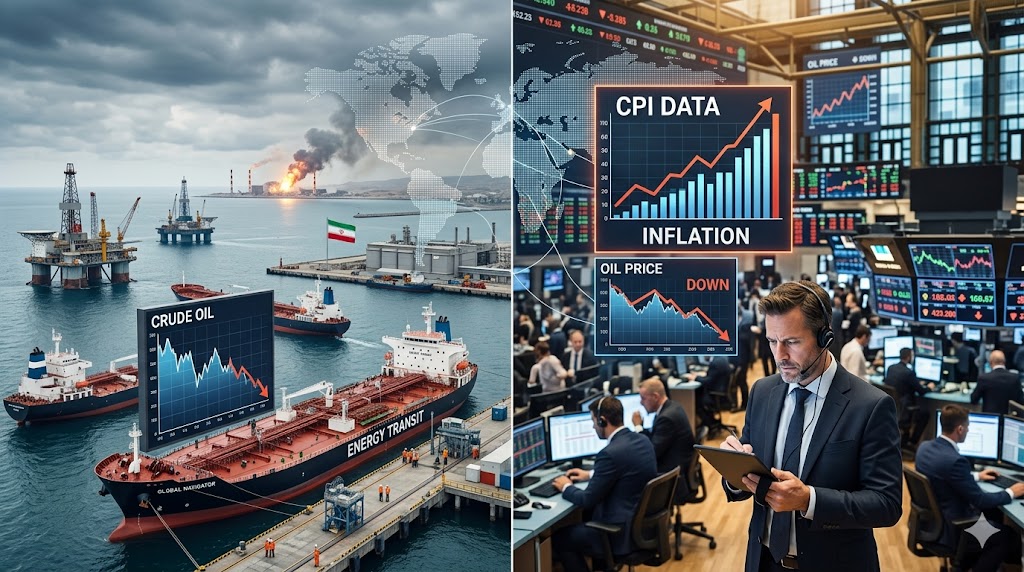
Wall Street woke up this Wednesday to one of the strangest split-screens in recent market memory. On one side: American warplanes striking Iranian air-defense batteries, ground-control stations and surveillance radars near the Strait of Hormuz overnight, the latest escalation in a war that has now ground on for more than three months. On the other side: an oil price that is not spiking but collapsing — WTI down 3.9% to $87.74 a barrel, Brent off 3% to $91.40. And as if the script needed one more twist, at 8:30 a.m. ET the Bureau of Labor Statistics will release the May Consumer Price Index, which economists expect to show the hottest annual inflation reading in three years. Geopolitics, energy and monetary policy are colliding in a single trading session — and the market’s verdict so far is a paradox that deserves unpacking.
A Night of Airstrikes — and a Falling Oil Price
The retaliation itself was no surprise. Late Tuesday night U.S. time, American forces hit Iranian military infrastructure clustered around the Strait of Hormuz: air-defense systems, ground-control stations, surveillance radars. The Pentagon framed the operation as a “proportional response to unjustified Iranian aggression” — language carefully chosen to signal punishment without an open-ended widening of the campaign.
What was a surprise, at least to anyone applying the old textbook, was the reaction in the oil pit. In a conventional world, U.S. strikes on Iranian assets guarding the planet’s most important oil chokepoint would send crude vertical. Instead, traders sold the news aggressively. The nearly 4% drop in WTI is not a rounding error; it is a deliberate, collective bet that this exchange of fire is the end of something rather than the beginning. That bet has a name, and it was given to the market by the president himself.
How We Got Here: From a Downed Apache to Retaliation
The chronology matters, because the speed of it tells you how compressed the market’s decision-making window has become. On Monday, June 8, Iranian forces shot down a U.S. Apache attack helicopter that was patrolling the Strait of Hormuz. Both pilots were recovered unharmed — a detail that almost certainly kept the response on the lower end of the escalation ladder. President Trump took to social media within hours, declaring that the United States “must necessarily respond to this attack.” Markets sold off instantly on the post: the Nasdaq slid intraday, with the tech sector at one point nearly 2% in the red.
Then came the pivot. The same president who promised retaliation also said on Monday that a deal with Tehran was “two or three days” away — and that the Strait of Hormuz would reopen “immediately” once an agreement was signed. The New York Times added substance to the rhetoric, reporting that the administration is negotiating a 15-year suspension of Iranian uranium enrichment. Stocks recovered much of their losses into the close: the S&P 500 finished Tuesday down just 0.26%, with only technology and energy in the red, while the Dow actually gained 0.17%, or 86 points, to close at 50,872.11. The Nasdaq ended down roughly 1% at 25,678.82 — a wound, but not a hemorrhage.
So within roughly 36 hours, the market processed a shoot-down, a presidential vow of retaliation, actual airstrikes, and a credible report of a comprehensive nuclear deal. The net result: oil down hard, equities mostly stable, and everyone’s attention already moving on to this morning’s inflation data.
The Peace Paradox: Why Crude Is Selling Off Anyway
To understand why oil fell almost 4% on a night of American airstrikes, you have to understand what has been priced into crude since early March. Iran declared the Strait of Hormuz “closed” on March 4 — and unlike past episodes of saber-rattling, it backed the declaration with sea mines, attacks on commercial shipping and explicit IRGC warnings. Maersk, MSC, CMA CGM and Hapag-Lloyd suspended transits. At the peak of the crisis, more than 150 tankers sat at anchor outside the strait, a floating monument to disrupted trade. Roughly 20 million barrels of oil per day normally move through Hormuz — about 20% of all seaborne oil trade. Brent above $90 is not a price for the oil market we have today in terms of barrels actually produced; it is a price for the barrels the market fears it might lose tomorrow.
That fear component — call it the war premium — is precisely what Trump’s deal talk is deflating. If the strait reopens “immediately” after an agreement, as the president claims, then tens of millions of barrels of delayed and rerouted supply come back online within weeks. Tankers at anchor start moving. Insurance rates on Gulf shipping collapse. The marginal barrel gets dramatically cheaper. Traders are not waiting for the signature; they are front-running it. In that light, last night’s strikes were read not as escalation but as choreography — a proportional, face-saving response that clears the political deck for a deal, rather than a step toward a wider war. Whether that reading is right is a separate question, and we will return to it. But it explains the tape.
Today’s Main Event: The Hottest CPI Print in Three Years
While the geopolitical drama plays out, the most consequential data point of the month lands this morning. At 8:30 a.m. ET, the BLS publishes the May CPI, and the consensus from the Reuters survey is uncomfortable reading: +0.5% month-over-month and +4.2% year-over-year for headline inflation. If the number comes in as expected, it would be the highest annual reading since April 2023 — a three-year high — and a sharp acceleration from April 2026’s 3.8%.
The driver is no mystery: energy. The war with Iran, now in its fourth month, has pushed energy and goods prices higher all along the Hormuz supply route. Crude that has to sail around chokepoints costs more to move; freight and insurance premiums bleed into import prices; gasoline at the pump does the rest. May was the month in which the blockade’s full force showed up in consumer prices, and today’s report will quantify the damage.
The core rate tells a different and more nuanced story. Excluding energy and food, economists expect +0.3% month-over-month and +2.9% year-over-year. That is not target-consistent, but it is nowhere near crisis territory. The gap between a 4.2% headline and a 2.9% core is, in effect, a measurement of the war itself — the inflationary shadow that the Strait of Hormuz casts over the American consumer. The question that will dominate trading today and positioning into next week is simple: does the Federal Reserve treat that gap as noise to look through, or as a fire that is starting to spread?
What It Means for the Fed on June 16–17
The timing could hardly be more loaded. The Federal Open Market Committee meets next week, on June 16–17, and will publish a fresh dot plot. Coming into June, markets still nursed hopes of rate cuts later this year. The May jobs report killed most of that on June 5: the economy added 172,000 jobs against expectations of just 80,000, a blowout that recast the entire soft-landing narrative. An economy creating jobs at more than twice the forecast pace does not need monetary rescue — and a hot CPI on top of it would bury the remaining cut hopes for good.
The honest answer on the Fed is that it faces a genuinely two-sided problem. Doctrine says the central bank looks through energy-driven supply shocks and anchors policy to core inflation, which at an expected 2.9% argues for patience rather than panic. But doctrine also says the Fed must guard against second-round effects — and those are exactly what a months-long blockade produces. Freight costs, transport surcharges and goods prices do not stay quarantined in the energy column forever; they leak into the core with a lag. Chair Powell’s committee will have to write a dot plot that acknowledges a 4.2% headline without validating it, and that keeps optionality alive in case the “two or three days” deal materializes and energy prices unwind as fast as they built up. Expect the word “temporary” to do a lot of heavy lifting next Wednesday — and expect markets to remember how that word aged in 2021.
Winners, Losers, and the Stocks Caught in Between
For U.S. investors, the peace paradox creates an unusual map of sector exposure, because almost every major group is being pulled in two directions at once.
Oil majors and services. ExxonMobil and Chevron have been quiet beneficiaries of Brent above $90 — every month of blockade fattens upstream margins and cash returns. But Tuesday’s price action is a preview of their deal risk: if Hormuz reopens and the war premium deflates, the windfall compresses quickly. Halliburton sits in a similar squeeze on the services side; elevated prices encourage drilling activity, but a rapid normalization toward pre-crisis crude would cool the capex impulse just as fast. Energy was one of only two S&P sectors to close red on Tuesday — the market is already marking this exposure down.
Defense. Lockheed Martin, RTX and Northrop Grumman embody the other side of the trade. Three-plus months of air war, depleted munitions stockpiles and a downed Apache argue for a multi-year replenishment cycle that survives any single ceasefire. But the sector has been bid up on escalation, and a genuine deal would test how much of that bid is durable structural demand versus headline-chasing. The historical pattern is that defense budgets outlast the conflicts that justify them — yet short-term, these names trade with deal headlines, not ten-year procurement plans.
Fuel-cost losers. Delta and United have spent the spring absorbing brutal jet-fuel costs; for airlines, a 4% drop in crude is direct margin relief, and a real deal would be a material earnings tailwind into the summer travel season. The same logic applies to FedEx and UPS, where fuel surcharges have been propping up revenue optically while squeezing customers — falling diesel and jet fuel would ease the cost side and support shipping volumes that have suffered from rerouted, slower global trade.
The consumer aisle. Walmart and Target tell the inflation story from the household’s perspective. Gasoline prices act as a tax on discretionary spending: every extra dollar at the pump is a dollar not spent on apparel, electronics or home goods. Walmart’s grocery-heavy, value-oriented mix historically holds up better in this environment than Target’s discretionary tilt. Today’s CPI will quantify exactly how hard that squeeze hit in May — and a deal-driven energy unwind would be the single best piece of news the retail sector could get before back-to-school season.
Rates and tech. Finally, the bond market is the transmission channel that ties it all together. The 10-year Treasury yield has been grinding higher since the jobs shock, and a 4.2% CPI print would extend that move, keeping pressure on rate-sensitive growth and technology stocks — which is exactly why tech was Tuesday’s worst performer, at one point down nearly 2%. Long-duration equities need either a cooler inflation path or a credible peace dividend to regain leadership. They might get both; they might get neither.
The Bear Case: This Deal Has Fallen Apart Before
Here is the uncomfortable historical footnote that should temper enthusiasm: we have seen this movie, and it ended badly once already. In mid-April, Iran temporarily reopened the Strait of Hormuz during an Israel–Lebanon ceasefire. The United States kept its blockade in place — and Iran promptly shut the strait again. Deal hopes have been priced in before, and they evaporated within days.
The current optimism rests heavily on a presidential timeline of “two or three days,” delivered on social media, about a negotiation — a 15-year enrichment suspension — that would be one of the most complex arms-control agreements in modern history. The gap between that timeline and that complexity is where the risk lives. Tehran is negotiating after the killing of Supreme Leader Ali Khamenei in the opening phase of the war; the internal politics of any Iranian concession are opaque even to seasoned analysts. A single failed session, a single attack by a faction with an interest in sabotage, and the war premium that just left the oil price comes back with interest. Positioning for peace at $87 WTI means accepting that the snap-back scenario could be violent.
The Stagflation Scenario Nobody Wants to Price
There is also a worse branch on the decision tree, and it deserves a paragraph precisely because so few portfolios are built for it. Imagine the deal stalls — not collapses spectacularly, just drifts — while May’s energy-driven inflation seeps into freight, transport and goods prices over the summer. Headline inflation stays north of 4%, the core starts creeping toward 3.5%, and the Fed, post-jobs-shock, has no plausible path to cuts. Meanwhile, the consumer squeeze visible in today’s CPI starts showing up in retail earnings and discretionary demand. That combination — sticky war-driven inflation, a central bank pinned in place, and decelerating real consumption — is the stagflation-lite scenario. It is not the base case. But it is the scenario in which both bonds and growth stocks lose simultaneously, and the only real hedges are energy itself, defense, and cash earning 4%-plus. The fact that the market assigns it a low probability is exactly why it is the scenario worth stress-testing.
Outlook: A Market Trading on Two Clocks
Today’s session will be governed by two clocks running at different speeds. The fast clock is the CPI at 8:30 a.m. ET: an in-line 4.2% is arguably already priced after the jobs shock, a 4.4%-plus surprise would hit rate-sensitive assets hard, and a downside miss would trigger a relief rally in everything with duration. The slow clock is Tehran: “two or three days” expires, by the president’s own arithmetic, this week. If a deal lands, the war premium in oil finishes deflating, airlines and retailers rally, energy and defense give back ground, and the Fed suddenly gets a plausible story in which the inflation spike of May 2026 was the peak. If the deal slips — as it did in April — crude reverses, and the hottest CPI in three years stops being a backward-looking energy artifact and starts being the new baseline. For investors, the discipline this week is to resist trading the headlines tick by tick and instead ask which of the two clocks actually drives each position they own. The peace paradox of June 10 is real: bombs fell, and oil fell with them. Whether that paradox resolves into peace or merely into a pause is the question the next 72 hours — and next Wednesday’s dot plot — will answer.
Try TradingView Free for 30 Days
Plus get a $15 discount on your first subscription through this link.
Read more in our topic hub: Topic Hub: Geopolitics & Your Portfolio