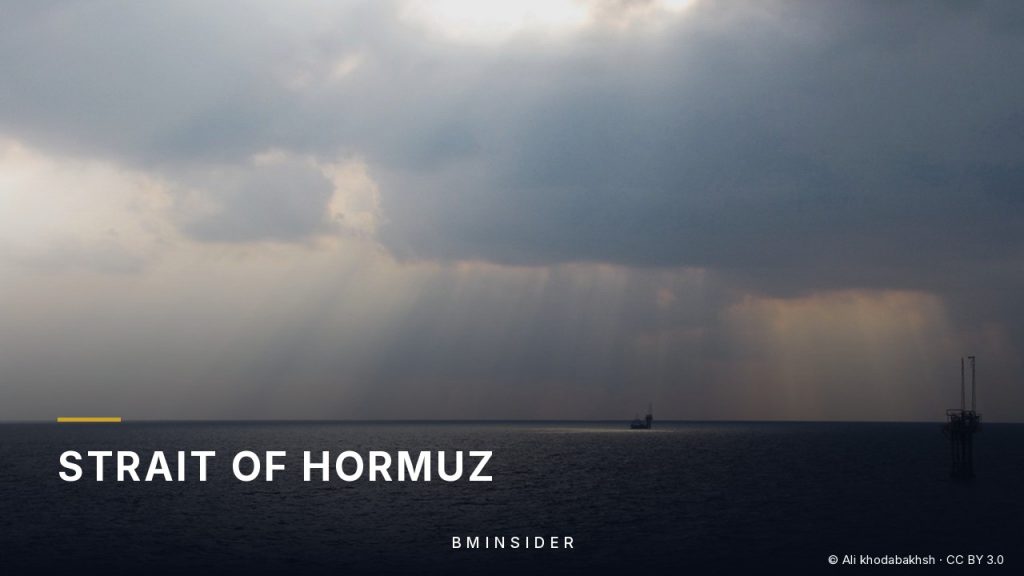
Oil fell more than seven percent last week, and the reason was good news: the Strait of Hormuz, shut since 4 March, is supposed to reopen. Iran and Oman are negotiating a shared traffic scheme — inbound vessels through Iranian waters, outbound through Omani waters. Brent traded back above 83 dollars on Friday, having marked its high for the year at 120.88 dollars on 30 April. The futures market is treating this as the end of an emergency.
Buried in the reporting on that deal, however, is a number that has not shown up in any price yet. The reopening is free of charge for a limited period — and not after that. According to Reuters, Tehran is demanding a transit levy of five to seven percent of declared cargo value; Muscat is offering three. What is being negotiated is not the end of a blockade. It is the price at which the blockade ends.
What is actually on the table in Muscat
The structure of the arrangement is strikingly simple. Inbound traffic would run through a northern lane in Iranian territorial waters, outbound traffic through a southern lane in Omani waters. Iran and Oman are the strait’s two riparian states; the split gives each of them one direction. Iranian Deputy Foreign Minister Kazem Gharibabadi has publicly described this as a temporary route intended to run for two to four months, and added explicitly that the understanding does not mean the full reopening of the Strait of Hormuz. Foreign ministry spokesman Esmail Baghaei said the deal was close to completion if certain third parties do not obstruct the process.
The sticking point is not the route. It is the fee. Reuters reports that the Iranian side insists on five to seven percent of declared cargo value while Oman proposes three. The United States objects to any payment to Tehran for passage at all. The Gulf states, for their part, insist that any payment by shipowners must remain strictly voluntary — a formulation that says a great deal about how hard every party is working to avoid calling this what it is.
Because a fee you pay voluntarily in order to be allowed through a strait that otherwise stays closed is a linguistic construction, not an economic one. The owner who declines to pay does not sail. That is where the real story starts, and it is considerably larger than whether crude prints 79 or 83 dollars this week.
Six months with the world’s most important waterway shut
The backstory is short and brutal. The air war against Iran began on 28 February. On 4 March, Iranian forces declared the Strait of Hormuz closed and began attacking ships that attempted to transit anyway. On 12 March, Brent crossed 100 dollars; by the end of April the year’s high stood just under 121. On 17 June, Washington and Tehran signed a fourteen-point memorandum of understanding: an end to strikes, an end to the naval blockade of Iranian ports, the reopening of the strait — and, in its own words, safe passage for commercial vessels with no charge for sixty days only.
That agreement lasted three weeks. On 25 June an Iranian drone struck a vessel in the strait. On 7 July three more ships were hit, and the United States rescinded Iran’s license to sell oil internationally. On 8 and 9 July a second round of retaliation hit roughly ninety targets, and the American president declared the ceasefire over. On 18 July Iran’s deputy foreign minister formally suspended the country’s commitments under the memorandum.
It is worth stating that plainly: this week the market is pricing the same promise for the second time in eight weeks — sixty days of free passage. The first time, it held for three weeks. That is not an argument that it will fail again. It is an argument that a temporary standstill and a settlement are different things, and that a forward curve treating one as the other is taking a position it does not disclose.
The volumes involved are well documented. In the first half of 2025 an average of 20.9 million barrels a day of crude and refined products moved through Hormuz, roughly a fifth of global liquid fuels consumption; on crude alone the International Energy Agency puts it at about a third of all seaborne trade. Add some 112 billion cubic metres of liquefied natural gas in 2025, close to a fifth of the global LNG trade — effectively the entire export volume of Qatar and the United Arab Emirates, Kuwait-bound cargoes excepted.
What seven percent looks like in dollars
Percentages of cargo value are abstract, so take a single ship. A VLCC carries roughly two million barrels. At 83 dollars, that is cargo worth about 166 million dollars. Seven percent of it is 11.6 million dollars; three percent is just under five million — for one transit that cost nothing before the war.
Per barrel, that works out to a range of 2.49 to 5.81 dollars. That number is the actual news of the past week, and it appears in no forward contract. The market has taken roughly ten dollars out of Brent because the strait is reopening, without booking the fact that once the free window expires, the reopening is meant to arrive with a permanent surcharge of up to 5.81 dollars a barrel attached.
Annualised: 20 million barrels a day at 83 dollars is cargo worth about 1.66 billion dollars daily. Seven percent of that is roughly 116 million dollars a day, or a little over 42 billion a year; at three percent it is about 18 billion. That lines up closely with the estimate of 40 billion dollars in annual revenue from maritime services attributed to Iranian officials after the June agreement. The figures of 100 or even 140 billion dollars circulating in parts of the press are reachable only if you tax all traffic in both directions — imports, containers and chemicals included. That may well be where this ends up; it is not yet a defensible number. Anyone looking for the order of magnitude is better served doing the arithmetic themselves.
For scale, compare the world’s two other great bottlenecks. The Panama Canal booked about 5.7 billion dollars of revenue in fiscal 2025, up more than fourteen percent. The Suez Canal took just under two billion dollars from 5,874 ships between July and early December 2025. A seven percent Hormuz levy would be a multiple of both — instantly the most expensive stretch of water on earth.
The difference between a fee and a tax
Which brings us to the legal core, and it is sharper than the debate suggests. Article 26 of the United Nations Convention on the Law of the Sea expressly forbids levying charges on foreign ships by reason only of their passage. The single exception is payment for specific services actually rendered, and even that only without discrimination. Article 42 bars states bordering straits from hampering transit passage, Article 44 forbids suspending it, and Article 300 obliges parties not to exercise their rights abusively.
Iran signed the convention in 1982 but never ratified it, and consistently treats transit passage as a treaty-only right that does not bind it. Oman has ratified, and has already signalled that unilateral tolls violate the law of the sea. The United States has likewise never ratified, yet has always asserted transit passage as customary law and runs freedom of navigation operations through the strait on that basis. From which follows an argument that is hard to escape: if the right of passage is customary, the prohibition on charging for it is customary too, because it is part of the same right.
Tehran meets this through the one door Article 26 leaves open, calling the payment compensation for naval escort, corridor clearance and administrative screening. The objection is old and simple: the exception covers services genuinely provided, not compulsory protection from a danger the party collecting the money created itself.
And here the fee base gives away more than any legal opinion could. A pilot boat costs the same whether it escorts 40 million or 400 million dollars of cargo. An escort costs the same. A clearance costs the same. No conceivable service scales with the value of what is sitting in the tanks. A charge assessed on cargo value is therefore, by construction, not a service fee but a tax on the oil price — and that is not a question of interpretation but of the formula. Tellingly, the Iranian draft approved by parliament’s national security and foreign policy committee at the end of March still envisaged a flat fee of roughly two million dollars per vessel for a northern corridor, payable in yuan and cryptocurrency. The switch from a flat charge to a percentage is the real regime change: a toll became an equity stake.
Who already pays ten percent — and to whom
The most useful comparison, though, comes not from international law but from insurance. Because an ad valorem charge for transiting Hormuz already exists. It is called the war risk premium, and it is quoted as a percentage of a vessel’s hull value.
Before the escalation, a single transit of the strait cost between 0.15 and 0.25 percent of insured hull value. By mid-March the rates had climbed to one to five percent; by July market reports put them at 7.5 to ten percent. For a tanker with a hull value of 100 million dollars, five percent means about five million dollars — for one passage. The reference bases matter and should not be conflated: insurance is assessed on the ship, the Iranian demand on the cargo. On a large crude carrier the two happen to land in the same order of magnitude, which is exactly what makes the comparison useful.
From that follows the sharpest finding of the week. If the strait genuinely reopens safely, war risk premiums do not ease slightly; they fall by a factor of thirty to forty back toward pre-war levels. Per VLCC transit that releases roughly seven to fifteen million dollars currently flowing to reinsurers in London. The levy under negotiation, at three to seven percent of cargo value, claims almost exactly that sum: five to 11.6 million dollars. Tehran is not pricing a service. It is pricing the difference between war and peace — and has set the rate so that the peace dividend is collected before it reaches the consumer.
The shipowner’s arithmetic — and America’s odd position
For shipping itself this inverts the usual reflex: peace is not good news for tanker equities. Frontline reported a 67 percent year-on-year jump in revenue for the first quarter and had more than eighty percent of its VLCC days for the second quarter already booked; DHT Holdings posted growth of nearly 135 percent. Those numbers are children of the closure — tight tonnage, longer voyages, a premium on every available cubic metre. Analysts at Evercore have accordingly cut both DHT and Frontline to a neutral rating, citing reversion risk: record rates born of a disruption disappear with the disruption. Anyone holding tanker stocks today holds a position against the reopening, and should know it. International Seaways sits in the same trade. Freight rates, meanwhile, are expected to stay firm for a while, because insurance, equipment availability and vessel supply normalise more slowly than headlines do.
The American position in all this is peculiar and worth spelling out. The United States imports almost nothing through Hormuz; as a net exporter its exposure runs through price, not through barrels. That is precisely why Washington can afford to reject the fee on principle — it would be paid overwhelmingly by Asian and European buyers. Yet American companies are on the hook in a way the political framing obscures. ConocoPhillips holds interests in Qatar’s North Field East and South projects and is the counterparty on the first long-term LNG supply contract Germany ever signed, up to two million tonnes a year for at least fifteen years into Brunsbüttel, with deliveries starting this year. Every one of those molecules has to pass through the strait where the levy is being negotiated.
And for the domestic consumer the mechanism is the one that always applies to freight: a cost that hits every ship on a route identically ends up in the freight rate, and from there in the price of the goods. It is not paid by the owner. It is paid by whoever fills a tank, heats a building or buys plastic at the end of the chain. For US refiners such as Valero and for the airlines, the relevant variable is not the toll itself but the crude price it is levied on.
The case against this reading
There are good objections, and the best one is economic. A state earning seven percent on every cargo suddenly has a hard interest in cargo moving. That is precisely how Egypt has behaved at Suez for decades: the canal is too valuable to use as a weapon. A levy could therefore stabilise the strait by turning Tehran from a disruptor into a toll collector. That is the benign reading, and it is not far-fetched.
The catch is in the fee base, which is why it matters so much. A charge on value pays more the more expensive oil is, and oil is expensive precisely when the strait is considered threatened. The revenue-maximising strategy is then neither closure nor frictionless operation, but a permanently credible reservation combined with the highest possible throughput. A per-ship toll would not carry that incentive. A percentage of value has it built in.
The second objection is magnitude. Even 5.81 dollars a barrel is a fraction of what the war has cost: the US Energy Information Administration raised its Brent forecast for this year to an average of 79 dollars, against 58 before the war began. Measured against a war premium of roughly twenty dollars, a levy of not quite six is meaningful progress. Turning the toll into an apocalypse confuses a permanent cost increase with a crisis.
The third objection is simply that it may not happen. Washington rejects the payment, Oman is offering less than half of what Tehran wants, the Gulf states want it declared voluntary, and the predecessor to this agreement lasted three weeks. Supply is working against the surcharge too: the IEA calculates that global output jumped 4.1 million barrels a day in June to 98.8 million as flows resumed. The buffer, though, is thinner than it used to be — OPEC spare capacity is seen averaging only about 2.5 million barrels a day in 2027, partly because the United Arab Emirates left the organisation on 1 May.
What to watch now
For the coming weeks, three gauges are more useful than the oil price itself.
First, the fee base. If the final text specifies a flat charge per ship or a rate per tonne, it is a toll in the Panama Canal tradition and economically small. If it specifies a percentage of cargo value, it is a stake in the oil price, and the rate itself is almost beside the point — the principle costs more than the number.
Second, the clock. Sixty days of free passage is an option, not a settlement. What matters is what applies the day after it expires, and whether anything at all has been agreed that reaches beyond it. On the first attempt in June, nothing had been, and the market priced that difference no better than it is pricing it now.
Third, the war risk premium. It is the most honest indicator in this story, because it is quoted daily by people who back their judgement with their own capital. If it falls briskly from seven to ten percent toward one, the market believes in the reopening — and that is the precise moment the sum being fought over in Muscat comes into existence. If it stays elevated while crude falls, two markets have diverged, and one of them is wrong.
For half a year the Strait of Hormuz was the most expensive stretch of water in the world because you could not sail it. On the way back to normal operation, it risks becoming the most expensive stretch of water in the world because you have to pay for it. For the oil market that is the difference between a disruption that passes and a cost that stays. Last week’s selloff celebrated the first and has not yet acknowledged the second.
Try TradingView Free for 30 Days
Plus get a $15 discount on your first subscription through this link.
Read more in our topic hub: Topic Hub: Geopolitics & Your Portfolio