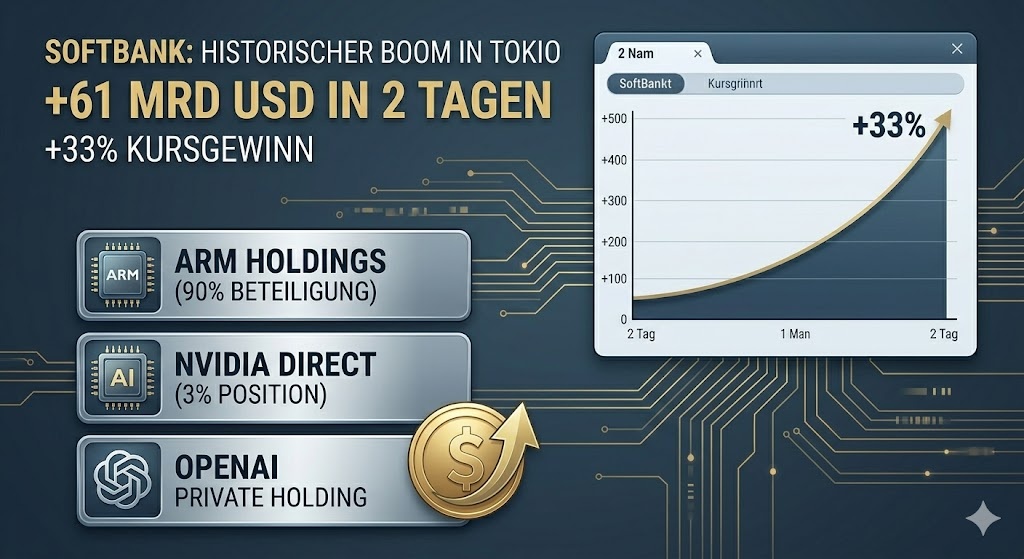
While the entire finance world was glued to Nvidia earnings Thursday evening and discussing the “muted stock reaction” Friday morning, something happened 6,000 kilometers away in Tokyo that almost nobody had on their radar: SoftBank Group shares exploded over 33 percent in two trading days. Thursday closed 20 % higher. Friday added another 11 %. The result: $61 billion in additional market capitalization in 48 hours. That’s one of the largest 2-day gains in Tokyo Stock Exchange history. While everyone discussed Nvidia, Masayoshi Son quietly engineered one of the biggest comebacks of 2026. If you understand this story correctly, you have one of the most underestimated market signals of this quarter. Let’s honestly go through why SoftBank exploded and what it really means.
The concrete numbers of the SoftBank boom
Let’s get specific because most headlines miss the real magnitude. Wednesday May 20 (pre-Nvidia): SoftBank Group (TSE: 9984) trades at roughly 11,200 yen per share. Market cap around $158 billion. Thursday May 21 (post-Nvidia earnings): stock opens at 12,000 yen, closes at 13,440 yen. +20 % in one day. Friday May 22: stock opens at 13,700 yen, closes at 14,920 yen. +11 % additional gain. Total over two days a stock-price gain of 33 percent, a market-cap increase of $61 billion, and a volume that ran at five times the daily average. Day 1 ranks among the largest 1-day gains in Tokyo Stock Exchange history, the 2-day performance lands in the top 10 of 30 years of TSE trading. That’s not “good day”. That’s historic movement.
Why SoftBank exploded (and Nvidia didn’t)
Here it gets interesting. Nvidia delivered the perfect quarter beat. Stock barely moved. SoftBank delivered nothing of its own — and stock exploded 33 %. How does this fit together? The answer lies in SoftBank’s AI holdings structure, which almost nobody understood. SoftBank owns 90 % of Arm Holdings, the chip designer whose architectures run in practically every smartphone, every car, and increasingly in data centers. Arm’s royalty stream grows exponentially with the AI boom. Nvidia’s beat confirmed: hyperscaler AI capex stays at $725 billion in 2026. Arm earns passive royalties on EVERY one of these chips. When Nvidia delivers, Arm earns. When AMD delivers, Arm earns. When custom chips from Google and Amazon come, Arm earns. Arm’s current market cap: $145 billion. SoftBank’s 90 % share: $130 billion. That’s more than SoftBank’s entire market cap was Thursday morning.
On top of that come three more key holdings. SoftBank quietly built a 3 % position in Nvidia over the last 18 months. At Nvidia’s current market cap of $4.5 trillion, that’s roughly $135 billion in value. SoftBank’s Vision Fund invested $30 billion in OpenAI. Current private valuation: $500 billion. With the confirmed OpenAI IPO 2026, this position is before massive realization moment. And SoftBank is key partner in the Stargate project (Saudi Arabia AI), India AI Sovereign Initiative, and Japan’s own AI strategy. $30 billion sovereign AI market in 2026 — SoftBank is everywhere.
The math nobody did
Let’s honestly calculate. Before the boom, Arm with the 90 % stake was worth roughly $130 billion. The Nvidia position represented around $135 billion, OpenAI via the Vision Fund an estimated $75 billion, other AI investments like Cerebras and ByteDance another $40 billion. That adds up to $380 billion in AI holdings value. SoftBank’s market cap before the boom: $158 billion. In other words: SoftBank traded at 42 % of the value of its AI holdings alone. That’s a sum-of-parts discount of over 50 percent. Plus SoftBank still has telecom business, Yahoo Japan, additional investments worth roughly $70 billion that came free in the valuation. This is mathematical reality markets ignored for weeks. Nvidia’s beat was the trigger that set off the repricing wave.
Why the repricing comes exactly now
There are three specific factors that came together this week. Factor 1 — Arm’s own earnings on May 10. Arm Holdings reported Q4 earnings early May with 47 % revenue growth and guidance that beat all estimates. That was the first signal that Arm’s AI royalty engine is massively accelerating. Markets initially viewed it isolated on Arm, not understanding the implication for SoftBank.
Factor 2 — OpenAI IPO confirmation on Wednesday May 20. WSJ reported Wednesday evening that OpenAI is working with Goldman Sachs and Morgan Stanley on IPO filing. SoftBank’s $30 billion OpenAI investment becomes concretely valuable. Before OpenAI IPO it was “private” and markets discounted massively. With IPO path, value becomes realizable.
Factor 3 — Nvidia’s hyperscaler capex confirmation on Thursday May 21. Nvidia’s earnings confirmed $725 billion hyperscaler capex in 2026. That’s direct royalty pipeline for Arm. Markets realized overnight: SoftBank isn’t “AI hype” — SoftBank is concrete royalty machine that earns money with every AI chip.
When Masayoshi Son was last positioned this well
Let me provide context for younger readers who know Masayoshi Son only as “the WeWork disaster guy”. 1999/2000: Son’s Vision Fund predecessor invested massively in internet companies. At peak Son’s wealth was $78 billion — he was the richest man in the world briefly. Dotcom crash cost him 99 % of his wealth. 2014: Son invested $20 million in Chinese online company called Alibaba. This position grew to over $90 billion in value. One of the largest single-investment returns in history. 2016: Son bought Arm Holdings for $32 billion — considered overpriced at the time. Arm is now worth $145 billion. 4.5x in 10 years.
2019/2020: WeWork disaster, Uber losses, Vision Fund 2 struggling. Son loses estimated $30 billion. Markets write him off. 2023/2024: Son goes into consolidation mode. Sells Alibaba positions, builds cash, stays publicly silent. Markets ignore him completely. 2025/2026: Quiet repositioning. Arm gets re-floated. OpenAI position built. Stargate Saudi Arabia deal. Nvidia position built. Now everything explodes simultaneously. That’s classic Son pattern: ignored for years, then suddenly everywhere.
What this means for the next 12 months
Let’s honestly go through scenarios. Scenario A with 40 % probability: SoftBank rally continues. If OpenAI IPO actually comes in Q3/Q4 2026 at $500 billion valuation, plus SpaceX IPO June 12 at $1.75 trillion, plus Anthropic IPO later this year — then the entire AI IPO wave is bullish for SoftBank. Stock could gain another 30-50 %.
Scenario B with 35 % probability: consolidation after boom. 33 % in 2 days is extreme. Profit-taking is likely. SoftBank could correct 15-20 % before next rally phase begins. But structurally the AI royalty story remains intact. Scenario C with 25 % probability: AI bubble bursts. If the AI IPO wave really is market top signal (John Blank from Zacks: “I see it as a market top”), then SoftBank is most exposed. Stock could correct 40-60 % on AI bubble burst. But: Arm and Nvidia positions retain fundamental value.
What DACH investors should concretely do
First, SoftBank is accessible via German brokers. ISIN JP3436100006, WKN 891624. Trade Republic, Scalable Capital, Comdirect, ING — all trade the stock. No direct Tokyo Exchange access needed. Second, caution with direct buy after 33 % rally. Whoever buys blindly now is late-comer. Mathematically the stock is still undervalued relative to holdings. But short-term correction possible.
Third, Arm Holdings as alternative. If you want AI royalty exposure without SoftBank’s conglomerate complexity, Arm Holdings (NASDAQ: ARM) is more direct play. Higher valuation but purer exposure. Fourth, be prepared for OpenAI IPO. SoftBank’s largest unrealized holding. When IPO comes, SoftBank’s book value revaluation is immediate. Plus eToro has signaled SpaceX pre-IPO access — similar for OpenAI likely. Fifth, mind correlation. SoftBank is highly correlated with Nvidia, Arm, OpenAI valuation. If your portfolio is already massively AI-exposed, SoftBank adds concentration risk rather than diversifying.
What smart money did this week
First 13F filings for Q1 are in. They show interesting moves around SoftBank-adjacent positions. Cathie Wood (ARK Invest) sold $40.6 million TSMC Wednesday to free up cash for other trades. Unusual move for Wood who typically doesn’t sell out of semiconductors. Speculation: she’s positioning for SoftBank or OpenAI-adjacent names. Pension Funds in Japan — the Government Pension Investment Fund is, with $1.7 trillion AUM, the largest pension fund in the world — increased SoftBank position in Q1. This was disclosed this week and triggered additional institutional inflow. Saudi Arabia’s Public Investment Fund is major Stargate partner with SoftBank. PIF’s allocation in SoftBank-adjacent assets was communicated this week. Sovereign wealth funds move markets long-term.
The honest bottom line
SoftBank +$61 billion market cap in 2 days is the underestimated story of this week. While everyone discusses Nvidia earnings reaction, the real AI trade reality revealed itself in Tokyo: not hardware makers profit most, but royalty players and IP holders. Masayoshi Son waited 6 years for this moment. He sold Alibaba, built cash, restructured Arm, built OpenAI position. While markets ignored him, he positioned. This week came the reward. $61 billion in 2 days. That’s more than the entire market capitalization of BMW. More than Lufthansa. More than Heineken. Generated in 48 hours, largely without DACH finance press coverage.
The question now is: is this beginning of multi-year AI conglomerate rally? Or late-cycle spike before AI bubble burst? Mathematically both are possible. Structurally SoftBank has the cards laid right. Whoever ignored Son for the last 30 years was often wrong. Sometimes right (Dotcom 2000, WeWork 2019). But more often wrong (Alibaba 2014, Arm 2016, now 2026). Smart money in Asia understood this. DACH investors typically don’t.
Try TradingView Free for 30 Days
Plus get a $15 discount on your first subscription through this link.
Read more in our topic hub: Topic Hub: AI Stocks Investing 2026