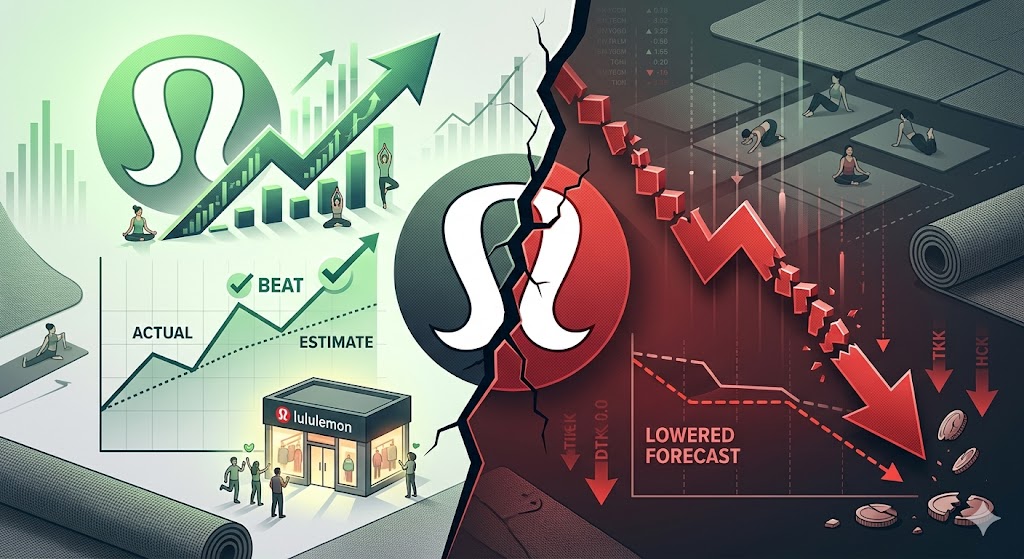
There is a moment in the life of almost every growth stock when the narrative breaks — not because a single quarter is catastrophic, but because the market simply stops believing the story. For Lululemon, that moment arrived Wednesday evening after the US closing bell. The athletic-apparel company posted results that, on the surface, actually beat expectations — and the stock still plunged roughly 11 percent. It was not a stumble. It was confirmation of a trend: the shares have shed about 41 percent since the start of the year and now sit at a seven-year low.
Anyone watching the tape this week recognizes the pattern. First the market cheered Snowflake with a 25 percent surge for beating estimates. Then it punished Broadcom with a 14 percent drop even as AI revenue exploded 143 percent. Now Lululemon brings the same logic to an entirely different corner of the market — the consumer, the premium segment, the brand once considered untouchable. The message each time is identical: what a company delivers right now matters less than what it promises for the future. And Lululemon’s promise just shrank dramatically.
A quarter that beats at the top and breaks underneath
Look only at the headline numbers and the fiscal first quarter was solid. Revenue rose 4 percent to about 2.47 billion dollars, edging past the roughly 2.44 billion analysts had penciled in. Adjusted earnings per share came in exactly in line at 1.69 dollars. In a calm environment this would have been an unremarkable, perfectly decent quarter.
The trouble lies one level down. Operating income collapsed from 438.6 million to 276.9 million dollars — a 37 percent decline. Reported earnings per share fell from 2.60 to 1.69 dollars. In other words, Lululemon is still selling a little more while earning meaningfully less on it. That widening gap between rising revenue and crumbling profitability is precisely what unnerves investors. It is the classic symptom of a brand losing pricing power and being forced to fight back with discounts, with higher costs, with thinner margins.
The home market crumbles while China rescues
The most alarming figure of the quarter is not in the income statement but in the regional breakdown. In the Americas — by far Lululemon’s largest and most important market — comparable sales fell roughly 5 to 6 percent. It marks the fifth consecutive quarter of declining comps in the region. Americas revenue slipped about 3 percent to around 1.6 billion dollars.
This is more than a cyclical dip. When a premium player shrinks on its core market for more than a year, the question is no longer about the economy — it is about the brand itself: desirability, innovation, and whether the next generation of shoppers still sees Lululemon as the defining label or merely as one expensive option among many.
What saved the quarter came from the other side of the world. In Mainland China, revenue jumped 30 percent and comparable sales rose 13 percent. China is the company’s great growth hope — but it is also a market loaded with its own geopolitical and economic risks. A growth story that leans ever more heavily on a single, politically sensitive foreign market while the home base erodes is not a comfortable position to be in.
Tariffs are eating the margin
A second structural drag is tariffs. In the first quarter they cost Lululemon roughly 280 basis points of product margin. The backdrop is a sharp escalation in US trade policy: a 30 percent tariff increase on goods from China, plus another 10 percent on imports from other sourcing countries. Because Lululemon — like nearly the entire apparel industry — manufactures in Asia, that hits the cost structure directly.
For the full year, management now expects gross margin to fall by about 110 basis points, primarily because of these tariffs. Efficiency programs offset part of the pressure, but the direction is unmistakable: the golden era of double-digit margin expansion is over. Lululemon is caught in a vise between rising import costs and a customer base that, in the current consumer climate, is unwilling to absorb every price increase.
The guidance cut is the real trigger
As ugly as the quarter was, the true reason for the sell-off lies in the outlook. Lululemon slashed its full-year guidance across the board. On revenue, the company now expects 11.0 to 11.15 billion dollars for fiscal 2026, down from a prior range of 11.35 to 11.50 billion — implying flat to slightly negative growth versus last year.
The profit warning was even more severe: expected earnings per share were cut by more than a dollar, from a prior 12.10 to 12.30 dollars down to just 10.95 to 11.15 dollars. And for the current second quarter the company guided to a revenue decline of 2 to 3 percent, with North America expected to contract in the low double digits. That combination — falling sales plus collapsing profit plus a weak quarterly outlook — is exactly what tips an already jittery growth stock over the edge.
Interim CEO Meghan Frank spoke of “headwinds” and a “moderating sales trend.” She pointed to negative commentary in the media weighing on store traffic, and to product launches that failed to generate the excitement the company had hoped for. It is an explanation that inadvertently exposes the core problem: when new collections no longer electrify shoppers, that is not a marketing issue — it is a brand issue.
Who else gets caught in the downdraft
Lululemon is not an isolated case but part of a broader cooling across the sportswear and athleisure space. Nike shares are also down about 31 percent year to date, and even the US-listed lines of Adidas have given ground. For American investors, the read-through runs across the whole sector: Nike and Under Armour face the same forces — more cautious spending, margin pressure from tariffs and sourcing costs, and intensifying competition from younger, cheaper rivals.
That competitive threat is the part worth watching most closely. Privately held challengers like Alo Yoga and Vuori have been peeling away exactly the aspirational, style-conscious customer Lululemon built its empire on, while Gap’s Athleta chases the value end. When a category leader starts losing share at both the premium and the value ends simultaneously, it is squeezed from both directions at once. Investors holding consumer-discretionary names in the Nasdaq or S&P 500 should treat the Lululemon print not as a one-off but as an early warning about more selective spending across higher-end consumer goods.
Risks, counterarguments and the road ahead
For all the gloom, the other side deserves a hearing. Lululemon remains highly profitable, generates substantial cash flow, and has a genuine bright spot in its China growth. Analysts are split: the consensus rating sits mostly at “neutral,” with an average price target around 186 dollars across a range that runs from roughly 130 to more than 280. Firms including Evercore, UBS and Piper Sandler have all cut their targets sharply in recent days, some to as low as 130 dollars. That signals not panic so much as wait-and-see skepticism.
The decisive factor will be leadership. With Meghan Frank serving as interim chief and a new CEO announced, this is precisely where the opportunity lies: a leadership change can be the catalyst for an honest reckoning — fresh product lines, a sharpened brand promise, a more realistic set of expectations. Stocks that have fallen this far can turn hard on the smallest positive surprise.
But the bar for a genuine turnaround is high. Lululemon has to prove it can win back its home market, that its products can excite again, and that the China strength is durable rather than a cyclical flash in the pan. Until then, the lesson the market drove home repeatedly this week stands: in a nervous environment, “good enough” is no longer enough. Investors want not just solid numbers but a credible story for the years ahead. Lululemon has to tell that story anew — and the clock is ticking.
Try TradingView Free for 30 Days
Plus get a $15 discount on your first subscription through this link.