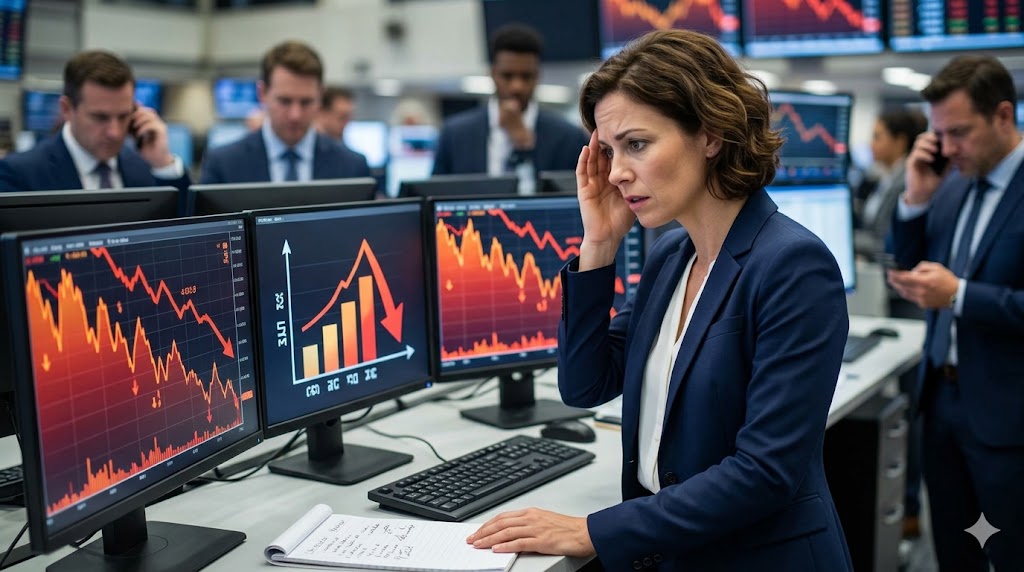
There are days when Wall Street receives good news and panics anyway. Last Friday was one of them. At 8:30 in the morning Eastern time, the U.S. Labor Department released its monthly employment report, and at first glance the numbers were excellent. The American economy had added 172,000 jobs in May, more than double the roughly 80,000 economists had penciled in. On paper, a reason to celebrate. Instead, one of the most violent sell-offs of the year tore through the market. The broad S&P 500 lost 2.64 percent to close at 7,383.74 — its worst single-day drop since October 10. The tech-heavy Nasdaq plunged an even uglier 4.18 percent, while the Dow Jones Industrial Average shed 695 points, or 1.35 percent.
How can a robust economy send stock prices tumbling? The answer lies in one of the oldest paradoxes in finance: sometimes good news is bad news. And on Friday that logic collided with a brutal collapse in semiconductor stocks to produce a perfect storm.
A labor market that simply will not cool
Start with the raw figures, because they tell the story of an economy running hotter than many would like. The 172,000 new jobs were broadly spread: leisure and hospitality added 70,000 (food services alone accounted for 48,000), local governments created 55,000 positions, health care contributed 35,000, and even manufacturing managed a gain of 7,000.
The unemployment rate held at 4.3 percent, exactly in line with expectations and historically low. And average hourly earnings rose 0.3 percent month-over-month and 3.4 percent year-over-year. That last figure is the sore spot. Wage growth above three percent is, for many central bankers, incompatible with a two-percent inflation target. As long as pay is climbing this fast, price pressure in the service sector stays elevated — and the Federal Reserve’s hands stay tied.
Why good news became bad news
The mechanism here is central for investors to understand. For months the market had been betting on a Fed rate cut. Lower rates make borrowing cheaper, fuel investment, and above all make richly valued growth stocks more attractive, because their future earnings are discounted less heavily. That hope was firmly priced in — only on Wednesday the S&P 500 had touched a record above 7,600.
The strong jobs report destroyed that narrative overnight. If the economy is generating this many jobs and wages are rising this fast, the Fed has no reason to cut — quite the opposite. In futures markets, the probability of a rate hike by year-end jumped above 60 percent, up from about 50 percent before the report. A cut is barely priced in anymore. Accordingly, the yield on the 10-year Treasury note surged to 4.54 percent. Rising bond yields are poison for equities: they raise corporate borrowing costs and make fixed-income a more appealing alternative to stocks.
The chip crash: $1.3 trillion in a single day
As much as the jobs report soured the mood, the real earthquake struck in semiconductors. Chip stocks shed roughly $1.3 trillion in market value in that one session. The closely watched Philadelphia Semiconductor Index (the SOX) suffered its largest percentage decline since the COVID crash of March 2020.
The list of losers reads like a who’s who of the AI revolution. Nvidia, the most valuable company in the world, fell 6.2 percent. The second tier was hit even harder: Intel, Micron, AMD and Broadcom dropped between 7.9 and 13.3 percent. The avalanche had already been triggered earlier in the week by Broadcom’s disappointing results, which raised doubts about demand for custom AI chips. Friday poured fuel on the fire: higher rates always hit the most expensive, highest-multiple growth segments hardest — and no segment has run hotter in 2026 than AI semiconductors.
This is the second warning in a single week. First Snowflake jumped 25 percent, then Broadcom fell 14 percent despite 143 percent AI growth, and now the broad sector crash. The market is reappraising the AI story in real time — moving from unconditional enthusiasm to a harder question: what actual profit will those astronomical investments produce?
What it means for investors
No portfolio can fully escape this undertow. Investors holding U.S. megacap tech felt the pain directly, but the ripple effects reach every market. European chip names such as the Dutch equipment giant ASML — effectively the beating heart of all modern chip manufacturing — and Germany’s Infineon are the most sensitive gauges of sector sentiment and will likely open under pressure. Even broad index funds tracking the S&P 500 or the Nasdaq 100 will register a meaningful one-day mark-down, a reminder that passive does not mean immune.
On the other side of the ledger sit the beneficiaries of higher rates. Banks such as JPMorgan and insurers earn more as yields climb, because they can reinvest their portfolios and price their loans at higher rates. The broader lesson for any globally diversified investor is sobering: when the Fed keeps rates high, it pressures other central banks — from the European Central Bank to the Bank of England — to rethink their own easing plans, and currency and bond markets transmit that shift instantly across borders.
Warsh’s first test
Hovering over all of this is a political dimension. Later this month, Kevin Warsh chairs his first monetary policy meeting as the new head of the Federal Reserve. Widely regarded as a hawk, Warsh must now demonstrate, under the gaze of a jittery Wall Street, how he intends to handle an economy that simply refuses to cool. Every word, every hint about the future path of rates will be parsed obsessively. The jobs report did not make his job any easier: he can fight inflation and risk slowing the economy, or he can indulge growth and risk letting price increases return.
Risks, counterarguments and outlook
For all the drama, a sober view is warranted. A single trading day does not make a bear market, and a single jobs report does not define a rate cycle. It is entirely possible that the May figures were inflated and will be revised lower in the coming months — with these volatile first estimates, downward revisions are more the rule than the exception. A sharp bounce after a day in which the Nasdaq fell more than four percent would also be nothing unusual.
What matters is the bigger picture. We are witnessing the transition from a market that celebrated every piece of good news as an argument for cheaper money to a market that must relearn how to value a strong economy without the prospect of rate cuts. That adjustment is rarely smooth. For long-term investors, the most important lesson of this week is not the one crash day but the reminder of how dependent lofty valuations are on cheap money. Those who stay broadly diversified and keep a steady hand will ride through such sessions. Those who bet on individual, expensively valued AI plays are getting a harsh lesson in risk — and in the old truth that nothing on the market is as costly as a priced-in expectation that fails to materialize.
Try TradingView Free for 30 Days
Plus get a $15 discount on your first subscription through this link.