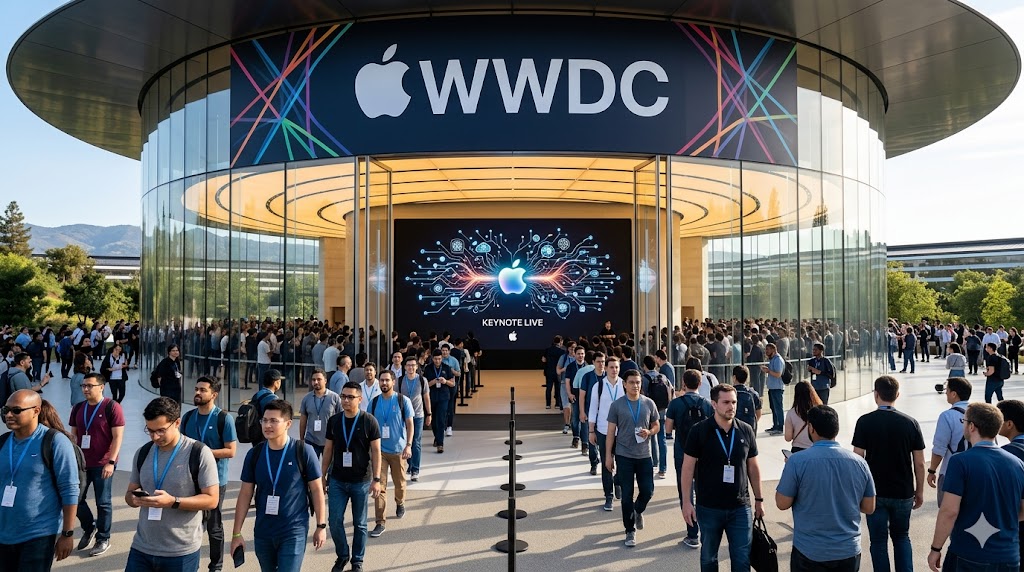
When Tim Cook walks onto the stage in Cupertino on Monday at 10 a.m. Pacific time, the stakes will be far higher than a routine software refresh. Apple’s Worldwide Developers Conference 2026 has become arguably the most consequential keynote the world’s most valuable company has delivered since the iPhone itself — because Apple now has to prove it still belongs in the artificial-intelligence era at all. Two years after an AI promise it spectacularly failed to keep, investors, developers and more than a billion iPhone users are watching for the answer to a single question: has Apple closed the gap, or will this keynote permanently cement its reputation as the industry’s AI laggard?
Why this keynote became a make-or-break moment
For Apple, the setup is unusually tense. For years the company set the tempo of the entire technology industry: whoever unveiled an iPhone defined the market. But the generative-AI boom — ignited by OpenAI, driven forward by Google and Anthropic — scrambled the pecking order. While Microsoft, Alphabet and Nvidia multiplied their valuations riding the AI wave, Apple looked strangely absent, a spectator on the sideline rather than the player setting the pace.
That is precisely why WWDC 2026 carries weight for the stock that goes well beyond the usual update cycle. Morgan Stanley called the event a “key catalyst” that would decide Apple’s entire AI investment story. Analyst Erik Woodring drew the parallel to WWDC 2024, after which the stock outperformed the broader market by roughly 20 percentage points. Pull off a similar re-rating, and the shares could become one of the year’s standout winners. Disappoint again, and the opposite looms.
The broken promise of 2024
To grasp why so much is riding on a single presentation, you have to rewind two years. At WWDC 2024, Apple unveiled a sweeping reinvention of Siri under the “Apple Intelligence” banner: the assistant was meant to understand a user’s personal context, take actions across multiple apps, and finally feel like a genuine digital aide rather than a dumb command box. The demos were dazzling — and they stayed demos.
The promised features, originally announced for iOS 18 in 2024, simply did not ship. Apple delayed the timeline again and again, wrestled with engineering hurdles, and ultimately had to concede that the overhauled Siri did not work. Only in February 2026 did the company deliver a portion of the capabilities — roughly 20 months after the original announcement. The reputational damage was real: in May 2026 Apple paid $250 million to settle a class-action lawsuit alleging false advertising and unfair competition. For a company that built its brand on the promise that things “just work,” that was a rare and painful blow.
The billion-dollar deal with its archrival
The most striking twist in the story: Apple is no longer building the new Siri alone. After years in which its in-house AI development failed to keep pace with Google, OpenAI and Anthropic, Apple struck a pact in early 2026 with a direct competitor — Alphabet. According to reports, Apple is paying roughly $1 billion a year to license a custom large language model from Google’s Gemini family, and that model is set to become the brain of the rebuilt Siri.
It is a remarkable admission. Apple, a company whose identity rests on vertical integration and control over every component of its products, is outsourcing the single most strategically important technology of the decade to a rival. Critics read it as capitulation; optimists as the pragmatic call of a company that would rather buy a working product from Google than ship a broken one of its own. The economic logic is hard to dispute: $1 billion a year is a rounding error for a company that earns more than $90 billion annually — and a bargain measured against the risk of being left behind in the AI race.
The race Apple has to catch up to
To gauge the urgency, it helps to look at the competition. Google has woven Gemini deep into Android, Search and its entire Workspace universe; its assistant answers complex questions, summarizes documents and drives apps. OpenAI’s ChatGPT has long set a cultural standard against which every voice assistant is now measured. Samsung, meanwhile, aggressively markets its Galaxy devices around “Galaxy AI,” seizing the very selling point Apple once expected to own. While rivals shipped feature after feature, Apple was stuck at announcements.
That gap is more than an image problem. For a company whose business model rests on the regular device upgrade, a missing “killer feature” is a real threat to the sales cycle. If customers see no compelling AI reason to buy a new iPhone, they stretch how long they hold their devices — and Apple is already feeling exactly that in several markets. WWDC therefore has to do more than thrill developers; it has to deliver a narrative that moves ordinary consumers to upgrade. That is precisely where the commercial stakes of Monday night lie.
What Apple is actually expected to show
On substance, observers expect a dense agenda. Apple is likely to unveil the next generation of its operating systems — iOS 27, iPadOS 27, macOS 27, watchOS 27, tvOS 27 and visionOS 27 — all threaded with new AI features. At the center sits the rebuilt Siri.
Apple reportedly plans a dedicated Siri app with an “Extensions” feature that spans iPhone, iPad and Mac. Users will be able to interact with the assistant in both voice and text — with access to their full conversation history, much as they already do with ChatGPT or Gemini. The most intriguing detail: Siri is expected to be able to hand certain questions off to third-party chatbots. If a user has Anthropic’s Claude or Gemini installed on the device, Siri can route more complex queries to those services. In doing so, Apple transforms its assistant from a closed system into a kind of broker — a switchboard that calls up whichever AI is best suited to the task at hand.
That approach marks a philosophical break. For years Apple insisted that the best experience could come only from a seamlessly controlled ecosystem. A Siri that routes requests to external models tacitly concedes that no single provider — not even Apple — leads in every discipline. For users that could be a win: they would get an assistant not bound by the limits of one technology. For Apple’s self-image it is a striking change of heart — and for privacy advocates a point the keynote must address convincingly, because Apple spent years building its brand on the promise of maximum privacy.
The numbers behind the hype
The market has already priced in some of the optimism. Heading into the conference, Apple stock trades near $315, up roughly 13% year to date, with about 15% of that gain coming in May alone. Market capitalization sits at around $4.6 trillion; the gross margin runs near a hefty 48% — Apple remains a money-printing machine regardless of the AI debate.
Analyst expectations are split but lean optimistic. Morgan Stanley sees a successful event re-rating the stock toward $365 to $385, with a bull case reaching as high as $440. Some houses peg the potential share-price contribution of a convincing AI and Siri strategy at $75 to $100 per share. Bank of America estimates Apple could generate between $15 billion and $30 billion in AI-related revenue by fiscal 2030. The psychology is decisive: because expectations are subdued after the 2024 debacle, a solid, credible product may be all it takes to trigger a positive re-rating.
Implications for the market and the supply chain
A successful AI showing from Apple would resonate well beyond its own stock. The most direct beneficiaries are suppliers and technology partners. Chipmakers such as Qualcomm, Broadcom and Skyworks feed components into countless Apple devices; a fresh device-and-upgrade cycle, sparked by compelling AI features, would lift the entire semiconductor supply chain. TSMC, which manufactures Apple’s most advanced silicon, would see demand for its leading-edge nodes climb if a new wave of AI-capable iPhones drives an upgrade super-cycle.
The interplay with Alphabet is equally worth watching. If Google’s Gemini model proves itself inside Apple’s ecosystem, it would be a powerful endorsement for Google — and a signal that the major AI providers are increasingly becoming infrastructure suppliers to the entire industry. For investors who hold diversified technology exposure through index funds, WWDC therefore doubles as a sentiment test for the whole AI complex. And for the broader narrative, a win for Apple would reassure a market still rattled by the previous week’s brutal sell-off that AI-driven growth remains intact.
The risks and the bear case
As alluring as the bull scenario sounds, the skeptics have solid arguments. First, the bar is high: with the stock already up 15% in May, part of the hoped-for success is baked into the price. A merely “solid” update could be read as a disappointment — on Wall Street, what matters is not absolute performance but performance relative to expectations. That very pattern recently caught Lululemon and Broadcom, whose strong numbers were still met with sharp sell-offs because expectations had run even higher.
Second, the strategic dependence on Google is a double-edged sword. Sourcing the heart of your flagship product from a competitor means ceding control — over the roadmap, the pricing, and ultimately the user experience. Third, AI monetization at Apple remains unproven. Unlike cloud providers that sell AI directly, Apple has to recoup value indirectly — through higher device prices, longer retention and new services. Whether and how quickly that works is an open question. And finally there is the reputational risk: a second broken promise after 2024 would not merely delay a feature but undermine the credibility of the entire AI strategy.
Outlook: what to watch on Monday
For investors, it pays to judge the keynote less by showmanship than by three sober criteria. First: does Apple deliver features available now, or at least with a concrete, credible date — rather than another round of vague promises for “later this year”? Second: how elegantly does Apple integrate the borrowed Gemini technology, without the new Siri feeling like a bolted-on ChatGPT clone? Third: is there a discernible path to monetization that goes beyond the pure wow factor?
It also helps to look beyond the first few minutes of trading. Apple stock often moves erratically on keynote day as traders react to individual headlines before the full picture is clear. The genuinely meaningful move frequently comes in the days that follow, once analysts adjust their models and developers test the new interfaces. Investors should therefore resist drawing hasty conclusions from short-term swings — what matters is whether the features actually reach devices in the coming weeks and whether developers start building on them. A vibrant app economy around the new Siri would be the most convincing sign that this time Apple delivered more than a demo.
WWDC 2026 is no ordinary developer event. It is the moment that decides whether Apple can flip the AI narrative and transform itself from laggard to credible contender — or whether the image of a company that slept through the most important technology trend of the decade hardens into permanence. On Monday, Tim Cook will not just be unveiling software. He will be answering a four-trillion-dollar question.
Try TradingView Free for 30 Days
Plus get a $15 discount on your first subscription through this link.