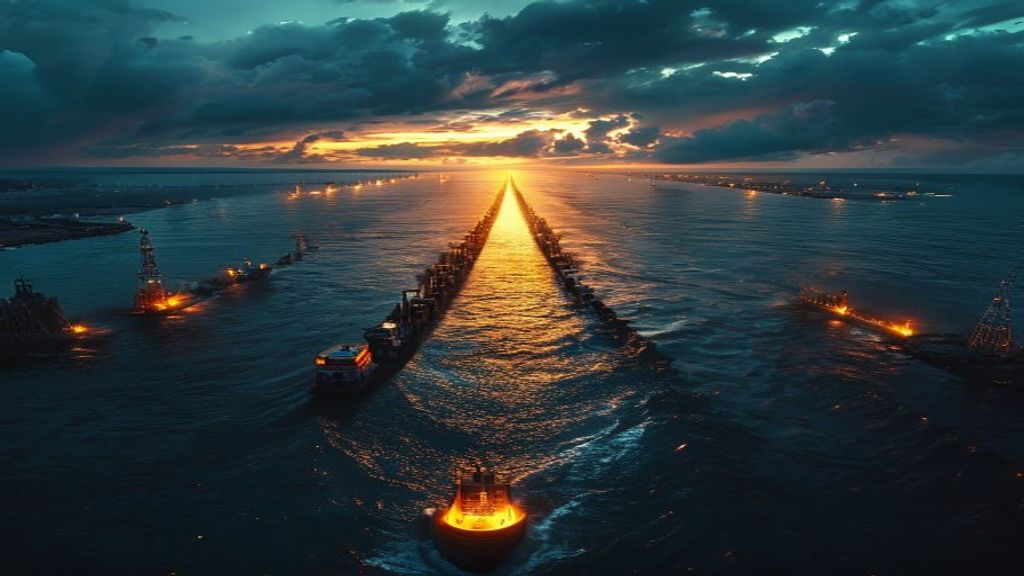
A Chokepoint Becomes a Tollbooth
Some sentences rebuild an oil market in seconds. This week’s runs, in effect: the United States declares itself the “Guardian of the Strait of Hormuz” and demands twenty percent on every cargo that passes through it. On Monday, President Trump announced that Washington would reinstate a blockade of the waterway and levy a fee equal to a fifth of the value of all cargo shipped through it. According to U.S. Central Command, the regime is set to take effect at 4 p.m. Eastern on Tuesday. A geopolitical threat has just been given a price tag.
For markets, this is something different from the usual oil shock. A war lifts prices because it endangers supply; here, the world’s single most important oil chokepoint is being converted into a tollbooth — permanent, calculable, monetized. That structure is what is new, and it is what forces markets to price in a risk premium that does not simply evaporate when the headline fades. July 14 is therefore less a news day than a regime change in how investors think about energy, freight, and inflation.
What Trump Actually Announced
The core message is as simple as it is consequential: the U.S. would be “reimbursed” for its services as guardian of the strait at a rate of twenty percent on “all cargo shipped.” Translated into numbers, market-side calculations put that at roughly $32 million on a single supertanker at current oil prices. For comparison, the tolls Iran itself had reportedly been charging for passage ran as high as $2 million. The American levy would therefore be about fifteen times what Tehran was asking — a qualitative jump, not an incremental one.
It followed an escalation spiral. Iran’s Revolutionary Guards, after an attack on a commercial vessel and U.S. retaliatory strikes, had declared the Strait of Hormuz closed “until further notice.” Washington turned that on its head, declaring the waterway its own responsibility: it would stay open, with or without Iran — but for a fee. The International Maritime Organization responded immediately and unambiguously: “There is no legal basis through which to introduce mandatory tolls simply to transit through a strait.” The United Nations Convention on the Law of the Sea guarantees the right of transit passage — a right, not a purchase. The toll, then, is not merely a price; it is a legal fight waiting to happen.
Why This Particular Strait Moves Everything
The Strait of Hormuz is not just any sea lane. Roughly a fifth of the world’s seaborne oil flows through it, along with a substantial share of liquefied natural gas, much of it from Qatar. At its narrowest it is only about 33 kilometers wide; the actual shipping lanes are barely three kilometers in each direction. There is no quick detour: the Saudi and Emirati pipeline bypasses can absorb only a fraction of the roughly 20 million barrels a day that transit here. To make Hormuz more expensive is to make a fifth of the world’s oil supply more expensive.
That is precisely why a toll is so economically potent. It does not have to stop the flow to bite — it only has to make it dearer. Twenty percent on cargo travels into the final price through higher charter rates, insurance premiums, and reroutings. And because the chokepoint has no real alternative, that premium cannot simply be optimized away. The market understands this: it is not pricing a one-off shock, but a structurally higher floor for crude and ocean freight.
The Numbers: Oil Leaps, Stocks Split
The reaction in commodities was violent. On Monday, Brent crude surged around 9.5 percent to trade above $83 a barrel; U.S. benchmark WTI cleared $78. For Brent it was the largest single-day jump since May 2020, and the close stood more than ten percent above Friday’s level. On Tuesday the move extended: Brent pushed into the mid-$80s — variously quoted between $86 and $87, a one-month high — while WTI traded in the high $70s toward $80. For context, Brent had been below $70 in late June, and the peak of the May conflict was above $111. This is a sharp re-escalation off a lull, not a fresh record.
Equities split — and that split is itself revealing. On Monday the S&P 500 closed 0.79 percent lower at 7,515, the Nasdaq Composite lost 1.55 percent to 25,873, and the Dow Jones slipped 0.26 percent to 52,499, after setting a record close of 53,056 on July 6. On Tuesday, futures were mixed: Dow contracts modestly lower, the S&P roughly flat, and the tech-heavy Nasdaq futures actually higher. This was not a clean risk-off session — energy names rallied while airlines and rate-sensitive stocks lagged. The broad market was up about ten percent for 2026 and priced for calm, with the VIX loitering near 15. It is exactly that complacency that a toll on the world’s oil challenges.
Who Wins and Who Pays
The clearest winners sit not with the oil majors but with the tankers. A blockade plus a toll drives charter rates and ton-miles higher — the longer and riskier the route, the higher the freight. The listed tanker owners were already having a strong year before this escalation: Frontline was up roughly 57 percent in 2026 at times, Scorpio Tankers around 50 percent. In an environment where freight is being made artificially expensive, they are the purest expression of the theme; DHT Holdings and International Seaways sit in the same basket. Among the oil majors, the reaction tracks price beta: Occidental Petroleum carries the highest oil-price beta among U.S. producers and jumped around four percent on the earlier spike, while ExxonMobil rose about three percent and Chevron roughly two.
The losers are the usual suspects of an oil shock. Airlines are the sharpest — jet fuel is a huge, non-hedgeable slice of the cost base, and carriers like Delta and United move inversely to crude. Cruise operators, energy-intensive manufacturers, chemicals and fertilizer producers all pay the tab. Defense names such as Lockheed Martin, RTX and Northrop Grumman tend to firm on any Middle East flare-up. For the tax framing that matters to U.S. investors, long-term capital gains and qualified dividends are taxed at preferential federal rates of 0, 15 or 20 percent depending on income, with an additional 3.8 percent net investment income tax at higher brackets — a reminder that after-tax positioning, not just the headline trade, is what compounds.
The Tanker War as a Historical Blueprint
To grasp what a durable premium on Hormuz does, it helps to look back four decades. In the “Tanker War” of the 1980s, during the Iran-Iraq conflict, hundreds of ships were attacked in the Gulf — and the real market effect played out not at the wellhead but through the insurers. War-risk premiums for a Gulf transit exploded, owners demanded surcharges, and crude carried those add-ons for months. That same transmission mechanism now threatens to repeat, except this time the surcharge does not come from private underwriters; it is imposed by decree as a state toll — predictable, but also permanent.
For the mechanics of freight, this means the effect of a toll is larger than the nominal 20 percent suggests. Owners fearing liability and seizure risk will avoid voyages or offer them only against generous surcharges; insurers tighten war-risk clauses; individual cargoes get rerouted around the Cape of Good Hope, inflating ton-miles and therefore effective freight rates further still. Each of these channels amplifies the others. That is why tanker equities react not linearly but in leaps during such phases: it is not the volume of oil transported that rises, but the price that scarce, risk-tolerant tonnage can command. For the investor, that is the real lesson of the 1980s — the second derivative, the rate at which shipping is getting more expensive, moves the stocks more than the oil price itself.
The Real Force: Collision With Inflation Week
The timing is anything but incidentally explosive. The toll lands in the exact week markets wanted to declare inflation beaten. On Tuesday morning the June Consumer Price Index was released; economists expected a 0.2 percent decline from the prior month, which would be the largest monthly drop since April 2020. But here is the trap: June CPI is backward-looking. It cannot capture an oil shock that begins in July. A soft print is therefore a mirage — the toll is a forward inflation impulse, one that seeps into the core rate through freight, airfares, plastics and fertilizer with a lag.
For the central bank, this is the most uncomfortable kind of inflation. Fed Chair Kevin Warsh, who scrapped forward guidance and is regarded as hawkish, is holding the funds rate at 3.50 to 3.75 percent, and traders had been lifting their bets on another hike. An oil-driven price surge raises headline inflation while dragging on growth — the classic stagflation bind that narrows the path to cuts. The next FOMC meeting is July 28–29, with no new dot-plot. And the same morning brought the start of Q2 bank earnings — JPMorgan, Goldman Sachs, Wells Fargo and Citigroup — a second swing factor layered on top. But the toll is the structural story; the banks are the sideshow.
The Counterarguments — Why the Premium Could Fade Fast
As forceful as the headline is, investors should be wary of linear extrapolation. First, the toll may be a negotiating gambit rather than a durable regime; maximalist openers walked back within days are not a new pattern. Second, the legal basis is contested — the IMO points to the law of the sea, and it is entirely unclear who collects the fee, how it is enforced, and whether allies comply. Third, the oil market is more resilient to supply shocks than in previous decades: U.S. shale, the Strategic Petroleum Reserve and OPEC spare capacity cushion the blow, and the United States is a net energy exporter, which relatively insulates it.
And finally, the iron law of every oil shock applies: too high a price destroys its own demand. Brent north of $90 slows the very growth that underpins the record rally — the energy trade can reverse if the shock persists and the economy buckles. Because the entire episode hangs on headlines, a single de-escalation report can unwind the premium within hours. Anyone piling into oil longs today is betting not on fundamentals but on the next dispatch from the Gulf.
Conclusion: A Premium to Respect, Not to Chase
July 14 marks less a single spike than a shift in base assumptions. When the world’s most important oil chokepoint becomes a tollbooth, a structural risk premium migrates into crude and ocean freight — favoring energy and tanker names, burdening airlines, consumers and industry, and stripping optionality from central banks on both sides of the Atlantic. That is the story behind the story: not the one-day leap in Brent, but the prospect of a permanently higher floor.
For investors, the sober response is posture, not panic. Energy exposure can serve as a hedge against precisely this scenario, tankers are the most direct expression of it, and the spread worth watching is the one between a soft, backward-looking CPI and a hardening, forward-looking oil impulse. What is not worth doing is chasing a headline that may be retracted by tomorrow. The market has just learned that a strait can carry a price tag, too — and the cooler heads are not asking how big today’s jump is, but how long the toll stands.
Try TradingView Free for 30 Days
Plus get a $15 discount on your first subscription through this link.
Read more in our topic hub: Topic Hub: Geopolitics & Your Portfolio