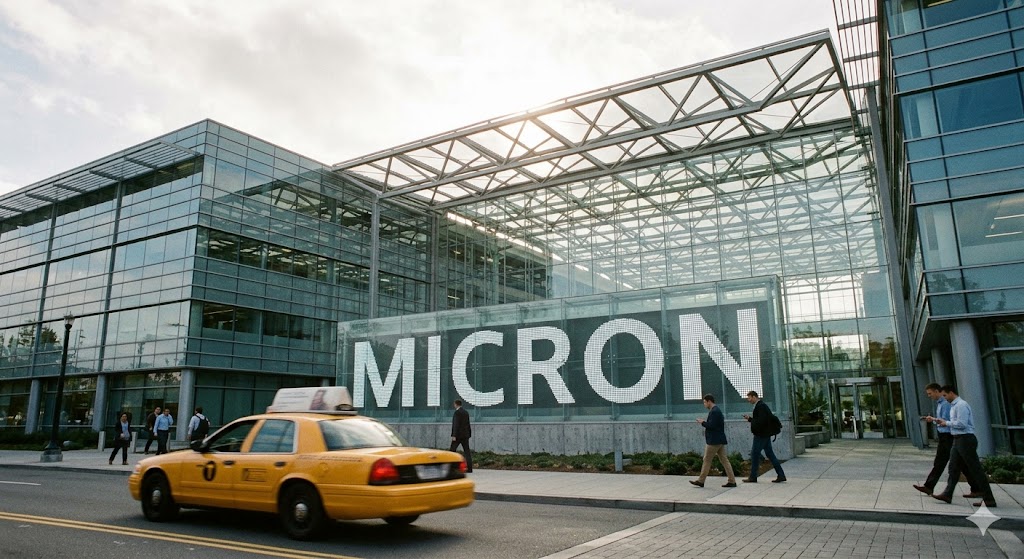
Early Thursday it was as if someone had quietly pulled the plug on fear. Less than 48 hours earlier the Nasdaq Composite had been rattled by a violent shudder, driven by the dread that the hyperscalers’ colossal artificial-intelligence spending might never pay off. Now futures on the Nasdaq 100 leapt 1.8 percent, S&P 500 contracts added better than half a percent, South Korea’s Kospi briefly surged six percent, and the entire Asian session turned green. The catalyst for this abrupt reversal of mood carries a name that barely registered on most retail investors’ radar two years ago: Micron Technology.
The largest US maker of computer memory reported results after Wednesday’s closing bell that obliterated even the most bullish expectations — and the stock jumped double digits in extended trading, somewhere between 13 and 15 percent depending on the data point. In the span of a single session, the narrative of the week has flipped on its head: “the AI bubble is bursting” has become “AI demand is real and accelerating.” For investors who panic-sold chip and memory names over the past few days, it is a painful lesson in the perils of market timing.
What Micron actually reported
The raw numbers explain why the reaction was so violent. In its fiscal third quarter Micron earned 25.11 dollars per share, against an analyst consensus of roughly 19.80 to 20.30 dollars. Revenue climbed to 41.46 billion dollars, comfortably clearing the consensus estimate of around 34.8 to 35.7 billion. The company described records in revenue, gross margin and earnings per share — all above the high end of its own guidance.
More striking than the rear-view mirror, though, was the outlook. For the current fiscal fourth quarter Micron guided to revenue of 50.0 billion dollars, plus or minus a billion. It projected a GAAP gross margin of roughly 86 percent and adjusted earnings of about 31 dollars per share. To put that in perspective, an 86 percent gross margin is the sort of figure you expect from a software house, not from a manufacturer of physical semiconductors that sinks billions into cleanrooms and fabrication plants. The fact that a memory producer — historically the most cyclical, lowest-margin corner of the chip industry — is posting numbers like these is the genuine sensation.
The engine behind it is a shortage the market has not seen in years. Because the price of memory chips has gone through the roof, Micron’s revenue has effectively quadrupled year over year. The data-center business alone contributed more than 25 billion dollars in the third quarter, an annualized run rate north of 100 billion dollars. A few years ago that figure was the company’s entire annual revenue.
Why HBM is the real engine
At the heart of this story sits an acronym: HBM, short for High Bandwidth Memory. This vertically stacked specialty memory sits right beside every modern AI accelerator and determines how fast a data center can shuttle the enormous volumes of data that large language models demand. Every Nvidia accelerator in the H200, GB200 and the forthcoming Blackwell Ultra generation is fitted with HBM — and Micron’s entire HBM output for the current year is already sold out and contractually committed. Volume shipments of the fourth HBM generation, HBM4, began in the first calendar quarter of 2026 for Nvidia’s coming Vera Rubin platform.
That changes the investment logic fundamentally. For decades memory makers were the plaything of a brutal boom-bust cycle: in good times everyone built capacity, in bad times prices collapsed, and the shares tracked the swings. HBM breaks that pattern, because capacity is booked years in advance and the technical barrier to entry sits so high that only a handful of suppliers worldwide can keep pace at all. Some analysts now project that Micron’s net income in calendar 2026 and 2027 will be exceeded only by Nvidia within the Philadelphia Semiconductor Index. A cyclical laggard has become a structural bet on AI infrastructure.
The mood swing of a single week
To grasp the ferocity of the reaction, you have to recall how grim the picture looked just hours earlier. Earlier this week the S&P 500 lost 1.44 percent in a day and the Nasdaq Composite 2.21 percent — led precisely by the AI infrastructure names that are now being celebrated again. The trigger was mounting skepticism over whether the hundreds of billions Microsoft, Amazon, Alphabet and Meta are pouring into data centers will ever generate an adequate return. Only on Tuesday had S&P Global announced that Alphabet would replace Verizon in the Dow Jones at the start of the new week — a symbolic triumph for the tech giants that nearly drowned in the risk aversion of the preceding days.
Micron now hands the bears an uncomfortable answer to those doubts: demand for AI hardware is not merely intact, it is outstripping supply so decisively that prices are exploding. When a supplier at the bottom of the value chain — memory is the ultimate commodity — earns margins like these, then the hyperscalers’ capital-expenditure boom is plainly no flash in the pan. It was precisely this logic that drove the futures higher on Thursday and sent investors scrambling to buy back the very shares they had dumped the day before.
The second tailwind: oil in free fall
It was not only the chips, though, that delivered relief. Alongside the Micron rally, the price of oil tumbled to its lowest level since the US-Iran war erupted nearly four months ago. US benchmark WTI fell around 4.4 percent and slipped below 70 dollars a barrel for the first time since the war began, while global benchmark Brent shed roughly 4.6 percent to around 73.50 dollars. Crude has now fallen nearly 40 percent from its wartime peak.
The driver is growing confidence that the ceasefire between Washington and Tehran will hold and that the Strait of Hormuz — through which a substantial share of the world’s oil transits — is returning to normal traffic. The International Energy Agency estimates that the United Arab Emirates alone is again exporting at nearly 85 percent of its pre-war volume. For equity markets, cheap oil is a double blessing: it dampens inflation, which gives central banks room to maneuver, and it relieves consumers and businesses on energy costs. For the US consumer, who feels every move at the gas pump in real time, falling crude is one of the most direct boosts to discretionary spending there is.
The shadow over the day: the PCE print
For all the euphoria, a risk lurks on this Thursday that could topple the good mood at any moment. At 8:30 a.m. Eastern the Commerce Department releases the May PCE inflation data — the price gauge the Federal Reserve prefers above all others. The expectations are uncomfortable: the headline rate is seen climbing to 4.1 percent year over year, up from 3.8 percent in April. Core inflation, stripping out food and energy, is pegged at around 3.3 percent, with a comparatively hot monthly reading of 0.37 percent.
This is the awkward flip side of the rally. Under new Fed Chair Kevin Warsh, the central bank has lifted its own core-PCE projection for 2026 from 2.7 to 3.3 percent and does not expect a return to the two-percent target before 2028 at the earliest. At the latest meeting the committee was split almost down the middle on whether rates should rise or hold steady — partly because Warsh pointedly withheld his own forecast. Should the PCE data confirm the inflation worries, hopes for rate cuts could take another hit, and today’s relief rally would rest on shaky ground. Cheap oil colliding with sticky core inflation produces a contradictory picture the markets will still have to work through.
The names US investors should watch
For American investors the question is how to play this theme without blindly chasing a single stock. Micron itself trades on every major venue, but the memory boom radiates far beyond the company. The most direct beneficiaries are its peers and the broader supply chain. Nvidia remains the gravitational center of the trade, with AMD and Broadcom close behind on the logic side. On the memory side, Micron’s chief rival is South Korea’s SK Hynix, while Western Digital and the recently independent Sandisk play in the storage adjacencies.
Further up the chain sit the equipment makers without whom none of this is possible: Lam Research and Applied Materials build the etch and deposition tools, while the Netherlands’ ASML supplies the lithography machines no advanced chip — and no HBM stack — can be made without. And do not overlook the downstream beneficiaries: server builders such as Dell and Super Micro, which assemble the AI systems these chips ultimately feed. For those who prefer not to pick a single winner, semiconductor ETFs tracking the Philadelphia Semiconductor Index bundle Micron, Nvidia, AMD and the equipment names into one basket, spreading the single-stock risk. Because as seductive as the numbers sound, a memory stock remains a memory stock, and the next cycle always comes.
The risks drowned out by the euphoria
That is exactly where the caution lies. The history of the semiconductor industry is a graveyard of investors who bought at the top of the cycle. Memory prices that are exploding today because capacity is scarce can collapse tomorrow, the moment manufacturers ramp their fabs and supply catches up with demand. The quadrupling of revenue is impressive, but it is also the product of extraordinary scarcity pricing that, by definition, does not last forever.
On top of that sits the overarching question that ignited the fear in the first place this week: will the hyperscalers sustain their hundred-billion-dollar AI budgets if the return on investment fails to materialize? Micron proves the demand is here today — it says little about tomorrow. Should Microsoft, Amazon or Meta so much as hint at trimming their investment plans, it would hit memory makers with full force. And finally there is the valuation. A stock that has risen roughly 300 percent in a year already prices in a great deal of optimism. Today’s rally piles more on top — anyone buying now should be clear-eyed about the thin margin of safety.
The bottom line: a reality check, not a free pass
Micron’s results are perhaps the single most important data point of the week, because they answer a fundamental question on which the entire AI rally hinges: is demand for compute real and affordable enough to justify the exorbitant spending? The answer, for the moment at least, is unambiguously yes. When the most unglamorous building block in the supply chain — memory — throws off margins like these, the boom is more than collective imagination.
But the market would not be the market if it did not deliver a warning in the same breath. The reality check Micron has passed is good for today. By the afternoon the PCE data could tell an entirely different story, and the next memory cycle will eventually point down again. For investors the message is this: the mood swing of this week is a reminder of how quickly panic turns to euphoria on the exchanges — and how rarely it pays to chase either move headlong. Anyone who wants to play the AI memory boom is best served doing so with a clear head, broad diversification, and the knowledge that every supercycle is eventually followed by the hangover.
Try TradingView Free for 30 Days
Plus get a $15 discount on your first subscription through this link.