
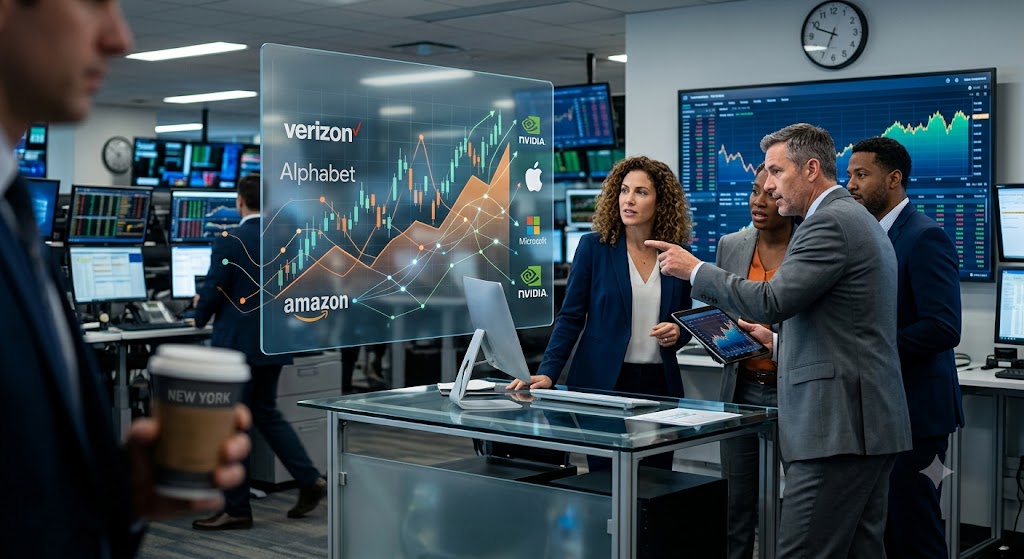
There are moments when a single sentence buried in a press release tells you more about the state of the markets than any single day of price action. One of those sentences arrived on Monday, June 23, 2026, courtesy of S&P Dow Jones Indices: before the opening bell next Monday, June 29, Alphabet — the parent of Google — will be added to the Dow Jones Industrial Average, displacing Verizon Communications. With that, the internet company that many were writing off as an artificial-intelligence laggard barely a year ago joins the club of thirty stocks that has stood as shorthand for the American corporate establishment since 1896.
The symbolism could hardly be sharper. Alphabet is being knighted as a blue chip in the very week Wall Street is busy punishing the entire technology complex — the company itself shed roughly $250 billion in market value last Monday, and chipmakers tumbled by double digits the following day. The Dow, that venerable, price-weighted yardstick that once tracked steel, railroads and oil, completes with this swap the transformation it has long been undergoing: it is now, more than ever, a barometer for artificial intelligence. That, not the headline itself, is the real story.
What Actually Happens on June 29
The mechanics are quick to describe; the consequences are not. At the open on Monday, June 29, Alphabet’s Class A common stock (ticker GOOGL) replaces Verizon in the Dow Jones Industrial Average. S&P Dow Jones Indices justified the move by saying that “its larger market capitalization and share price, together with the breadth of its businesses,” make Alphabet “a more representative Communication Services constituent in the DJIA.” In the same breath, the index provider clarified that Honeywell — which after spinning off its aerospace arm will trade as Honeywell Technologies — stays in the Dow.
It is the first change to the Dow’s composition since 2024. Back then, Nvidia took Intel’s seat and Sherwin-Williams replaced the chemicals group Dow Inc.; a few months earlier, Amazon had stepped in for the drugstore chain Walgreens. Each of those moves told the same story of a slow drift away from old-line industry toward technology and consumer names. Alphabet’s addition brings that evolution to a provisional climax — and to a genuine historical milestone, which we will come back to shortly.
Why a Share Price Alone Decides the Power
To understand why this swap is more than a cosmetic tweak, you have to know a quirk of the Dow that sets it apart from virtually every modern index: it is price-weighted. A company’s influence is not determined by its size as measured by total market value, but simply by the nominal price of a single share. A stock trading at $300 moves the Dow about six times as much as a stock at $50, regardless of which of the two underlying companies is actually worth more.
That is precisely where the drama lies. Verizon, now departing, recently traded near $46, representing barely half a percentage point of the index — its influence on the daily move was effectively negligible. Alphabet, by contrast, trades around $349. Overnight, the stock becomes one of the heaviest-weighted members of the entire index, inheriting many times the sway the departing telecom ever had. To keep the substitution from artificially distorting the index level, S&P Dow Jones Indices will adjust the so-called divisor before the open on June 29 — the figure used to convert the sum of all member share prices into the Dow’s point reading. The new divisor will be available in end-of-day index files starting June 26.
The Irony of the Timing
Few additions to the Dow have ever landed at a more awkward moment for the stock involved. Only last Monday, Alphabet lost roughly 6 percent — about a quarter of a trillion dollars in market value — after two high-profile researchers left its DeepMind AI lab, an episode that crystallized a much larger fear: that the enormous AI investments being made across Big Tech may never pay for themselves. The next day brought a bloodbath in semiconductors. Nvidia fell 4.2 percent, AMD 5.8 percent, Qualcomm 8 percent, and Micron cratered 13.2 percent. The Nasdaq Composite dropped 2.21 percent and the S&P 500 fell 1.44 percent, while the Dow — thanks to its old-economy heavyweights — finished nearly flat, off just 47 points at 51,665.
That coincidence is not accidental; it is revealing. At the very moment investors are collectively presenting Big Tech with the bill for its spending spree, the establishment of the index committee is elevating one of those very companies into Wall Street’s most exclusive circle. The stock responded with defiance: on the news of its Dow inclusion, Alphabet rose roughly half a percent, and a $400 price target was already making the rounds on social media. With a market capitalization of about $4.23 trillion, Alphabet is long since the second- or third-most valuable company on earth — and the $5 trillion club is now within reach.
For the First Time, All Five Giants at One Table
The genuinely historic aspect of this reshuffle is easy to overlook. With Alphabet’s entry, the Dow Jones Industrial Average will, for the first time ever, hold all five American technology giants simultaneously: Apple, Microsoft, Amazon, Nvidia and now Alphabet. Four of them have crossed the $4 trillion threshold in market value — a concentration of economic power inside a single index that has never existed before in this form.
For the Dow, that means a profound change in character. An index originally meant to capture the breadth of the American real economy — from the machinery maker to the consumer-goods conglomerate to the bank — is increasingly dominated by a handful of platform companies whose fates are tightly intertwined. When sentiment toward artificial intelligence rises or falls, these stocks tend to move in lockstep. The Dow thus becomes more correlated with the tech-heavy Nasdaq and sheds some of the defensive ballast that distinguished it for decades. The relative calm with which the Dow weathered this week’s tech sell-off may prove rarer in the future.
Verizon — the Dividend Payer Pushed Aside
Behind every addition stands a removal, and the case of Verizon tells its own story about the market’s tastes in 2026. The telecom is anything but a bad company: with a price-to-earnings ratio of about eleven, a dividend yield above six percent and an annual payout of $2.83 per share, Verizon is a textbook holding for income-oriented investors. Yet those very virtues — stability, a fat dividend, low share-price drama — are condemned to irrelevance in a market driven by growth fantasy and AI euphoria. Verizon’s low share price simply made it inconsequential to the price-weighted Dow.
This is a moment for American income investors to take stock. Verizon has been a staple of dividend portfolios and retirement accounts for a generation, prized precisely for the qualities the market now disdains. Its ejection from the Dow does not change the cash it sends shareholders every quarter, but it does carry a message: the market currently values reliable distributions less than the promise of boundless growth. Whether that is a shrewd or a dangerous stance will only become clear the next time AI euphoria is put to the test — which, as this week demonstrated, can happen faster than anyone expects. For those holding Verizon for its yield, the index change is noise; for those holding it as a proxy for safety, it is a reminder of how out of fashion safety has become.
What the Change Means for Index Investors
Here a dose of perspective is in order. Despite its fame, the Dow is a far less important benchmark for actual portfolios than its headlines suggest. The overwhelming majority of indexed money in 401(k) plans and brokerage accounts tracks the S&P 500, not the Dow; dedicated Dow funds such as the popular DIA exchange-traded fund are comparatively small. In the S&P 500 and the Nasdaq 100, Alphabet has long been a top-five holding — so for most investors, the company’s weight in their portfolio will not change one iota because of this swap. The mechanical buying triggered by Dow-tracking funds rebalancing into Alphabet on June 29 should be modest.
The more useful takeaway concerns concentration. With all five megacap names now anchoring the Dow as well as dominating the S&P 500, the typical American index investor is more exposed to a single theme — the fortunes of large-cap technology and AI — than at almost any point in market history. The top handful of stocks now account for a historically large share of the broad market. That is not in itself a reason to panic, but it is a reason to know what you own. An investor who believes they are diversified by holding an S&P 500 fund is, in practice, making a very large bet on a very small number of companies, all of them now riding the same AI wave. The Alphabet-into-the-Dow headline is best read as a symbol of that concentration, not as a buy or sell signal in its own right.
The Counterarguments — an Index From Another Era
As much as the addition is being celebrated, the skeptics have a point — several, in fact. First is the question of timing. Alphabet joins the Dow near an all-time high and in the middle of a bout of nervousness about AI valuations. Index committees are notoriously procyclical: they admit winning stocks at the peak of their fame and eject losers at the bottom. Studies have shown for years that newly added names often have their best performance behind them, while the discarded ones not infrequently go on to outperform. The ejection of Intel in favor of Nvidia at the end of 2024 is the textbook example — and a warning that membership in the Dow is no quality seal for future returns.
Second, price-weighting remains methodologically dubious. The idea that a company gains more influence simply because its shares carry a higher nominal price — rather than because it is economically more significant — is a relic of an age when index levels were computed by hand. A stock split, a purely cosmetic act with no economic substance whatsoever, can halve a company’s weight in the Dow overnight. And third, the addition sharpens the concentration problem: the more a handful of correlated tech giants dominate the index, the less it serves its original purpose of representing the breadth of the economy. Should the AI narrative break, the Dow would be markedly more vulnerable than it has been in the past.
The Outlook — Rebalancing, the $5 Trillion Club and Micron’s Test
Concretely, two independent events face the markets in the days ahead. The first is technical: with the divisor adjustment on June 29, every fund that tracks the Dow must rebalance its holdings — Verizon out, Alphabet in. Because pure Dow funds are relatively small compared with S&P 500 or Nasdaq products, the mechanical buying flows into Alphabet should stay contained; the bigger effect is the signaling. The second event is fundamental: today, June 24, Micron reports earnings after the close — the purest proxy there is for demand for AI memory chips. After this week’s brutal semiconductor sell-off, Micron’s numbers and, above all, its guidance will decide whether investors see their fresh skepticism toward the AI boom confirmed or whether it was overdone.
Step back, and Alphabet’s elevation to the Dow tells a larger story about this market. It marks the moment when even the most conservative symbol of the American stock market makes its peace with the dominance of the AI platforms — and, paradoxically, it does so just as the first real doubts about their limitless growth begin to surface. For long-term investors, the lesson is less spectacular than the headline implies: an index reshuffle changes nothing about the value of a company, and the Dow remains a historical curiosity, not a compass. The more important question is the one smoldering beneath all of it — whether the largest companies in the world will ever earn back the money they are pouring into artificial intelligence today. Alphabet celebrates its entry into Wall Street’s most exclusive club next week. Whether that proves a triumph or a top to sell into will be decided not by the index committee, but by cash flow.
Try TradingView Free for 30 Days
Plus get a $15 discount on your first subscription through this link.