
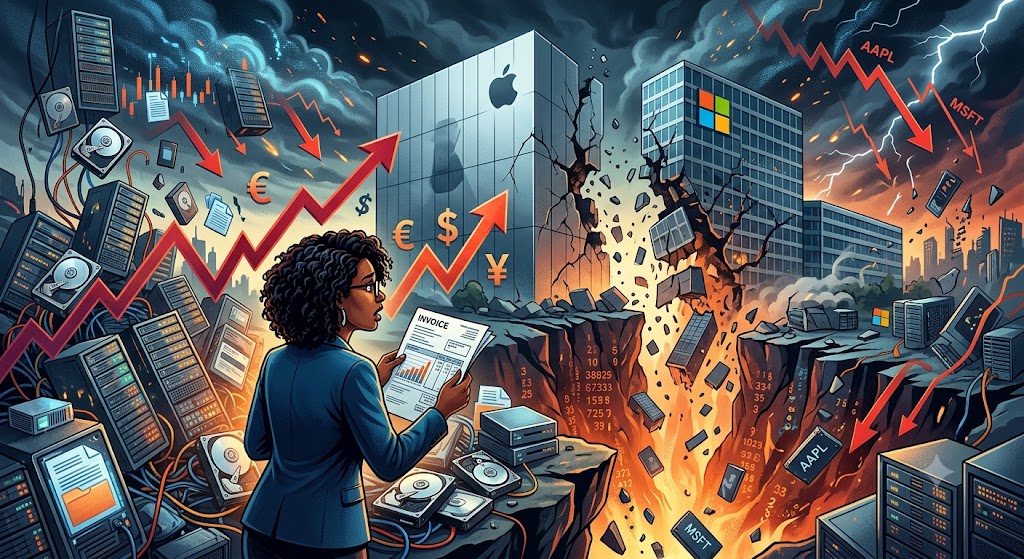
It is the punchline the skeptics of the AI boom have been warning about for months — and it hit the market with full force on Friday: the data centers’ insatiable hunger for memory is now showing up as a price markup on the receipts of ordinary consumers. Overnight, Apple raised prices across its Mac, iPad and home-device lineup and openly blamed surging memory costs. Microsoft lifted Xbox prices for the third time in 13 months. And on Wall Street, a one-day relief rally sparked by Micron’s record results curdled within hours into a broad selloff of the tech heavyweights. Apple posted its worst trading day in more than a year with a loss of roughly 6 percent, and in Asia South Korea’s Kospi cratered 8.8 percent, triggering a 20-minute emergency halt of trading.
The trigger: Apple and Microsoft pass the memory bill along
The spark was a piece of news so matter-of-fact it almost sounded harmless. Apple announced it would raise prices across its Mac and iPad ranges and on home products — by several hundred dollars at the top end. The 13-inch MacBook Air climbs from $1,099 to $1,299, the base iPad from $349 to $449, the iPad mini from $499 to $599, and the Mac Studio with the M3 Ultra chip leaps from $3,999 to $5,299. The iPhone, Apple Watch and AirPods were spared this round — but chief executive Tim Cook left no doubt that the situation was “unsustainable,” pointing explicitly to a shortage of high-bandwidth memory driven by AI-server demand.
Hours later Microsoft followed suit. Starting August 1, Xbox prices rise again — by $100 on the 512-gigabyte models and $150 on the one-terabyte versions, while the two-terabyte model is being discontinued entirely. It is already the third increase in just over a year. Microsoft put it bluntly: console storage and memory costs have risen more than two-and-a-half times, and it expects another doubling by the fall of 2027. Two of the most recognizable consumer-tech brands in the world admitted on the same day that they can no longer absorb the cost wave alone.
Background: the memory supercycle and its two faces
To understand why prices are breaking now, you have to look at the semiconductor market — specifically at a brutal fight over manufacturing capacity. The three big memory makers, Samsung Electronics, SK Hynix and Micron, are steering their limited cleanroom space and capital spending consistently toward the highest-margin product: HBM, the stacked high-performance memory that feeds AI accelerators. Every wafer that goes into an HBM stack for an Nvidia GPU is a wafer no longer available for the LPDDR module of a mid-range smartphone or the SSD of a consumer laptop. It is a zero-sum game — and the data centers are winning it.
This is precisely the irony of the memory supercycle: the very force that just handed Micron a record quarter and a $50 billion outlook this week is now squeezing the device makers’ margins. What began as a windfall for the chip producers turns into a burden one rung down the chain. By some estimates, data centers now consume roughly 70 percent of all memory chips produced worldwide. The consumer bears the consequences of a structural shift that analysts say is likely to persist well into 2027.
The numbers in detail: a price explosion without precedent
The scale is extraordinary even for a market accustomed to cyclical swings. Contract prices for conventional DRAM climbed an unprecedented 90 to 95 percent quarter-over-quarter in the first quarter of 2026 — and individual spot quotes rose by as much as 98 percent. For the current second quarter, the analysts at TrendForce forecast a further increase of 58 to 63 percent. NAND flash, the memory inside SSDs and consoles, rose 55 to 60 percent in the first quarter and is expected to climb even faster in the second, by 70 to 75 percent.
For manufacturers’ bills of materials, that is an earthquake. Memory is set to account for more than 20 percent of a notebook’s total component cost in 2026 for the first time. The big PC builders — Dell, Lenovo and HP — have already signaled that they must raise retail prices by 15 to 20 percent. TrendForce has cut its production forecasts accordingly: smartphone output is now seen shrinking 2 percent in 2026 rather than inching up, and notebook production is projected to fall 2.4 percent. Drawing on the 2016-to-2018 cycle, Morgan Stanley warns that industry median gross margins could collapse by up to 60 percent in 2026, with earnings per share running 11 percent below consensus.
How a rally turned into a rout
The market action of the past few days reads like a textbook on shifting sentiment. As recently as midweek, Micron’s blowout numbers had dispelled the AI fears of the prior sessions and fueled a relief rally. But the Apple news flipped the narrative overnight: suddenly the same memory boom was no longer a triumph but a threat to the margins of the most expensive stocks on earth. The S&P 500 fell to 7,325, down 0.44 percent, and the Nasdaq Composite slid for a fourth consecutive day. The megacap technology names were under pressure across the board: Apple down 6.1 percent, Microsoft down 3.5 percent, Amazon down 3.1 percent, Meta down 2.7 percent, Nvidia down 1.6 percent.
In Asia the reaction was even harsher. The Kospi plunged 8.8 percent and triggered a circuit breaker with a twenty-minute trading halt for the first time in ages, as index heavyweights Samsung and SK Hynix each fell nearly 10 percent. Both remain the heart of the memory boom — and yet they were sold as if AI exposure had become a liability rather than a strength overnight. Japan’s Nikkei 225 lost 3.4 percent. US futures pointed to a weak open on Friday morning: Nasdaq 100 contracts down 1.6 percent, S&P 500 futures down 0.7 percent. Adding to the unease was a report that OpenAI might delay its planned initial public offering, souring an already tense mood.
The stocks in focus: winners and losers on the US tape
For US investors the value is in the nuance, because the memory cycle sorts winners from losers cleanly. On the losing side sit the device makers and end-market names whose unit costs rise immediately — Apple and Microsoft are the headline cases, but the squeeze runs through Dell, HP and Lenovo on the PC side and Sony, whose PlayStation competes head-on with Xbox in a market where every console maker now faces the same component math. On the winning side sit those who supply the AI infrastructure: Micron, the memory maker that just printed a record quarter, plus Nvidia, whose accelerators command the scarce HBM, and the equipment suppliers benefiting from the building boom.
Spiral one step further and the picture sharpens. The memory producers — Micron domestically, Samsung and SK Hynix abroad — hold genuine pricing power in a shortage, even if Friday’s panic dragged them down with everything else. Storage specialists such as Western Digital and Sandisk ride the NAND wave. Investors who want broad exposure can reach for semiconductor ETFs, but the cleaner trade is to separate the supply side, which benefits from scarcity, from the demand side, which pays for it. Buying or selling “chips” wholesale misses that a massive redistribution of profits is under way inside the value chain.
The inflation shadow: a new hardware price wave
What makes this memory shock politically and monetarily fraught is its timing. The latest US inflation data showed a PCE price index of 4.1 percent, with the core rate at 3.4 percent — the highest since October 2023. Into that environment now lands a tangible hardware price increase. When notebooks, tablets and game consoles get more expensive across the board, that is not merely a problem for individual corporate balance sheets but a contribution to goods-price inflation that makes the central banks’ already difficult disinflation harder still.
The newly assembled Fed under Kevin Warsh has already lifted its core PCE projection for 2026 to 3.3 percent. Persistent price pressure from the electronics chain plays into the hands of the hawks who warn against premature rate cuts. For markets that is a double burden: higher input costs compress corporate margins, and the resulting inflation keeps rates higher for longer — a combination that has historically treated growth stocks especially badly.
Risks and counterarguments: panic or buying opportunity?
As dramatic as Friday looked, a sober reading is in order. The selloff does not prove the AI cycle is broken — it shows instead how quickly crowded positions become forced selling when rates, currency and chip sentiment turn against the trade at once. Apple and Microsoft are highly profitable companies with enormous pricing power; a few-hundred-dollar markup on premium devices lands on a customer base that has historically been relatively price-insensitive. The real question is whether volumes collapse — and here the forecast production declines of around 2 percent are noticeable but hardly a crash.
At the same time there is a bullish reading of the memory shortage: scarcity means pricing power for the makers and better visibility for the equipment suppliers. Investors who play the cycle from the supply side — memory producers, lithography, back-end equipment — could profit from the same trend that burdens the device makers. The skill lies in not confusing the two sides of the coin. Buying or selling chips indiscriminately overlooks that a massive redistribution of profits is happening right now within the value chain.
Outlook: the AI bill becomes visible
Friday marks a turning point in how the AI boom is perceived. Until now the narrative was one of seemingly limitless growth fantasies and record capital spending. Now the flip side is showing: the bill for building out AI infrastructure is no longer hidden abstractly in capex tables but appears concretely on the price tag of a MacBook and an Xbox. That visibility changes the political and psychological dynamic. As long as the boom merely lifted stock prices it was popular; once it raises consumers’ costs of acquisition, it becomes vulnerable.
Three questions will set the tone in the coming weeks: How far will the price wave spread to other makers and to the iPhone segment in the fall? How will sales volumes respond once the higher prices sit on the shelf? And how will the Fed weigh a hardware-driven price rise in the light of already stubborn core inflation? Investors should play the memory cycle with nuance — avoid the losers, identify the structural beneficiaries on the supply side, and resist the reflexive conclusion that one red day signals the end of an era. The supercycle is not over. It has merely begun writing a bill that everyone can see.
Try TradingView Free for 30 Days
Plus get a $15 discount on your first subscription through this link.