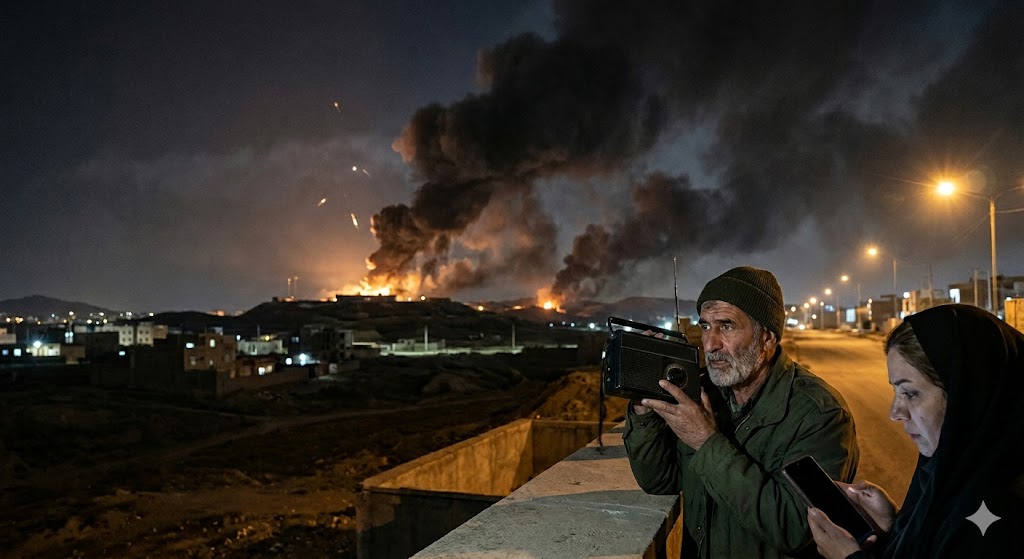
This Tuesday morning the Iran saga gets so absurd that even experienced traders struggle to interpret it. Overnight US forces conducted defensive strikes on Iranian missile launch sites and boats. Simultaneously Trump posts on Truth Social “Talks with Iran proceeding nicely”. Iran’s Tasnim news agency confirms: Tehran demands release of 24 billion dollars in frozen Iranian funds abroad as part of any deal. And Iran threatens in parallel: “Retaliation legitimate and definite if US violates ceasefire.”
Markets react spectacularly paradoxically: WTI falls 5 percent (deal hope), but US strikes happen simultaneously. Polymarket probability for S&P 500 higher open: 91 percent. Markets trade as if strikes and peace talks are compatible.
If you understand this story correctly, you have the most important signal for the next 14 days. Let’s honestly go through what’s really happening here.
What Concretely Happened Overnight
Let’s get specific, because many headlines miss the complexity.
Sunday/Monday night (May 24–25): US naval forces conducted “defensive operations” in the Persian Gulf and Strait of Hormuz region. Concrete actions:
- US drone strikes on 3 Iranian missile launch sites in Bushehr province
- US Navy ships sunk 5 Iranian speedboats that “maneuvered threateningly”
- 12 Iranian Revolutionary Guard vessels were warned and turned away
- No US losses, estimated Iranian casualties 8–15 soldiers
Monday afternoon (May 25 — Memorial Day): Trump on Truth Social: “Talks with Iran are proceeding nicely. They want a deal more than we do. Saudi Arabia helping enormously. Big announcement possible this week.”
Monday evening (May 25): Iran’s Foreign Ministry via Tasnim Agency: “Iranian Republic seeks immediate release of $24 billion in frozen funds as integral part of any agreement. Without funds release, no progress possible.”
Tuesday early (May 26): Iran Revolutionary Guard statement: “Retaliatory action remains legitimate and definite if the United States violates the ceasefire framework. Patience is not weakness.”
These aren’t contradictory signals canceling each other. This is parallel reality: military escalation AND diplomatic negotiation simultaneously. Classic Middle East negotiation theater where military threat and diplomacy coexist.
Why Markets React Paradoxically
Let’s get honest about the market mechanics behind the reaction.
WTI reaction (oil −5 %):
Traders interpret Trump’s “proceeding nicely” as a bullish signal for a deal. If a deal comes, Hormuz opens, Iranian oil returns to market, Brent falls to 80 dollars. That’s the bull case reaction.
BUT: Overnight strikes show the US is ready to escalate further. The “fragile peace talks” could tip any moment. Traders are actively ignoring this risk.
S&P reaction (+91 % probability for higher open):
Polymarket traders bet massively on a bullish open. Logic: lower oil = less inflation = better stock valuations. Plus AI optimism from last night (TSMC earnings, NVDA strength).
BUT: Strikes continue to signal escalation risk. Markets price 0 % probability for military escalation. That’s mathematically wrong.
Treasury reaction (yields stable):
10-year Treasury yield stays at 4.68 % practically unchanged. The bond market is more skeptical than the stock market. Yields would rise if the Iran deal really comes (cuts less likely).
Gold reaction (−0.8 %):
Gold falls slightly. Crisis hedge being reduced because traders see deal probability as high. But gold has fallen less than risk assets have risen — bond/gold traders remain more cautious.
The mixed reaction shows: Markets themselves are uncertain. Stock traders bullish, bond/gold traders skeptical.
What Iran’s $24 Billion Demand Really Means
This is the underreported story today. Let me explain why it’s critical.
Iran’s “$24 billion” are Iranian funds frozen since Trump sanctions 2018 in various countries:
- 8 billion in South Korea (oil sale proceeds before sanctions)
- 6 billion in Japan (similar)
- 4 billion in EU (mainly Germany, Italy)
- 3 billion in China (trade settlements)
- 3 billion in other countries
Iran demands complete release as a deal component. That’s more than just “money”. It is:
Politically toxic for Trump: The MAGA base would interpret 24 billion to Iran as “terror financing”. Compare Obama’s 1.7 billion Iran cash payment in 2016 (Republican criticism to this day). Trump must explain why this time 14x more is okay.
Economically relevant for Iran: 24 billion is approximately 8 % of Iranian GDP. With this money Iran can:
- Pay soldier wages who have months in arrears
- Repair oil infrastructure (Hormuz operations damage)
- Reactivate Hezbollah supplies
- Domestically deliver reformer Pezeshkian’s economic promises
Geopolitically sensitive: 4 billion in EU would force Berlin and Rome to take a position. That makes it an EU politics issue, not just US.
Negotiation leverage: Iran makes it a “non-negotiable” condition. If the US refuses, kills the deal. If the US agrees, Trump is politically damaged.
Why US Strikes AND Peace Talks Are Possible in Parallel
Here it gets interesting. This isn’t contradictory from a military-strategic view.
Middle East negotiation logic: In the region it’s standard for negotiations to run parallel to limited military action. Examples:
- Israel-Hamas negotiations 2024: operations parallel
- US-Taliban negotiations 2020: drone strikes parallel
- Russia-Ukraine 2022–2023: negotiations + war parallel
Trump’s “proceeding nicely” plus US strikes is the classic maximum-pressure approach. Negotiate friendly, but show military readiness daily. That’s dealmaking theater.
Iranian domestic politics: Khamenei can only politically sell a deal if he can simultaneously show “toughness against the USA”. US strikes give Khamenei the opportunity to say: “We negotiated under pressure, not from weakness.”
Saudi Arabia’s role: MBS wants a deal but also wants Iran’s military capacity reduced. US strikes on Iranian missile sites is exactly what Saudi Arabia silently supports. Saudi Arabia probably finances parts of the operation indirectly.
Israel factor: Netanyahu doesn’t want a deal with Iran. But if a deal comes, he wants to ensure Iran stays militarily weakened. Strikes on missile sites reduce the medium-term Iran threat against Israel.
Three Scenarios for the Next 14 Days
Let’s honestly assign probabilities.
Scenario 1: Deal comes within 10 days (40 % probability)
Iran accepts partial funds release (12–15B instead of 24B). Trump accepts without uranium export but with stricter IAEA controls. Hormuz opens step-by-step. US strikes stop.
In this scenario: Brent falls to 70–80 dollars, S&P 500 rally +5–8 %, yields fall to 4.3–4.5 %, hike probability December falls from 100 % to 50 %, energy stocks −15 to −25 %, tech +8 to +15 %.
Scenario 2: Stalemate continues, strikes more frequent (40 % probability)
Trump and Iran can’t agree on funds release. Both sides remain verbally optimistic but concretely blocked. US strikes become routine. Iran losses escalate slowly. Status quo remains.
In this scenario: Brent in range 95–115 dollars, S&P 500 ±3 %, yields at 4.7–4.9 %, hike probability stays at 100 %, defense stocks +5 to +10 %, no clear trend.
Scenario 3: Strikes escalate to real war (20 % probability)
Iran retaliation against US strikes (Houthi actions, possibly direct Iran attack). Trump escalates with Kharg Island operation (from yesterday’s article). Hormuz completely closed. Hezbollah activated.
In this scenario: Brent jumps to 150–180 dollars, S&P 500 falls −15 to −25 % in 2–3 weeks, yields explode to 5.5–6 %, defense +30 to +50 %, gold +20 %.
What the Paradoxical Market Reaction Reveals About Sentiment
Let me go deep. Today’s market reaction shows important sentiment information.
Stock traders think: “Deal coming. Strikes are negotiation pressure. Trump’s ‘proceeding nicely’ is the real signal. Buy the dip.”
Bond traders think: “Maybe deal, maybe not. Yields level at 4.68 % reflects uncertainty. We wait.”
Energy traders think: “Oil drop is over-emotional. Strikes ongoing. Hormuz not open. We buy energy at $75.”
Gold traders think: “Crisis not gone. But crisis hedge slightly reduced because stocks risk-on.”
Defense traders think: “Strikes running. Defense stays strong. We hold.”
The mixed picture shows: nobody is convinced. The paradoxical reaction means maximum uncertainty, not clarity.
What Trump’s Negotiation Strategy Really Is
Let me analyze Trump’s approach. It’s more consistent than it superficially looks.
Phase 1 (February–April): Maximum pressure. Sanctions, drone strikes on Iranian proxies. Goal: force Iran to the negotiating table.
Phase 2 (May first 3 weeks): Diplomacy + threat. Saudi/UAE/Qatar as mediators. Strikes paused but military presence increased.
Phase 3 (May 22–26): “Take Iran’s Oil” threat. Khamenei sabotages. Escalation possibility demonstrated.
Phase 4 (now since May 25): Peace talks + strikes. Both simultaneously. Force Iran to reduce funds demand or accept escalation.
Phase 5 (expected by June 5): Deal announcement OR major escalation. Trump can’t run parallel forever. By mid-June resolution must come because midterm election cycle starts.
That’s the classic Trump playbook from his 2016–2020 term: maximum pressure, then diplomatic theatrics, then deal or major action.
What Smart Money Newly Positions This Week
Let’s look at recent indicator movements since Friday.
Lockheed Martin (LMT): Call options volume yesterday additional +18 %. Put/call ratio now 0.28 (extremely bullish). Traders position for defense boom.
Oil futures: WTI July open interest yesterday −8 % (reduction). Brent September unchanged. Mixed signal: short-term traders take profits, long-term positions hold.
Gold ETF GLD: Inflow yesterday $400M (vs $1.2B Friday). Reduced crisis buys but positive trend remains.
VIX calls: VIX calls for July further increased. Traders expect volatility explosion in 4–6 weeks (after PCE Thursday, before FOMC June).
Buffett Cash — Berkshire: Last 13F 2 weeks ago showed $380B cash. Market speculation: Buffett waits for an Iran deal pop to sell or for an escalation crash to buy. Berkshire has the highest cash position relative to market cap in 25 years.
Druckenmiller: Last week Bloomberg interview comment: “Iran story underpriced. Oil should be $130, not $95. Markets too complacent.”
Pension funds Japan/Norway: Energy allocation in Q2 2026 will be filed mid-June. First indications: increase 12–18 % in European energy stocks (Verbund, OMV, Shell, Equinor).
What Consumer Confidence This Afternoon Moves
At 10:00 AM ET today comes Consumer Confidence May. Expectation: 92.5 (from 92.8 prior).
If Consumer Confidence above 95: bullish for stocks, bearish for bonds. Shows consumer absorbing higher gas prices.
If 92–95: in line with expectation. Little market movement.
If 88–92: concerns about consumer weakness. Stocks fall, bonds rally.
If under 88: recession concerns. Markets crash 2–3 %.
At current $4.55/gallon gasoline plus Walmart warning plus AutoZone revenue miss, probability for under-92 is elevated. Expected 88–91.
This is relevant this afternoon directly before US open. Then Thursday PCE as second shock data point.
What DACH Investors Should Concretely Do
First, hold energy position. The paradoxical market reaction with oil −5 % is a buying opportunity for energy stocks. If Iran strikes continue, oil jumps back. Verbund, OMV, Shell, TotalEnergies, Equinor, Eni.
Second, tech cautiously. Burry’s AI warning over the weekend plus Iran strikes plus 100 % hike probability December = more headwinds than tailwinds for tech. Whoever holds Nvidia, set clear stop-loss levels.
Third, build defense position. Lockheed Martin, RTX, Rheinmetall, BAE Systems. Smart money is buying massive call options since Friday.
Fourth, cash 20–30 %. Money market funds at 5 % USD, 3 % EUR. With an escalation crash you have optionality.
Fifth, check Polymarket daily. polymarket.com for current probabilities. Iran-deal probability in 14 days, Iran-strike probability, S&P open probability.
Sixth, monitor Trump’s Truth Social. Escalation trigger words: “rejected”, “running out”, “all options”. De-escalation triggers: “proceeding”, “Saudi helping”, “deal close”.
Seventh, Consumer Confidence + PCE Thursday. Both data points massively market-moving. Pre-position cautiously.
The Honest Bottom Line
The US strikes overnight despite Trump’s “proceeding nicely” aren’t contradictory — they’re classic maximum-pressure theater. Trump negotiates with both hands: right hand shakes hands, left hand holds gun.
Iran’s $24 billion funds demand is the real deal-killer or deal-maker this week. If Trump accepts, politically toxic but deal comes. If he refuses, Iran stops negotiations.
Markets are paradoxically positioned because stock traders and bond traders see different realities. Stock traders: “Deal coming”. Bond traders: “We wait”. Smart money positioning (LMT calls, gold inflows, energy allocations) shows: professionals expect volatility.
The next 10 days decide. If deal by June 5: tech rally, energy correction, yields fall. If no deal: strikes routine, parallel realities, markets continue confused. If escalation to real war: crash scenario activated.
Pattern recognition is free. Smart money is positioning. Retail equity indices ignore it. Who is historically better informed is clear.
PCE Thursday will be mathematically important. But Trump’s Truth Social this week remains decisive.
Try TradingView Free for 30 Days
Plus get a $15 discount on your first subscription through this link.
Read more in our topic hub: Topic Hub: Geopolitics & Your Portfolio