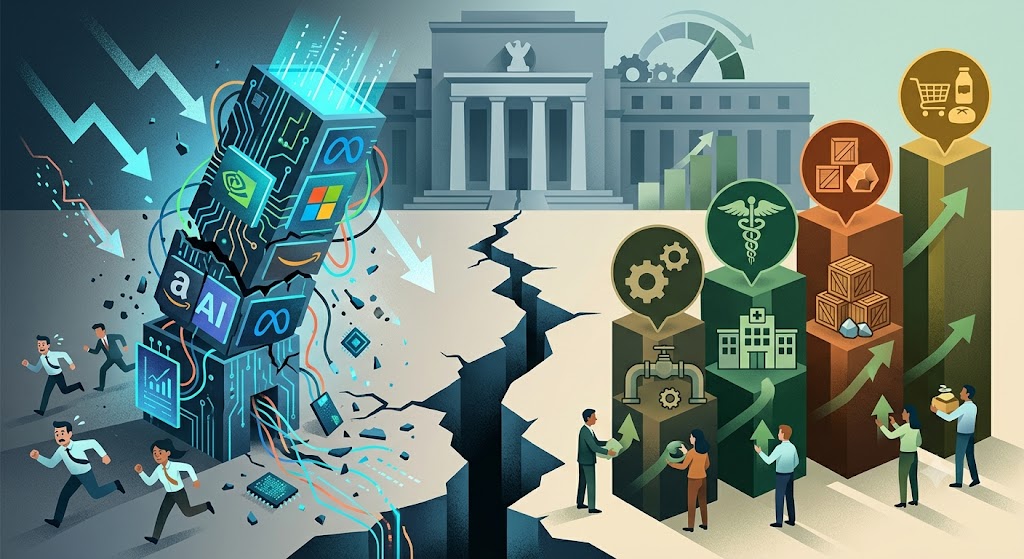
It was the week the story cracked. For months a single narrative had carried the market higher: artificial intelligence, bottomless demand for compute, semiconductors without end. In the five trading days through Friday, June 26, 2026, that narrative suffered its first serious fracture. The technology-heavy Nasdaq Composite shed 4.6 percent on the week and closed Friday at 25,297.62, its fifth straight losing session. The broad S&P 500 slipped nearly 2 percent to 7,354.02. And the old-fashioned Dow Jones Industrial Average, long dismissed as the index of yesterday, actually rose 0.6 percent over the same stretch to finish at 51,876.11. The polarity has flipped.
What is unfolding here is more than an ordinary pullback. It is a rotation — a large-scale reallocation of capital out of crowded growth bets and into the long-neglected, defensive corners of the market. For investors who spent the past two years bending their portfolios around a handful of tech giants, it is a wake-up call. Below we unpack what triggered the week, who is benefiting, why Bank of America has suddenly called for three rate hikes, and what matters most in the week ahead.
What knocked the AI trade off balance
The trigger was not a single event but a convergence. At the center sat the swelling fear of runaway AI infrastructure costs. The hyperscalers — Microsoft, Amazon, Alphabet, Meta — have committed to capital-spending budgets in the hundreds of billions of dollars for 2026, even as their free cash flows shrink under the weight of data-center buildouts. Investors are increasingly asking the uncomfortable question: when exactly do these colossal outlays turn into the profits that justify today’s valuations?
The match that lit the fuse was a New York Times report. According to it, OpenAI is leaning toward delaying its hotly anticipated initial public offering until 2027. Founder Sam Altman reportedly wants to hold out for a roughly one-trillion-dollar valuation target and would rather wait until the company’s financials are stronger and markets have steadied. The bankers advising the company are said to have grown especially nervous after SpaceX’s record-setting IPO ended in an initial rally and a subsequent slide — a warning sign that retail appetite for expensive AI stories is cooling. OpenAI had only confidentially filed its IPO paperwork with the SEC in June.
The message the market took from this was blunt and unwelcome: even the poster child of the AI revolution does not dare go public, because it judges sentiment to be too fragile. If the most valuable private AI company in the world is hesitating, why should investors pay double-digit revenue multiples for every supplier down the chain? The chip stocks that had been lifted only a week earlier by Micron’s blowout quarter came right back under pressure.
The numbers in detail
The weekly scorecard paints a clear picture of a split tape. The Nasdaq Composite, with its heavy concentration of technology and semiconductor names, lost 4.6 percent — its worst stretch in weeks. The S&P 500, where the Magnificent Seven still carry outsized weight, fell just under 2 percent. The Dow Jones, by contrast — spread more evenly across industrials, health care and consumer names — did not merely hold up but gained 0.6 percent. The small-cap Russell 2000 also advanced Friday, a classic signal that money is migrating out of the mega-caps and into the second and third tiers of the market.
Friday’s session itself was subdued but directional: the S&P 500 closed essentially flat at minus 0.05 percent, the Nasdaq lost 0.24 percent, and the Dow gave back a modest 44.51 points, or 0.09 percent. Beneath that calm surface, however, a sector battle raged. While the heavy technology names dragged on the overall index, defensive areas advanced sharply. Industrials led the gainers, up roughly 2.2 percent, health care added about 1.5 percent, and materials around 1.4 percent. Utilities and consumer staples pushed higher as well.
The great rotation — substance over growth
What market strategists have been talking up for months as a healthy broadening has now arrived with force. Investors are reallocating out of the crowded growth segment and into defensive sectors that are cheaply valued, pay steady dividends, and bear little correlation to the AI trade. Consumer staples are the textbook example: low valuation, defensive character, minimal dependence on the AI narrative. A company that sells toothpaste, electricity and medicine does not need a data center to break even five years from now.
At its core this rotation is the return of value investing. For more than two years, growth crushed value, propelled by the belief that scale and network dominance justify any valuation. Now, with rates likely to stay higher for longer and the earnings quality of the tech giants in question, the tide is turning. Higher rates hit richly valued growth stocks twice over: their far-off future profits get discounted more heavily, and at the same time fixed-income holdings offer a genuine alternative. In that environment, businesses with reliable cash flows in the here and now shine.
The Fed shock: Bank of America calls for three rate hikes
The second, perhaps even more consequential story of the week came from monetary policy. Bank of America dramatically revised its rate forecast. As recently as the prior week, the firm expected no change to the policy rate in 2026. Now it projects three rate hikes — 25 basis points each in September, October and December, or 75 basis points in total — that would lift the benchmark from the current 3.50 to 3.75 percent range up to 4.25 to 4.50 percent. BofA economist Aditya Bhave did not mince words: “The Fed’s inflation problem has gotten unambiguously worse.”
The catalyst for the about-face was Thursday’s PCE report, the central bank’s preferred inflation gauge. The headline rate climbed above 4 percent in May, while the core rate reached roughly 3.4 to 3.5 percent — the highest since October 2023. Layered on top is the hawkish tone of new Fed Chair Kevin Warsh. At his first press conference following the rate decision, he repeatedly stressed the need to restore price stability and suggested that policy may not even be especially restrictive. At the FOMC meeting itself, half the members had penciled in rate hikes.
For equities, this combination is poison for the growth dream. Rising rates lift the discount rate applied to future profits and therefore devalue precisely those stocks whose worth rests on distant promises — the AI beneficiaries. At the same time, higher rates make bonds and money-market instruments more attractive, supplying the very capital now draining out of tech. The rotation into defensives and the hawkish Fed are two sides of the same coin.
Megacaps under the microscope
The most exposed names are the very giants that powered the rally. Nvidia, the bellwether of the AI build-out, and the cloud trio of Microsoft, Amazon and Alphabet now find their enormous capital commitments scrutinized rather than celebrated. Apple, already battered after announcing price increases tied to surging memory costs, remains under a cloud. The contrast with the rotation winners could not be starker: while a NextEra Energy in utilities, a Procter & Gamble or Coca-Cola in staples, and a Johnson & Johnson in health care offer modest growth but dependable dividends and resilient demand, the megacaps must now prove that hundreds of billions in AI spending will translate into returns before investor patience runs out.
This does not mean the AI story is over. It means the market has shifted from pricing the dream to pricing the bill. Companies that can demonstrate real monetization — not just usage growth, but margins — will be rewarded. Those that cannot will see the multiple compression continue. That is a healthier market than one in which every name with “AI” in its pitch deck trades at fifty times sales, but the adjustment is painful for anyone overweight a narrow slice of the index.
Risks and counterarguments
As compelling as the rotation story sounds, it is not without pitfalls. First, one week does not make a trend. The AI trade has been declared dead several times over the past two years and came back stronger each time. Should a hyperscaler deliver convincing proof of AI monetization in the coming earnings season, the money could flow back as fast as it left.
Second, the rotation into defensives is no risk-free harbor in its own right. Utilities and real estate are sensitive to rising rates because they carry heavy debt loads and their dividends compete with bond yields. If Bank of America is right and the Fed hikes three times, some of the supposed safe havens could come under pressure. Third, the central question remains open: can the economy withstand such tighter policy without sliding into recession? If it cannot, the downturn would also hit the cyclical industrial and consumer names now cast as winners.
Finally, the BofA call is only one voice among many. Other houses are far more cautious and warn against over-reading a single hawkish press conference and a single inflation report. Markets currently price one hike as a near certainty and assign a better-than-fifty-percent chance to a second by year-end — but three hikes are nowhere near consensus. The history of forecasting after a leadership change at the Fed is humbling: a new chair’s first press conference is often over-interpreted, and the market’s read on Warsh could swing again with the very next data point.
Outlook: a week that begins with data
The coming week will put the rotation to the test, because it is loaded with labor-market data. Tuesday, June 30, brings consumer confidence and the JOLTS job-openings figures, plus quarterly results from Nike and Constellation Brands. Wednesday, July 1, delivers the ADP employment report, the ISM manufacturing index and construction spending. The crescendo arrives Thursday, July 2: the official jobs report, with nonfarm payrolls, will be released a day early because of the holiday. The consensus calls for roughly 172,000 new jobs, though early forecasts point to a meaningful cooling from the prior month. On Friday, July 3, U.S. markets are closed for Independence Day.
The logic for investors has turned paradoxical: strong labor data would support Bank of America’s thesis and hand the Fed ammunition for hikes — bad for richly valued tech, good for the rotation winners. Weak data, by contrast, might ease rate fears but would stoke worries about the economy. For a well-diversified portfolio, this crosscurrent is less threatening than it sounds. The lesson of the past week is not “get out of stocks” but “get out of concentration.” Anyone who narrowed a portfolio to a handful of AI names during the boom is now being shown why spreading across sectors, regions and styles is not a brake but an insurance policy. The great rotation may not be finished — but it has already served as a reminder that on Wall Street, no story runs forever.
Try TradingView Free for 30 Days
Plus get a $15 discount on your first subscription through this link.