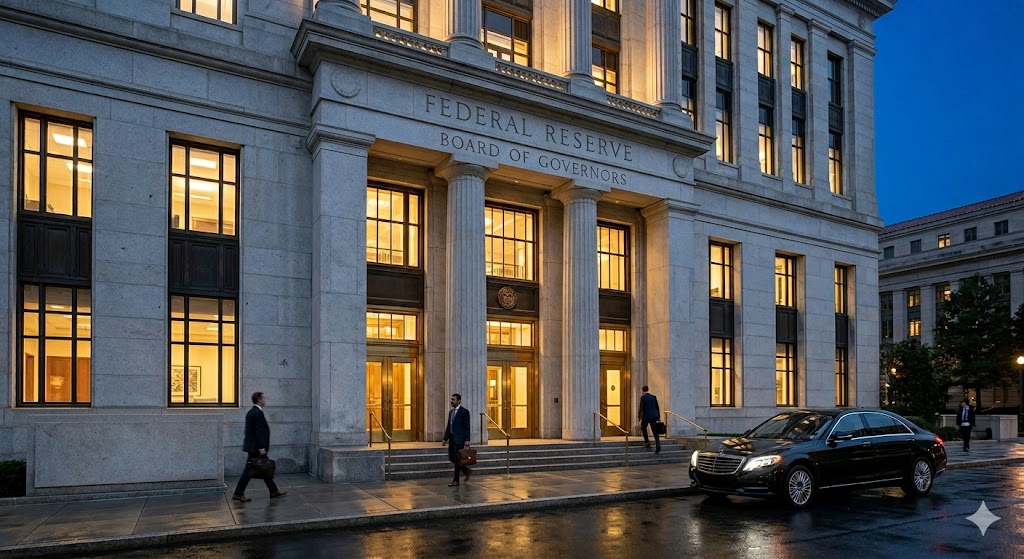
When U.S. markets open on Monday, the most nerve-racking trading week of the summer begins. On Wednesday, June 17, 2026, at 2:00 p.m. Eastern, Kevin Warsh steps in front of the microphones for the first time as Chair of the Federal Reserve, and not a single strategist on Wall Street is willing to publish a clean playbook. CME FedWatch data show a 98.2 percent probability that the fed funds rate stays at 3.50 to 3.75 percent. Sounds dull. It is not. Beneath that flat surface, the market is pulling on three threads at once. Will Warsh erase the last remaining 2026 rate cut from the dot plot? Will he scrap the dot-plot framework entirely? And how will he respond to a White House that has already labeled any rate hike “the wrong thing to do”? Whoever positions on Monday lives with the answer on Wednesday, which is exactly why this weekend is being worked through on trading desks from London to Singapore.
The Largest Central-Bank Week of the Year, Loaded on a Powder Keg
Rarely has an FOMC date arrived under this much pressure. The consensus that still treated rate cuts as inevitable in January has reversed brutally over the past six weeks. The first crack came with the U.S. jobs shock on June 6, when the Bureau of Labor Statistics reported 172,000 nonfarm payrolls for May, more than twice the 80,000 the market had priced. In a single session the Nasdaq Composite lost 4.18 percent, the S&P 500 dropped 2.64 percent, and the semiconductor ETF complex had its worst day since March 2020. Ten-year Treasury yields jumped to 4.54 percent because the bond pit suddenly stopped pricing a cut and started pricing a potential hike. Two days later the University of Michigan year-ahead inflation expectation print landed at 4.6 percent, the second-highest reading since the 1980s. Then on Friday of this past week, one day after a U.S. consumer price report that came in at a 4.2 percent annual rate — “hotter than anything seen in three years” in the words of one strategist — the European Central Bank raised its deposit rate to 2.25 percent. That marked the first ECB upward move since 2023. If Frankfurt is releasing the brake and Washington does nothing, the dollar wobbles. If Washington pulls the brake harder, Warsh risks an open confrontation with Donald Trump in his first week on the job. The June 17 meeting is sandwiched precisely between those two outcomes.
Who Is Kevin Warsh, and Why He Is Not Jerome Powell
Warsh, born in 1970, is the youngest Fed Chair since William Miller in the late 1970s. He first joined the Federal Reserve in February 2006 as a Governor under Ben Bernanke, four days after his 36th birthday, the youngest Board member in history. During the 2008 to 2009 financial crisis he sat at Bernanke’s side and was known inside the building as the man who worked the Lehman weekends on the phone with JPMorgan, Goldman Sachs and Bank of New York Mellon. In 2011 he resigned, reportedly out of frustration over the Fed’s willingness to keep expanding its balance sheet. That posture made him the favorite candidate of monetary hawks. Across speeches between 2014 and 2024, Warsh repeatedly attacked the dot plot as “illusory precision” and argued that quantitative easing had elevated asset prices ahead of productive investment. In May 2026 the Senate confirmed him as Chair by the narrowest margin in modern central-bank history, decisive Trump votes lined up against almost unanimous Democratic opposition. What investors still cannot tell is whether he will govern as a hawk — the way he has talked — or as a pragmatist who wants to survive his first month without an open clash with markets.
The Dot Plot: The Single Most Important Chart Nobody Truly Understands
The Summary of Economic Projections is a quarterly document filled out by each of the 19 voting and non-voting Fed members. Each dot on the famous dot plot shows where a single Fed official sees the policy rate at year-end. The March dot plot still contained exactly one rate cut for 2026, with the median sitting at 3.375 percent by year-end. That lone cut has become the most consequential number in the document, because it embodies the fragile promise that the Fed has not yet given up on cheaper money. Most strategists expect that dot to vanish on Wednesday. Goldman Sachs writes that the median is likely to slip to “no cuts in 2026, two cuts in 2027.” Morgan Stanley sees “a clean wipe of the 2026 cut plus a built-in hike tail.” If that happens, tech stocks sell off immediately, because higher discount rates compress the present value of future cash flows. Then there is the far more radical thesis: that Warsh kills the entire dot-plot system. In speeches in 2018 and 2023 he called the dot cluster a “false commitment” that forces investors to read monetary policy like a betting parlor. If he removes the dot plot or anonymizes it, as the ECB has always done, that would be the largest structural change in Fed communication since 2012, when the chart was introduced.
A 56 Percent Hike Probability by Year-End: What the Futures Actually Say
While the odds of a move on June 17 itself are essentially zero, the hike path through December 2026 has shifted dramatically. Fed funds futures now price a 56 percent probability that the central bank raises rates by at least 25 basis points before year-end. Six weeks ago that number was zero, and the market was firmly priced for the opposite. The reversal was triggered by three data points. First, the May jobs report. Second, the most recent CPI print at 4.2 percent. Third, the recognition that wage inflation across healthcare, education and the government sector now runs at 5.1 percent annually. Anyone reading the strip can also see that May 2027 contracts imply a policy rate of 3.95 percent, higher than today. In other words, the bond market has largely written off the disinflation path. For the equity universe that implies a fundamental repricing of multiples. The S&P 500 currently trades at a 22.4 forward price-to-earnings ratio, the Nasdaq 100 at 28.1, both historic peaks for an environment with a three-and-a-half percent policy rate. If Warsh confirms that reading on Wednesday, growth equities face a repricing wave that the June 6 Nasdaq shock only previewed.
Trump in the Background: “A Rate Hike Would Be the Wrong Thing to Do”
On June 7, the White House released a statement in which Donald Trump said outright that a rate increase “would clearly be the wrong thing to do.” Three days later, at a press conference, he repeated that he “did not pick Warsh for higher rates” and would “not accept” the economy being throttled because of “academic inflation fantasy.” This is the most fraught political constellation a new Fed Chair has ever inherited. Warsh, in his April confirmation hearings, said repeatedly that the central bank’s independence was “non-negotiable,” but he also did not rule out that the Fed might have to “reconsider the flexibility of the policy corridor” in a world of structurally higher inflation. That phrasing was read in two directions. Hawks heard a readiness to pivot toward hikes; doves heard an attempt to quietly raise the inflation target. What unfolds on Wednesday will not just be a rate decision. It will be the first litmus test of whether the best-credentialed Republican monetary thinker of the past twenty years resists the President who put him in the job.
Market Impact: The U.S. Stocks Most Exposed to a Hawkish Pivot
U.S. investors should split their watchlist into three columns. The first column is mega-cap tech, where duration of cash flows is highest. Nvidia, Tesla, Palantir and ARM Holdings each trade at forward multiples that assume the disinflation path stays intact. A clean hawk-Warsh print on Wednesday could compress Nvidia’s multiple from 38 to 32 in a single session, taking 14 percent off the equity in mathematical terms. Tesla’s leverage is even higher because the energy-storage backlog gets renegotiated quarterly. The second column is rate-sensitive consumer discretionary. Carvana, Lennar, Toll Brothers, RH and Wayfair all depend on credit availability for end consumers. If thirty-year mortgage rates climb back to 7.5 percent on a hawkish dot plot, homebuilder pipelines extend by three months and earnings revisions follow. The third column is regional banks. The KBW Regional Bank Index has already broken below its March low because the deposit base for second-tier lenders is more rate-sensitive than the Big Four. Warsh hawkishness pulls liquidity out of First Horizon, Comerica and Western Alliance first. Conversely, the winners of a hawkish surprise are JPMorgan, Bank of America and Citigroup — their net interest margins would expand 10 to 16 basis points on the move — plus the energy complex, where ExxonMobil and Chevron benefit from a stronger dollar squeezing emerging-market supply. The single most overlooked beneficiary is short-duration Treasury ETFs like SHV and BIL, which would see their yield base rise without principal risk. Retirees and conservative allocators who have parked cash in money-market funds yielding 4.7 percent could see those yields push above 5.1 percent within three months.
Risks: Three Scenarios Where Consensus Is Wrong
The most likely script — Warsh holds rates, erases the 2026 cut from the dot plot, sounds “data-dependent” in the press conference — is fully priced. Three scenarios are not. First risk: Warsh announces a formal review of the inflation target. That would be a sensation, because it would signal that the Fed is ready to live with three percent rather than two on a structural basis — a dovish pivot through the back door. Stocks would rally, the dollar would fall, gold would print new all-time highs. Second risk: Warsh removes the dot plot entirely and replaces it with an ECB-style strategy corridor. That is the reform he has preached for years. It would inject short-term uncertainty but lower the volatility regime over the medium term. Third risk: Warsh openly signals readiness to hike in September if the August CPI prints above 4.5 percent. That would be the sharpest hawkish shock since Powell’s 2022 Jackson Hole speech and would correct the S&P 500 by six to eight percent within days. Investors need to be prepared for each of these paths, because Warsh has, in the eighteen years since he first joined the Fed, repeatedly acted in unexpected ways exactly when the market had locked in a clean consensus.
What Disciplined Investors Should Do This Weekend
First, hold cash on the watchlist. Anyone who is not already exposed to short-dated options structures with a hike or cut bias should be ready to step in at much more attractive levels at Thursday’s close than Tuesday’s. Second, raise the weighting of defensive sectors. Consumer staples (Procter & Gamble, Colgate, PepsiCo), utilities (NextEra, Dominion, Duke) and healthcare (Johnson & Johnson, UnitedHealth, Merck) absorb a hawkish pivot far better than tech or consumer discretionary. Third, audit any U.S. tech position by stress-testing what happens if the ten-year Treasury climbs to 4.85 percent. For Tesla, Palantir and ARM Holdings the leverage point is closer than most investors estimate. Fourth, do not mistake gold and bitcoin for an inflation hedge on Wednesday. Both react first to the dollar move, not to the policy rate itself. A hawkish Warsh print pushes the dollar index past 108, and both assets initially decline before they are revisited as a policy-volatility hedge. And fifth, read the bond market before the equity market. If the ten-year Treasury climbs above 4.75 percent on Thursday morning, equities have not yet fully processed the message, and the second day will be the painful one.
Bottom Line: A Week That Rewrites the Second Half of 2026
Kevin Warsh’s debut on June 17, 2026 is more than a routine FOMC. It is the moment when the Federal Reserve either publicly buries the disinflation path or recalibrates its credibility between market expectations and political pressure. The 56 percent year-end hike probability, the hottest inflation print in three years, last Friday’s ECB pivot and a President who is publicly warning against any increase — those four forces collide in a single room on Wednesday evening. For U.S. investors that means inventory checks across the portfolio, currency-exposure reviews, defensive-sector reinforcement and dot-plot vigilance at a level normally reserved for major elections. Whoever reads the market correctly on Thursday morning trades the second half of 2026 with a clear lead. Whoever has no opinion by then risks buying volatility rather than selling it. That is the single most expensive mistake of a trading career, and Kevin Warsh is about to force many market participants into making it in his very first act.
Try TradingView Free for 30 Days
Plus get a $15 discount on your first subscription through this link.
Read more in our topic hub: Topic Hub: Fed Policy, Rates & Bonds 2026