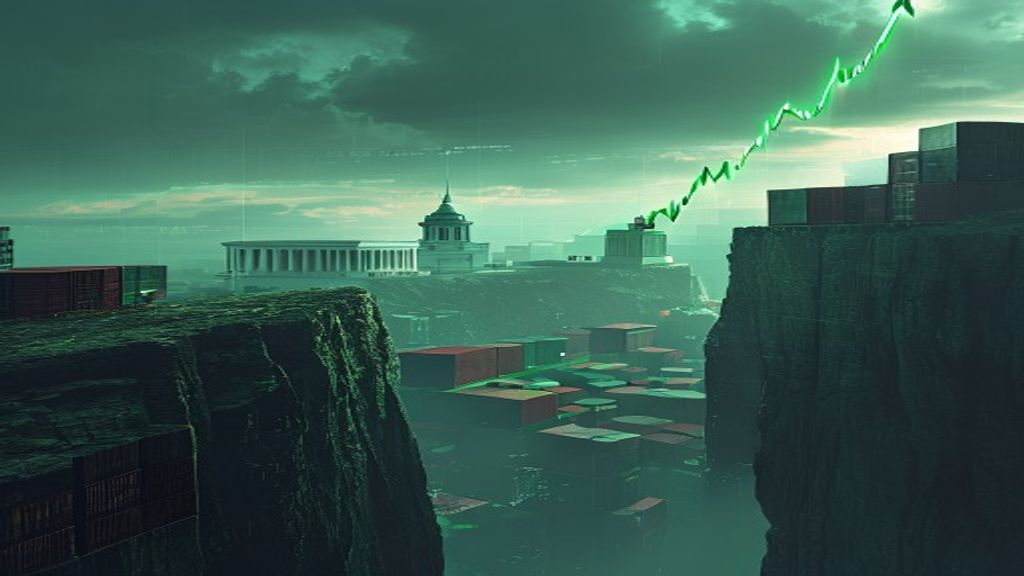
Wall Street closed the week exactly where optimists like it best: within touching distance of record highs, with the fear gauge fast asleep. The S&P 500 finished Friday at 7,575.39, up 0.42 percent; the Nasdaq Composite climbed to 26,281.61; the Dow Jones Industrial Average added 149.60 points to 52,637.01. The VIX, Wall Street’s most-quoted measure of anxiety, dropped more than five percent to 15.03 — a level that does not express caution but its opposite: an almost total absence of fear. The market is calm, confident, very nearly drowsy. And that is precisely the problem.
Because while the tickers celebrate records, a clock is ticking in the background that will run out in less than two weeks. It is not a vague threat, not another burst of anger from an interview, not one of the countless tariff announcements that in 2025 became little more than background noise. It is a statutory calendar deadline — and it has the power to reshape the entire trade architecture of the United States within a handful of days. The market is pricing that risk at effectively zero. This gap between the serenity of prices and the hardness of the calendar is the real story of the weekend.
The deadline nobody has on their radar
On July 24, 2026, the blanket ten percent tariff that Washington imposed in February under Section 122 of the Trade Act of 1974 expires. That measure was the legal stopgap adopted after the Supreme Court in February struck down the administration’s original tariffs, which had been levied under the IEEPA emergency statute — a ruling that triggered a refund pool of roughly 166 billion dollars. But Section 122 permits such an emergency tariff for a maximum of 150 days. That window ends on July 24. After that date, the legal foundation for the across-the-board baseline tariff simply disappears.
That is precisely why the Office of the U.S. Trade Representative is racing to build a replacement. Two Section 301 investigations, launched on March 11, are due to be completed by July 20 — just four days before the cliff. One targets excess manufacturing capacity across sixteen economies; the other, insufficient enforcement against forced labor in more than sixty countries. The outcome is already sketched out: a 12.5 percent duty on imports from 46 countries, among them China, Vietnam, India, Thailand, Japan, South Korea, Brazil, Singapore, Norway and Russia. The public comment period ran through July 6, and the hearing was held on July 7. The machinery, in other words, is already in motion — largely beneath the radar of a market that would rather watch chip stocks and quarterly numbers.
What happens when the clock runs out
The real risk does not lie in the 12.5 percent rate itself. For many Asian countries that figure would actually be lower than the old IEEPA rates, which stood at 46 percent for Vietnam and 35 to 36 percent for Cambodia and Thailand. The risk lies in the gap. If the Section 301 replacement is not legally in force by July 24, imports do not fall to zero; they revert to a chaotic patchwork of pre-IEEPA rates: the standard most-favored-nation duties, plus the existing Section 232 sector tariffs on autos, steel, aluminum and semiconductors, plus the old China Section 301 duties left over from the first term.
For importers, buyers and supply-chain planners, that means a dangerous stretch of uncertainty: nobody can say with absolute confidence which rate applies on July 25 to which product from which country. Such tariff vacuums are poison for margin predictability — and margins are exactly what a market at record valuations reacts to most sharply. There is a further wrinkle: much of what has been celebrated as robust demand in recent weeks may simply be pull-forward. Companies that see the cliff coming accelerate imports, stock warehouses, lock in goods at known rates. That flatters second- and third-quarter economic data on the way up — and makes any subsequent air pocket in demand look all the harsher.
July 14: inflation and banks on the same morning
As if the tariff cliff were not enough, a double test looms even sooner and promises to fray nerves. On Tuesday, July 14, the Bureau of Labor Statistics releases the June Consumer Price Index at 8:30 a.m. New York time. At that very hour, the largest U.S. banks — JPMorgan Chase, Bank of America, Goldman Sachs, Citigroup and Wells Fargo — open their second-quarter books. Two of the most market-moving data points in existence, compressed into a single pre-market window.
The banks have long served as a thermometer for the U.S. economy: their loan-loss provisions, their net interest income and their read on consumer behavior say more about the sturdiness of the expansion than any single balance sheet. If the CPI comes in hotter than expected, the already-fragile hope for rate cuts slides further out; under its new and emphatically restrictive leadership, the Federal Reserve is seen as reluctant to ease quickly, with the median projection placing the policy rate no lower than 3.8 percent by year-end. In precisely that configuration, a tariff jolt read as an inflationary impulse would leave the central bank even less room to maneuver. July 14 is thus the overture, and the tariff cliff the climax — a two-week gauntlet the market has so far been ignoring almost silently.
Why investors have learned to look away
The complacency has an understandable origin. The year 2025 trained investors to stop taking tariff threats seriously. Again and again, a martial announcement would land, prices would flinch, and then would come the postponement, the exemption, the last-minute deal. Wall Street even gave the pattern a mocking name — the expectation that a climbdown is always coming in the end. Anyone who sold every tariff headline in 2025 lost money; anyone who ignored them and bought was rewarded. That conditioning runs deep.
But there is a decisive difference between a political threat and a statutory deadline. Section 122 does not vanish because someone strikes a deal or has a change of heart — the 150-day limit is the law. July 20 is a hard completion date for an administrative process, not another appointment that can be pushed at will. That is the complacency trap: the market extrapolates a behavioral pattern into a situation where the pattern no longer applies. A VIX of 15 says that protection is dirt cheap right now — which, in periods of elevated but underappreciated risk, has rarely been a good omen.
Where the exposure sits on U.S. balance sheets
For American companies, the cliff is not an abstraction — it lands directly on cost of goods sold. Apple assembles and sources across China, Vietnam and India, three countries squarely on the 46-nation list. Nike manufactures roughly half its footwear in Vietnam, making it one of the most tariff-sensitive megacaps in the index. The big-box importers — Walmart, Target, Best Buy — run on razor-thin margins and vast volumes of imported goods, so even a few points of tariff friction ripples straight to earnings. Hardware names like Dell and much of the Nvidia supply chain lean on Asian assembly; furniture retailer Wayfair sells imported inventory that could grow more expensive overnight.
The mirror image matters too: purely domestic services, software, utilities and companies with home-grown supply chains are relatively insulated, and in a tariff scare they tend to outperform the import-heavy names. That divergence is worth watching, because it is often where the market first reveals whether it is truly repricing the risk or merely paying lip service to it. So far, the breadth of the rally — with import-sensitive consumer and hardware names still trading near highs — suggests the latter. The market is behaving as though the calendar were negotiable.
The quiet channel: bonds, the dollar and the Fed
Tariffs act not only across the store counter but through a far subtler channel that equity investors love to overlook: the bond market. An import tariff is, in economic terms, a supply shock — it raises the cost of inputs and finished goods, pushing prices up without strengthening demand. That exact combination of higher inflation and potentially weaker growth is what central bankers dread, because there is no clean answer to it. If the market suddenly prices in a disorderly tariff patchwork on July 25, the first reaction would probably not show up on the stock ticker but at the long end of the U.S. yield curve and in the dollar.
Rising long-end yields would hit the valuations of the most expensive growth names hardest — which is to say, precisely the technology and AI stocks that have carried the record rally. A firmer dollar, in turn, would erode the overseas earnings of U.S. multinationals and raise the debt burden of many emerging markets. For the Federal Reserve, already leaning on the brakes under its restrictive leadership, a tariff-driven inflation impulse would be the single most uncomfortable scenario imaginable: it would have to hold rates higher for longer just as the economy begins to stumble. This transmission path is why the tariff cliff is not a pure trade story but potentially strikes at the core of what supports equity prices in the first place — the expectation that rates will eventually fall. An investor who watches only the green number on the index does not see this channel until it opens.
The other side of the ledger
An honest market commentary must take the counterargument seriously — and it is far from weak. First, the market’s pattern has been right more often than wrong: deadlines slip, rates get diluted, exemptions get negotiated. It is entirely possible that USTR quietly puts the Section 301 duties into force on time and July 24 turns out to be a non-event. Second, for a substantial share of the affected countries the proposed 12.5 percent rate is a de facto easing relative to the old IEEPA levels — for Vietnam it would be less than a third of the prior burden. On that reading, the transition would be no escalation at all, but an orderly step toward more predictable, lower rates.
Third, the legal picture is not settled either: just as the Supreme Court threw out the IEEPA tariffs, the new Section 301 measures could be challenged too — with an uncertain outcome, but the possibility of further dilution. None of that makes the cliff harmless. It means the outcome is binary and hard to forecast: either the market glides silently over the deadline and the record rally continues, or a gap, a delay, or an ugly coincidence on July 14 unleashes volatility that, with the VIX at 15, almost nobody is insured against.
What it means for the next two weeks
The sober takeaway is this: the market is entering the most important trading week of the summer with maximum self-satisfaction and minimum protection. That is not a forecast of a crash — the underlying story of a powerful AI investment cycle, resilient corporate demand and the hope of eventually lower rates remains intact. It is a warning about asymmetry. If everything goes smoothly, an investor gains a few more percentage points in an already expensive rally. If it goes wrong — a hot CPI, a cautious bank outlook, a tariff vacuum on July 25 — it strikes a market that, at a volatility reading of 15, is not braced for it.
For long-term investors the message is less dramatic but just as clear: this is a moment when diversification, an honest look at the actual supply-chain exposure inside a portfolio, and a realistic reckoning with one’s own risk tolerance pay off — not panic, but also not the reflexive looking-away that worked so well in 2025. The calendar, this time, is not a bluff. In less than two weeks it will become clear whether the calm on the markets was foresight, or merely the stillness before a leap across a cliff no one wanted to see.
Try TradingView Free for 30 Days
Plus get a $15 discount on your first subscription through this link.
Read more in our topic hub: Topic Hub: Geopolitics & Your Portfolio