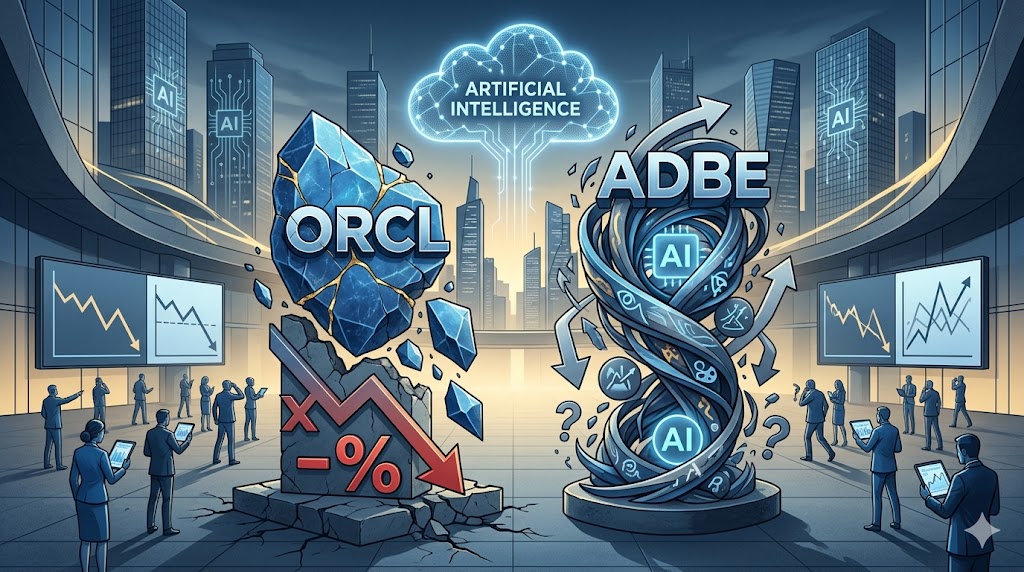
Within twenty-four hours this week, two of the most important software companies in the world walked up to Wall Street with numbers that beat expectations — and both were sent home bruised. Oracle, reporting Wednesday evening, delivered $19.2 billion in quarterly revenue, a 21% jump that edged past the $19.1 billion consensus, and earned $2.11 per share against expectations of $1.96. Adobe, reporting Thursday evening, posted a record $6.62 billion in revenue, beat on earnings, raised its full-year guidance and announced that its “AI-first” recurring revenue had roughly tripled year over year. Oracle opened Thursday down roughly 11% and closed at $184.10, off about 8.5%. Adobe fell around 5.6% in after-hours trading on top of a roughly 30% decline already booked in 2026.
Two beats, two sell-offs, two very different companies. What links them is the trade that has defined equity markets for three years: artificial intelligence. Oracle is the company spending the money — borrowing it, in fact — to build the data centers the AI boom runs on. Adobe is the company the market has decided AI will eventually eat. This week, investors punished both. The infrastructure builder was punished for the cost of its ambition; the supposed disruption victim was punished even for excellence. That is not a coincidence. It is the sound of the AI trade entering its “show me the money” phase — and it is happening at precisely the moment when money itself has started costing something again.
A Brutal Week to Ask the Market for Patience
Oracle and Adobe did not report into a calm tape. On Wednesday, June 10, the U.S. consumer price index for May came in at 4.2% — the hottest inflation reading in three years — and the Dow Jones Industrial Average shed 953 points in a single session. On Thursday, June 11, the European Central Bank raised interest rates for the first time since 2023, lifting its deposit rate by 25 basis points to 2.25% and citing inflation pressure flowing from the U.S.–Iran conflict and energy prices. Christine Lagarde called the decision “robust across a range of scenarios” and pointedly refused to commit to a rate path, which markets correctly read as: more could come.
That double blow landed on a market that was already raw. Earlier this month, a shockingly strong U.S. jobs report — 172,000 new positions against far lower expectations — triggered a semiconductor rout that erased roughly $1.3 trillion in market value across the chip complex, as investors abruptly repriced the odds of monetary easing. And on Friday, June 12, as this is written, SpaceX is making its debut on the Nasdaq under the ticker SPCX at $135 per share, a roughly $1.77 trillion valuation and the largest IPO in history — an enormous magnet for capital and attention arriving in the same week that two software bellwethers asked investors for patience. Patience, this week, was in shortest supply.
Oracle’s Quarter: Strong Where It Counts, Expensive Where It Hurts
Start with what went right, because plenty did. Oracle’s fiscal fourth quarter, reported Wednesday after the close, showed revenue of $19.2 billion, up 21% year over year and ahead of the $19.1 billion analysts expected. Non-GAAP earnings per share of $2.11 beat the $1.96 consensus and rose 24% from a year earlier. The cloud business — the entire reason Oracle trades the way it does — grew 47% to $9.9 billion, and within that, Oracle Cloud Infrastructure, the unit renting raw computing power to AI developers, nearly doubled, up 93% to $5.8 billion. For a company of Oracle’s age and size, these are extraordinary growth figures.
And yet the stock opened Thursday down about 11%, traded off more than 12% at its worst, and closed at $184.10, a loss of roughly 8.5%. From its high, Oracle has now surrendered about 25%. The damage came not from what Oracle is earning, but from what it is spending — and how it intends to pay for it.
A $638 Billion Promise — and the Bill for Keeping It
The number that defined this earnings report was not revenue or earnings per share. It was 638. Oracle’s remaining performance obligations — the contracted backlog of work customers have committed to pay for — reached $638 billion, up an astonishing 363% year over year and up $85 billion from the prior quarter’s $553 billion. On paper, this is one of the great order books in the history of capitalism: more than thirty times the company’s quarterly revenue, locked in. Bulls have spent months treating Oracle’s RPO as a kind of guaranteed future, a river of revenue that merely needs time to flow through the income statement.
The market is now asking two uncomfortable questions about that river. The first is concentration. According to Bank of America analysts, more than 50% of Oracle’s backlog comes from a single customer: OpenAI. That transforms the quality of the backlog entirely. A $638 billion order book spread across thousands of enterprises is an annuity; one where a majority depends on a single, still unprofitable AI laboratory is a leveraged bet on that laboratory’s ability to keep raising and spending capital at historically unprecedented rates. If OpenAI’s funding environment tightens — and in a world of 4.2% inflation and rising rates, funding environments do tighten — Oracle’s future is hostage to it.
The second question is cost. Building the capacity to serve that backlog consumed Oracle’s cash machine whole: free cash flow for fiscal 2026 came in at minus $23.7 billion. Capital expenditure plans for the current fiscal year run to roughly $70 billion, and management intends to raise about $40 billion in fresh financing to help fund it — a mix of debt and equity that includes a stock sale of around $20 billion. That last item stung most. Equity issuance means dilution: existing shareholders will own less of the company so that Oracle can build data centers whose returns depend, in large part, on one customer. Investors who bought Oracle as a disciplined, buyback-friendly cash generator woke up Thursday owning a capital-hungry infrastructure developer. The 25% drawdown from the high is the price of that identity change.
Adobe: When Even a Record Quarter Can’t Change the Story
If Oracle shows what happens when the market doubts the spending side of AI, Adobe shows what happens when it doubts the survival side. By any conventional standard, Adobe’s fiscal second quarter, reported Thursday evening, was excellent. Revenue hit a record $6.62 billion, up 13% year over year and 11% in constant currency, comfortably above the $6.456 billion consensus. Non-GAAP earnings of $5.96 per share beat the $5.82 estimate; GAAP earnings came in at $4.25. The company raised its full-year revenue and profit guidance and continues to work through a $25 billion share buyback program. Most strikingly, Adobe said its “AI-first” annualized recurring revenue crossed $500 million for the first time — roughly triple the level of a year ago. CEO Shantanu Narayen described a record quarter “reflecting strong AI-driven demand.”
The stock fell about 5.6% after hours anyway. Adobe shares were already down roughly 30% in 2026 before the report, weighed down by a single, stubborn fear: that generative AI will not expand the market for Photoshop and Premiere subscriptions but replace it — that tools capable of conjuring images and video from a sentence will hollow out the professional creative software franchise Adobe spent four decades building. Against that narrative, a beat-and-raise quarter is treated not as refutation but as a lagging indicator. The bears’ argument was never about this quarter; it is about 2028. And there is no number Adobe can print today that settles an argument about 2028.
The symmetry with Oracle is what makes this week remarkable. Oracle is being punished for spending too aggressively on AI; Adobe is being punished because AI might eventually spend it into irrelevance. One company can’t convince the market its AI exposure is affordable; the other can’t convince the market its AI exposure is survivable. Heads, the stock falls. Tails, the stock falls.
When Capital Costs Something, the AI Math Changes
It is impossible to separate this week’s reactions from the macro backdrop, because the macro backdrop is precisely what changed the math. For most of the AI buildout, capital was abundant and cheap enough that the question “how will this be financed?” barely registered. A company announcing $70 billion of capex in 2024 was rewarded for ambition. A company announcing it in June 2026 — the same week U.S. inflation printed at a three-year high of 4.2% and the ECB began hiking again — is asked about interest costs, refinancing schedules and dilution.
This is the structural shift hiding inside the Oracle story. Debt-funded data centers are a duration bet: you borrow today against computing revenue that arrives over years, while the chips inside those facilities depreciate on a brutally short cycle. Every increment of yield makes that bet more expensive on both ends — the financing costs more, and the discounted value of the distant revenue shrinks. Oracle’s planned $40 billion raise will be priced in this environment, not the one of 2024. The roughly $20 billion equity component is itself a tell: when a company chooses dilution at a share price already 25% off its high, it is signaling something about how much additional debt it believes the balance sheet — or the bond market — will comfortably bear.
The ECB’s move matters here even for American companies, and not only symbolically. A world in which both major central banks lean against inflation is a world of structurally higher global yields, and global yields are the gravity that acts on every long-duration asset — AI infrastructure most of all. Lagarde’s refusal to define a rate path keeps that uncertainty alive. For the AI buildout, the cost of capital has stopped being a footnote and become a protagonist.
Hyperscalers, Nvidia and the OpenAI Question
For U.S. investors, the cleanest way to frame Oracle’s predicament is against the hyperscaler comparison set: Microsoft, Amazon and Alphabet. All three are spending enormous sums on AI infrastructure — but they are funding that spending overwhelmingly from operating cash flow generated by profitable, diversified franchises in software, e-commerce, advertising and cloud. Their AI capex is an allocation decision. Oracle’s, increasingly, is a financing decision. A free cash flow of minus $23.7 billion alongside a $70 billion capex plan means Oracle is building with borrowed and newly issued money in a way Redmond, Seattle and Mountain View simply are not. In a zero-rate world, that distinction was academic. At current yields, it is the whole investment case.
Then there is Nvidia, which sits on the comfortable side of every one of these checks. Whether Oracle’s data center bet ultimately earns its cost of capital or not, the GPUs get paid for upfront. The supplier collects in cash today what the infrastructure provider hopes to recoup over years — the same asymmetry that made shovel-sellers the reliable winners of every capex boom in history. The risk for Nvidia and its peers is second-order: if financing costs force the Oracles of the world to stretch out their buildouts, the order flow eventually reflects it. The early-June chip sell-off, which vaporized about $1.3 trillion of semiconductor market value when rate-cut hopes collapsed, was a preview of exactly that transmission channel.
Looming over the entire chain is the OpenAI concentration. If Bank of America is right that more than half of Oracle’s $638 billion backlog traces back to OpenAI, then a single private company’s funding needs now sit upstream of Oracle’s revenue, Oracle’s revenue sits upstream of its debt service, and the data center buildout sits upstream of chip demand. The AI economy has developed a load-bearing column, and a surprising amount of public-market capitalization is stacked on top of it. Concentration is fine until the moment it isn’t, and markets have begun pricing the possibility.
The Bull Case the Sell-Off Ignores
Intellectual honesty requires the other side of the ledger, and it is not weak. Oracle’s backlog, however concentrated, is contracted demand — these are obligations customers have signed, not hopes a strategy deck describes. Adding $85 billion of RPO in a single quarter while growing OCI 93% is evidence of execution, not just appetite. Negative free cash flow during an infrastructure land grab is, viewed charitably, what winning looks like in mid-buildout: Amazon spent years being punished for AWS capex that later defined a decade of returns. And choosing roughly $20 billion of equity within the $40 billion raise, rather than pure debt, is arguably the prudent path in a rising-rate world — dilution is painful, but it is not a covenant.
Adobe’s rebuttal is even more straightforward. Tripling AI-first recurring revenue to beyond $500 million in a year is exactly what early, successful monetization looks like, and a raised full-year outlook is management betting its credibility that demand is real. The $25 billion buyback means the company is acquiring its own shares at valuations the market may later regret offering. It is also worth remembering the tape these reports landed on: a 953-point Dow decline, the hottest CPI in three years, a surprise ECB hike and the gravitational pull of history’s largest IPO. Some portion of both sell-offs is macro shrapnel, not company verdict. Sell-offs born of sentiment in weeks like this one have a way of overshooting.
The Show-Me Phase Begins
Still, the message of this week is bigger than either ticker, and it would be a mistake to dismiss it as noise. For three years, the AI trade ran on promises: promised demand, promised productivity, promised disruption. Oracle and Adobe just demonstrated that promises no longer clear the market’s bar in either direction. The builder must now show that hundreds of billions in backlog convert into profitable revenue without breaking the balance sheet or depending existentially on one customer. The incumbent must show, quarter after quarter, that AI is feeding its franchise rather than feasting on it — and accept that a record quarter buys only a little time with a skeptical jury.
What to watch from here follows directly. For Oracle: the terms and timing of the $40 billion financing, any disclosure that diversifies the backlog beyond OpenAI, and the trajectory of free cash flow as the $70 billion capex year unfolds. For Adobe: whether AI-first recurring revenue can keep compounding from its new $500 million base fast enough to change the narrative before the narrative changes the multiple. For everyone: inflation prints and central bank decisions, because the ECB has reminded markets that the cost of capital is a live variable again, and the entire debt-funded AI buildout is, at bottom, a wager on what money costs. The “show me the money” phase of the AI boom has begun. Friday’s SpaceX debut will reveal plenty about how much risk appetite survives this week — but for the AI trade itself, the burden of proof has shifted, durably, from the storytellers to the spreadsheets.
Try TradingView Free for 30 Days
Plus get a $15 discount on your first subscription through this link.