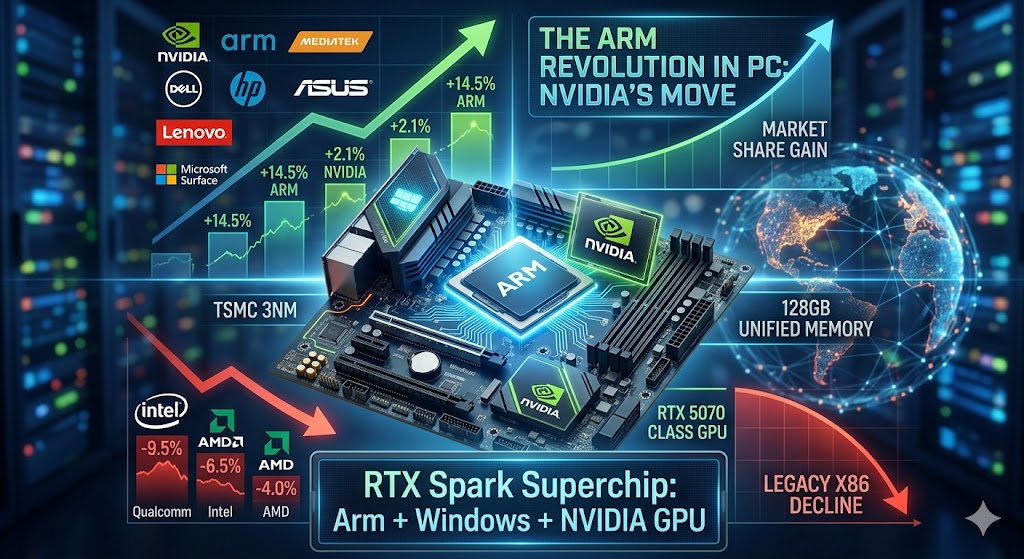
This morning, on stage at Computex in Taipei, Jensen Huang announced perhaps the most aggressive move in Nvidia’s history. The RTX Spark Superchip — a processor that, for the first time, combines a full-fledged Nvidia graphics chip with its own Arm-based CPU inside a Windows laptop. Huang called it the “reinvention of the computer” and compared its significance to the invention of the smartphone.
The market reacted instantly and brutally clearly. Some stocks shot up, others crashed — all within the first minutes of trading. This very split is the real story. Because when a $3.2 trillion giant like Nvidia marches into a mature market, winners and losers shift abruptly. Let’s walk cleanly through what was announced, who wins, who loses — and what the secret winner is that almost nobody is talking about.
What Nvidia actually announced
The RTX Spark isn’t an ordinary laptop chip. It’s a “superchip” that unites three things in one that were previously separate:
- GPU: A Blackwell graphics core with 6,144 CUDA cores — per the manufacturer, roughly on par with an RTX 5070, meaning gaming-capable
- CPU: A custom-developed 20-core Arm processor, designed together with MediaTek
- Memory: 128 GB of unified memory, shared between CPU and GPU
- Performance: One petaflop of AI compute, 70 billion transistors, built on TSMC’s 3-nanometer process
The crucial point: the RTX Spark brings the full CUDA software stack — Nvidia’s 30-year-old software ecosystem — into a thin, Arm-based Windows laptop for the first time. The platform was developed together with Microsoft, which is positioning Windows as an “agentic AI operating system”: personal AI agents are meant to run directly on the device, without the cloud. Devices from Dell, HP, ASUS, Lenovo, MSI, and Microsoft Surface are slated to arrive this fall — in the premium price tier, with no concrete price announced yet.
The historical context: the first real attack on x86 in decades
To grasp the significance, you need to understand the architecture question. Intel and AMD built their PC empires on the x86 architecture — a processor design dating back to the late 1970s. Nvidia instead bets on Arm, the same architecture family that powers virtually every smartphone and Apple’s Mac lineup.
Apple demonstrated in 2020 how powerful this switch is when it threw Intel out of its Macs and moved to its own Arm chips. Qualcomm has been trying for years to achieve the same for Windows with its Snapdragon chips — with modest success. Now the world’s most valuable semiconductor company enters the same stage. This is, in the words of several observers, the biggest shake-up in the PC market since Apple turned its back on Intel.
Who wins: the reaction in real time
The stock market delivered a clear verdict in just a few minutes this morning. Here are the winners:
- Arm Holdings: +14.5% — by far the biggest winner (more on that shortly)
- MediaTek: +5% — as co-developer of the CPU
- Microsoft: +4% — as the software partner repositioning Windows
- HP: +3.5% and Dell: +1.5% — as device makers building RTX Spark laptops
- Nvidia itself: +2% — modest, because the PC market is a side business for Nvidia next to its enormous data-center operation
And the losers:
- Qualcomm: -9.5% — the hardest hit, because Qualcomm previously supplied the only other Arm chip for Windows and now faces direct competition from the industry giant
- Intel: -6.5% — the x86 incumbent sees its core business threatened
- AMD: -4% — also x86, also under pressure
The secret winner: Arm Holdings
Here lies the real investment insight of the day. While everyone stares at Nvidia, Intel, and Qualcomm, the biggest beneficiary is the company that sells no chips of its own: Arm Holdings, majority-owned by SoftBank.
Arm doesn’t sell chips — Arm sells the architecture on which chips are built, and collects royalties on virtually every Arm-based chip shipped worldwide. The RTX Spark is Arm-based. Qualcomm’s Snapdragon is Arm-based. Apple’s M-series is Arm-based. In other words: no matter which of these giants wins the PC war — Arm collects on every chip sold.
This is the classic “shovel stock” of a gold rush: Arm sells tools to all the prospectors at once. That’s exactly why the stock jumped over 14% today, while the actual chipmakers tore into each other. Analysts reacted promptly — Mizuho raised its price target from $360 to $425. Arm has already more than tripled in 2026. SoftBank, the majority owner, also rose over 14% in Tokyo, becoming Japan’s most valuable company.
The important counterpoint: not everyone sees doom
Before writing off Intel and Qualcomm, a sober look at the risks for Nvidia is worthwhile. The competitors’ reactions were remarkably calm — and not without substance.
Qualcomm welcomed Nvidia’s entry almost warmly, seeing it as a validation of the Windows-on-Arm ecosystem it has built over years. Intel reacted more cautiously, speaking of a “healthy dose of paranoia,” but pointed to a real problem: Windows-on-Arm has struggled with compatibility issues for years. Older x86 software doesn’t always run smoothly, and there are DRM and driver hurdles that x86 systems don’t have. Nvidia claims to have solved this problem — and as proof, Adobe is rebuilding Photoshop and Premiere Pro natively for the new platform, something Qualcomm failed to achieve in two years. But that’s only proven once the devices are actually in users’ hands this fall.
What this means mathematically
For Nvidia, the PC market isn’t a lifeline but a bonus. The company has guided to $20 billion in CPU revenue for this year alone and pegs the addressable market for its Vera CPUs at $200 billion — a market Nvidia didn’t serve at all before. The RTX Spark thus opens an entirely new revenue stream.
For Arm, the math is even simpler: every RTX Spark chip sold means royalty income. Barclays noted that the CPU-to-GPU ratio is shifting — CPU demand is reaching new highs in the age of agentic AI. More Arm cores everywhere mean more royalties for Arm, without Arm bearing the manufacturing risk.
Three scenarios
Scenario 1 — Nvidia prevails (~40%): The RTX Spark devices impress this fall, the compatibility problem is solved, and Nvidia captures a meaningful share of the premium laptop market. Intel and Qualcomm lose share, Arm wins across the board.
Scenario 2 — Coexistence (~40%): The market grows larger rather than one player displacing all others. Arm chips (from whomever) gain against x86, but Intel and AMD hold their core business. Qualcomm’s “welcome to the family” stance proves right — more Arm suppliers enlarge the pie for all Arm beneficiaries.
Scenario 3 — Nvidia stumbles (~20%): Windows-on-Arm’s compatibility issues prove more stubborn than promised, premium prices deter buyers, and the RTX Spark stays a niche product. Intel and AMD recover, today’s reaction was overdone.
What smart money is doing
What’s interesting is that today’s reaction wasn’t blindly euphoric. Nvidia itself rose only modestly — the market understands that the PC push is a sideshow for a data-center heavyweight. The big money flowed into the shovel stock Arm, not into the prospectors. That’s a classic smart-money pattern: when the direction of a trend is clear but the winner among direct competitors is unclear, you buy the supplier that profits in any outcome.
At the same time, a second headline caused a stir today: Berkshire Hathaway is acquiring U.S. homebuilder Taylor Morrison outright for $6.8 billion — the stock jumped nearly 23%. While the tech world marvels at chips, Buffett keeps buying tangible, rate-sensitive real economy. Two very different bets on the same year.
What investors should concretely do
- Consider the shovel over the prospectors: Arm benefits from every Arm chip, no matter whose. That’s the cleaner trend investment than betting on a single chipmaker. But: after +300% in 2026 and +14% today, much is priced in — the easy part is over.
- Don’t write off the losers too quickly: Intel -6.5% and Qualcomm -9.5% in one day is an emotional reaction to an announcement, not a business result. The devices don’t arrive until fall. Overreactions to the downside can be entry opportunities — or value traps. Look closely.
- Wait for the proof: Windows-on-Arm has been a promise for years that foundered on compatibility. Before betting on Nvidia’s PC success, wait for the first real device reviews this fall.
- See the whole trend: RTX Spark, Microsoft’s agentic Windows, Adobe native on Arm — this is part of the same AI wave as Anthropic, Dell, and Micron in recent days. The question isn’t whether AI changes the PC, but who captures the margin.
- Plan for taxes: Gains from U.S.- and UK-listed stocks like Arm are subject to Austrian 27.5% capital gains tax plus possible withholding. Calculate net.
The honest bottom line
Nvidia today pushed open a door that seemed locked since the 1970s: the x86-dominated PC market. Whether this becomes a landslide or merely a showcase moment will only be decided in the fall, when the first devices hit the shelves and it becomes clear whether the old compatibility problem of Windows-on-Arm is truly solved.
What’s already certain today: the architecture shift from x86 to Arm is real and accelerating. And the cleanest way to bet on it isn’t wagering on the one winner among chipmakers, but on the company that earns from each of them. The market acknowledged this very clearly today with Arm’s +14.5%. The art for you as an investor is distinguishing a good trend from a good entry price — and after a tripling, those are two different things.
Try TradingView Free for 30 Days
Plus get a $15 discount on your first subscription through this link.
Read more in our topic hub: Topic Hub: AI Stocks Investing 2026