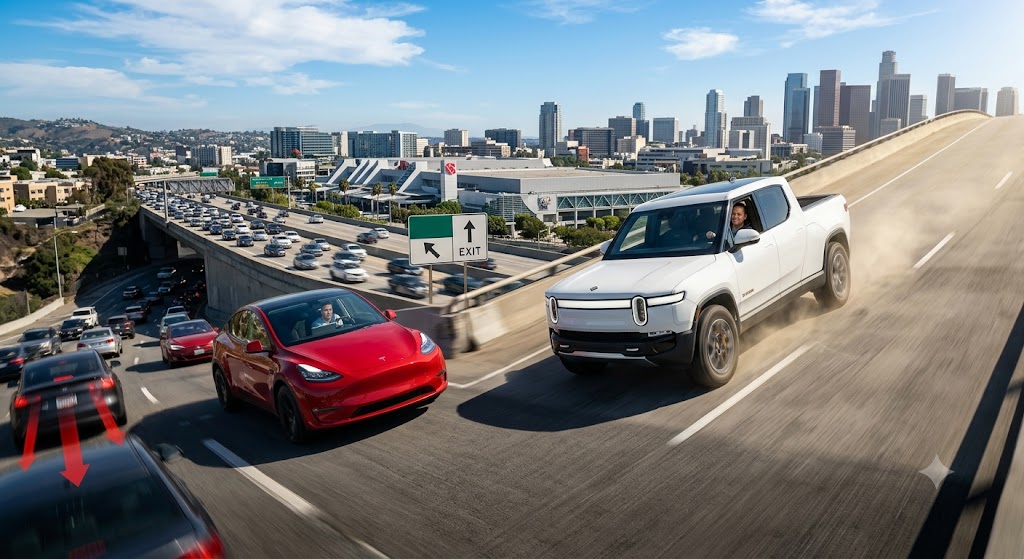
Tesla just delivered the best second quarter in its history — 480,126 vehicles, up 25 percent from a year earlier, roughly 74,000 units ahead of what Wall Street had penciled in. It was the company’s first quarter of annual growth since deliveries peaked back in 2023, the statistical end of a two-year sales slump that bears had spent countless notes eulogizing. And the market’s response? It sold the stock down 7.5 percent, to $393.45, in a single session. On the very same day, a company that shipped fewer than 13,000 cars in three months — barely one-fortieth of Tesla’s volume — jumped more than 15 percent to its highest level since January. Welcome to the great electric-vehicle shakeout of 2026, where the tape has stopped rewarding size and started rewarding slope.
The two tapes that told the whole story
Thursday, July 2, was the last trading day before the Independence Day holiday, and it delivered one of the cleanest illustrations of market psychology you will see all year. The Dow Jones Industrial Average closed at a fresh record near 52,844, up more than 500 points, carried by defensive and consumer names as a soft June jobs report cooled the interest-rate debate. Beneath that placid index-level surface, though, the electric-vehicle complex was tearing itself in two.
On one side stood Rivian, up better than 15 percent, briefly touching $19.79 — a price it had not seen since the second week of January — on volume roughly 155 percent above its three-month average. On the other side stood Tesla, down 7.5 percent, and Lucid Group, down 8.3 percent to $6.08. Three companies, three different verdicts, all handed down in the same eight hours of trading. When a sector’s biggest name posts a record and gets punished while a small-cap posts a modest absolute number and gets celebrated, the market is telling you something important: it is no longer buying the electric-vehicle story as a monolith. It is discriminating, ruthlessly, between the companies that are accelerating and the ones that have plateaued.
Rivian: a small number that pointed in the right direction
Rivian delivered 12,194 vehicles in the second quarter and produced 12,613, comfortably above its own guidance range of 9,000 to 11,000 units. More important than the beat itself was what the company did next: it raised its full-year 2026 delivery outlook to a range of 65,000 to 70,000 vehicles, up from 62,000 to 67,000. In a year when almost every consumer-facing company has been trimming forecasts and hedging language, a guidance raise from a cash-burning EV maker is a rare and powerful signal.
The engine behind that confidence has a name: R2. Rivian began public customer deliveries of its long-awaited mid-size electric SUV on June 9, and the vehicle is the entire investment thesis compressed into sheet metal. The R2 Performance with the Launch Package starts at $57,990, offers up to 330 miles of range and around 656 horsepower, but the number that matters is the one further down the menu: a base price target of roughly $45,000, some $30,000 below the flagship R1S. Rivian is guiding to 20,000 to 25,000 R2 deliveries before the end of the year alone. For a company that has spent its entire public life as a maker of expensive adventure trucks admired by reviewers and ignored by the mass market, the R2 is the bridge from boutique to scale. Thursday’s move was the market pricing in the first evidence that the bridge might actually hold.
Tesla: when a record is not enough
None of this should obscure what Tesla accomplished. Snapping an annual-growth drought that had lasted since 2023 is not a footnote; it is a genuine inflection, and the 74,000-unit beat over consensus suggests the demand cliff bears warned about simply did not materialize this quarter. Refreshed models, aggressive financing and a stabilizing price environment pulled buyers back into showrooms. On the fundamentals, this was a good print.
So why the 7.5 percent drubbing? Three reasons, layered on top of one another. First, positioning: Tesla shares had already run up roughly 13 percent over the four sessions into the report, including a sharp pop on July 1 after the company confirmed the tape-out of its next-generation AI5 inference chip. When a stock has front-run good news, the good news itself becomes the exit. Second, the law of large numbers: 25 percent growth off a base of nearly two million annual units is arithmetically impressive but narratively deflating for a stock that still trades on a hyper-growth multiple. The market does not pay 2023 valuations for 2026 growth rates. Third, mix and margin anxiety: record deliveries achieved partly through incentives raise the uncomfortable question of what those units did to the bottom line — a question the delivery report does not answer and the earnings report will. In a shakeout, the market punishes ambiguity, and Tesla handed it a quarter that was strong on volume and silent on profitability.
Lucid and the cash-burn cohort
If Rivian is the inflection story and Tesla the plateau story, Lucid is the cautionary tale. Its 8.3 percent slide to just over six dollars is the market’s verdict on a company that builds beautiful, technically brilliant sedans in volumes too small to matter and burns cash at a rate that keeps the dilution question permanently open. In the exuberant phase of the EV cycle, from roughly 2020 to 2022, a compelling product and a big addressable market were enough to command a rich valuation. That era is definitively over. The shakeout phase asks a colder set of questions: How many units, at what gross margin, funded by whose balance sheet, on what timeline to breakeven? Lucid has dazzling answers to the first question about engineering and unconvincing answers to all the ones about money. Investors have noticed.
The dispersion between these three names — celebration, punishment, and something close to resignation — is not noise. It is the signature of a maturing industry. Early-stage sectors trade as themes, where a rising tide lifts every ticker with the right keywords. Mature sectors trade as businesses, where capital concentrates in the winners and drains from the also-rans. The EV sector crossed that line in 2026, and the second-quarter delivery reports were the moment the crossing became impossible to ignore.
The incumbents are quietly winning the volume war
Lost in the drama of the American pure-plays is a fact that would surprise anyone who still equates electric vehicles with Silicon Valley: the legacy automakers are shipping far more electric cars than any startup, and most of that volume is flowing through Europe. Volkswagen Group sold roughly 247,900 EVs in Europe last year, up around 50 percent, with global EV deliveries rising more than 30 percent; the group has now crossed four million cumulative electric sales. Its forthcoming ID.Polo, arriving this year at around 25,000 euros, is aimed squarely at the affordable segment that Tesla vacated and Rivian has not yet reached. BMW’s Neue Klasse platform is ramping, and even a struggling Mercedes-Benz and a demand-challenged Porsche are shipping electric volume that dwarfs Lucid’s.
The catch is that the incumbents are caught in a vise. Above them sits Tesla’s scale and software advantage; below them sits a wave of Chinese manufacturers competing on price in a way European cost structures cannot easily match. Volkswagen still missed its EU carbon target last year despite the growth, a reminder that volume and profitability remain in tension across the industry. The lesson for investors is that the EV trade is no longer a single ticker or even a single country. It is a global map of who can build an affordable electric car at a profit — and on that map, the loudest names and the largest volumes do not always belong to the same companies.
The risks hiding inside the bullish tape
It would be a mistake to read Rivian’s surge as an all-clear. Several risks sit just beneath the optimism. Delivery numbers are not earnings; a company can ship record volume and still lose money on every car, and both Rivian and Tesla will have to prove in their upcoming income statements that the units converted into improving margins rather than deeper losses. There is also the perennial question of demand pull-forward: some of this quarter’s strength, on both sides of the shakeout, may reflect buyers rushing to beat the expiration or reduction of purchase incentives, borrowing sales from future quarters. Tesla’s own history is a warning here — the stock’s 13 percent pre-report run means a good chunk of the good news was already in the price, and momentum unwinds faster than it builds.
For Rivian specifically, the R2 ramp is the whole thesis, and manufacturing ramps are where ambitious electric-vehicle companies have historically stumbled. Hitting 20,000 to 25,000 R2 deliveries in six months requires flawless execution on a brand-new production line, and any hiccup would hit a stock that just repriced sharply higher on the assumption of success. Valuation, as always, cuts both ways: the market’s willingness to reward Rivian’s slope over Tesla’s scale can reverse the instant the slope flattens.
The bottom line for investors
The through-line of this quarter is dispersion, and dispersion is what a healthy, maturing market is supposed to produce. For most of the last decade, owning electric vehicles meant owning a theme and hoping the tide kept rising. In 2026 it means owning specific businesses and forming a specific view: Is Rivian’s R2 the beginning of a genuine volume story, or a well-received product from a company that still has to prove it can make money? Has Tesla become a mature growth company that will be valued like one — or is the AI and robotics option value enough to sustain the premium through a plateau in cars? Can the European incumbents defend their volume lead against Chinese price competition without destroying their margins?
Those are the questions the second-quarter delivery reports posed, and none of them will be answered until earnings season fills in the missing profitability picture. Until then, the market has given us its provisional ranking in the only language it speaks fluently — price. It rewarded acceleration, punished a plateau dressed up as a record, and left the cash-burners to fend for themselves. Investors who internalize that the EV story is now a story about individual companies, not a single sector bet, will read the coming earnings reports far more clearly than those still waiting for the whole complex to move together. That era is over. The shakeout has begun, and it is separating the accelerators from the rest one delivery report at a time.
Try TradingView Free for 30 Days
Plus get a $15 discount on your first subscription through this link.