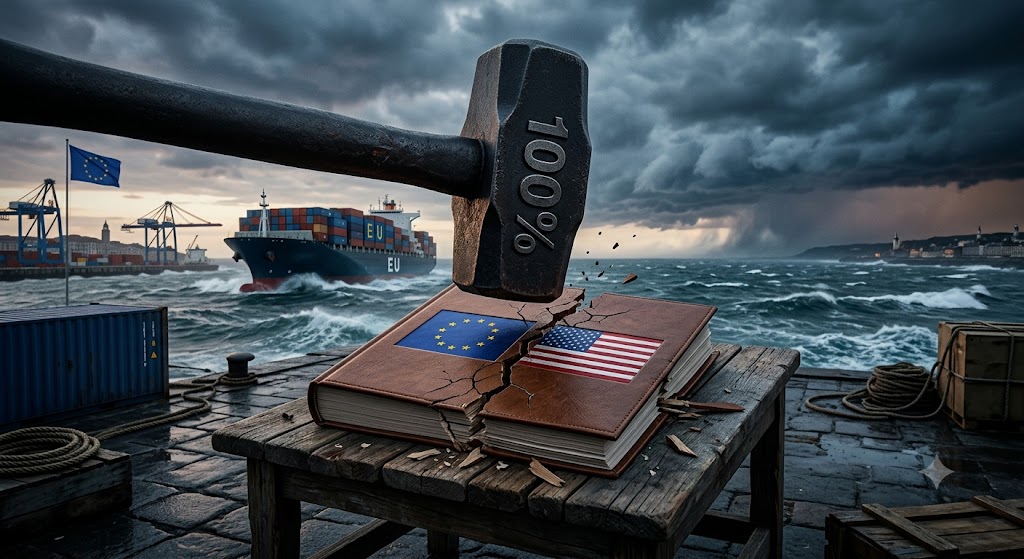
It was supposed to be the summer of transatlantic calm. On July 1, the painstakingly negotiated trade agreement between the European Union and the United States took effect: a ceiling of 15 percent on most EU exports, no stacking of duties, and the abolition of all EU tariffs on American industrial goods. July 4 marked the deadline for full implementation. Investors exhaled, the Dow Jones closed at a record near 52,844 on July 2, and the first half of 2026 went into the books as the strongest since 2021. Yet the ink had barely dried when President Trump lobbed a grenade into the celebrations — and Europe’s digital taxes are the fuse.
A tariff truce, barely two weeks old, already under fire
On the Friday before the long holiday weekend, the president threatened, via an online message, a 100 percent tariff on all goods from any country that levies a digital services tax on American companies. The wording left nothing to the imagination: any country that imposes such a tax will “immediately be met with a 100% TARIFF on any and all Goods sent to the United States of America.” The decisive coda: the measure would supersede any previously negotiated trade agreement — “whether implemented, signed or not.”
With that, Trump has cast doubt on the very 15 percent deal that had carried markets for weeks. Digital taxes were never part of the accord; they remained the raw nerve both sides had chosen to avoid. Now the president unravels the freshly won stability with a single sentence. For a continent whose prosperity rides on exports, this is not diplomatic sparring but an immediate threat to the terms of trade. And for American investors, the irony is sharp: the threat meant to protect U.S. champions could end up taxing U.S. consumers and destabilizing a market sitting at all-time highs.
What the 100 percent threat actually means
To grasp the explosive potential, consider the mechanics. A 100 percent tariff simply doubles the price of an imported good at the U.S. border. A European machinery maker selling equipment for a million dollars into the United States would suddenly see that shipment saddled with a million dollars in duty — the American buyer pays double or sources elsewhere. On margins that are rarely double-digit in heavy industry, that effectively ends the U.S. business for the affected line. Unlike the 15 percent ceiling, which companies can bake into prices and supply chains, a doubling tariff is a prohibition sign.
Then there is the legal potency of the phrase “supersede any trade agreement.” It means that even the freshly sealed 15 percent deal would offer no protection if so much as a single EU member state clung to its digital tax. Washington thereby ties the fate of the entire bloc to the tax codes of individual capitals — making Berlin, Vienna, or Amsterdam co-liable for decisions made in Paris or Rome. That collective liability is precisely what makes the threat so dangerous: it pits EU states against one another and turns a domestic tax debate into a continental trade crisis.
Digital taxes in Europe: the real bone of contention
To understand the conflict, you have to reach its core. Digital services taxes are levies on the revenue of large technology firms that earn enormous sums in a country yet pay little profit tax there, because those profits can be shifted into low-tax jurisdictions. France charged ahead in 2019 with its “GAFA tax” of three percent — named for Google, Apple, Facebook, and Amazon. In its 2026 budget, the French National Assembly has now raised the levy: an initial proposal to quintuple the rate to 15 percent was pared back, but it climbs from three to six percent, while the revenue threshold rises from 750 million to two billion euros.
France does not stand alone. Italy imposes its digital services tax of three percent and is debating a recalibration in its 2026 budget. Spain collects three percent with its own “Google tax,” and Belgium and Latvia match that rate. From the American vantage point, these levies are a targeted burden on U.S. champions and U.S. champions alone, because it is Apple, Alphabet, Meta, Amazon, Microsoft, and Netflix that shoulder the lion’s share. From the European vantage point, this is legitimate fiscal policy against aggressive profit shifting. Between those two truths, no compromise is in sight — which is why the threat is more than a storm in a teacup.
A familiar script: the 2019 digital-tax standoff
Anyone trying to place the current escalation in context should recall the script of 2019 — because at its core it is the same drama. When France introduced its GAFA tax back then, Washington answered with an investigation under Section 301 of U.S. trade law and openly threatened punitive duties on France’s flagship exports: Champagne, handbags, cosmetics, cheese. The list was chosen with care, aimed squarely at the high-margin luxury goods that anchor French pride and its trade balance. Only a fragile truce, tied to hopes for a global solution under the OECD framework, defused the conflict for a time.
The decisive difference today is scale. In 2019 the fight was over punitive tariffs on the order of 25 percent on a narrowly defined list of goods; today the specter is a blanket doubling tariff of 100 percent, explicitly designed to override any trade agreement. Moreover, the OECD’s vision of a unified international digital tax — its so-called Pillar One — never fully entered into force, which is why national digital levies, originally conceived as a stopgap, keep running unabated, and France has actually doubled its rate. The old interim measure has become a permanent fixture, and that is precisely what ignites the new dispute. Investors should draw two lessons from the history: first, these conflicts flare up periodically, and second, they usually end in compromise — but the road there is paved with volatility, and the market rarely prices the détente until it arrives.
U.S. Big Tech in the crosshairs — and why Wall Street pays anyway
One might assume Trump’s threat is a gift to the American technology giants it aims to shield. The arithmetic is not that clean. True, Apple, Alphabet, and Meta would feel a higher European digital tax directly in their earnings, so Washington’s defense serves their short-term interests. But an escalating trade war has no clean front lines. Should the EU respond with counter-tariffs or even the anti-coercion instrument — the mechanism Brussels holds as its sharpest weapon — the U.S. digital titans would find themselves in the crossfire of regulatory retaliation across a market of more than 400 million affluent consumers.
Moreover, in the United States it is not the exporter who pays the tariff but the importer. American retailers, industrial buyers, and ultimately consumers would pay the 100 percent on European goods — from machinery and pharmaceuticals to luxury handbags and sports cars. That is inflationary at a moment when the Federal Reserve is already on a knife’s edge. The latest jobs report, showing just 57,000 new positions against expectations roughly double that, pushed the odds of a July rate hike down to around 20 percent. A tariff shock would reheat price data and squeeze the Fed from both sides. Wall Street, which ended the first half in euphoria, could stumble into a trade war it believed it had averted.
The exposed names: from the Magnificent Seven to the importers
For investors, the concrete names matter. Directly in the frame stand the mega-cap platforms — Apple, Alphabet, Meta, Amazon, Microsoft, and Netflix — whose European revenue would be dented by higher digital levies and whose share prices already carry rich valuations that leave little room for a policy shock. These are the same stocks that powered the Nasdaq’s 12.8 percent first-half gain, so any wobble in the AI-and-platform complex reverberates through the entire index. A market this concentrated in a handful of tech leaders is a market with concentrated risk.
Less obvious but just as exposed are the American importers of European goods. Consumer names that sell European luxury, industrial distributors that rely on German and Italian machinery, and pharmaceutical supply chains threaded through Ireland and the continent would all absorb a doubling tariff. The semiconductor complex, already reeling — the PHLX Semiconductor Index shed roughly 12 percent over two days in early July — sits atop deeply globalized supply lines that a trade rupture would only strain further. Investors holding broad S&P 500 or Nasdaq positions should recognize that a transatlantic tariff war would not spare a single sector; it would compress the earnings multiple of the whole market.
Risks and counterarguments: bluff or accelerant?
For all the drama, the counterpoint belongs on the table. Trump’s negotiating style follows a familiar pattern: maximal threat to extract a last-minute concession. It is entirely possible the 100 percent salvo is leverage meant to bend Paris and Rome on their digital taxes without the tariff ever taking effect. Lending weight to that reading, it remained wholly unclear how the measure would be implemented in practice — broadly against the entire EU or narrowly against individual countries. Equity markets before the holiday reacted with relative restraint, a sign many investors filed the threat under negotiating noise.
Yet investors would be unwise to grow complacent. First, the line between threat and execution has proved thin more than once in this administration. Second, the European side is not in a yielding mood: the European Commission countered at once that unilateral measures against legitimate policy choices are “unjustified,” and pledged to respond “swiftly and decisively” to defend its rights and regulatory autonomy. When both sides negotiate principles rather than prices, compromise grows harder. And third, a market at record highs, undercut by a stumbling chip sector, has no appetite for a second front of pressure. The very strength of the first half — that best-since-2021 rally — is also its vulnerability, because it leaves valuations stretched and sentiment primed to snap.
The outlook: what investors need to know before Monday’s open
When U.S. exchanges return from the long weekend on Monday, July 6, they will meet an altered landscape. The holiday lull granted markets a pause, but the real price discovery around the digital-tax threat is still to come. Astute investors will watch three signals: first, whether Paris and Rome send signals of compromise or defiantly hold their six and three percent; second, whether Brussels escalates the standoff or steps it down; and third, how the export-heavy European indices — the DAX and the CAC 40 above all — react in the first full trading week, since their moves will telegraph how global capital reads the risk.
For a portfolio, moments like these reward the old virtue of diversification across regions and sectors. An investor heavily concentrated in U.S. technology or in European export names should be conscious of the cluster risk a transatlantic trade war would expose. More defensive building blocks — utilities, domestically oriented dividend payers, broad global index funds — cushion such a shock better than concentrated bets on individual tariff casualties. The sober takeaway is this: the 15 percent deal was never the end of the story, only a ceasefire. And ceasefires hold only as long as both sides want them to. For markets on both shores of the Atlantic, a week begins in which tax policy becomes market policy — and in which the fine print of a trade truce may matter more than any earnings report.
Try TradingView Free for 30 Days
Plus get a $15 discount on your first subscription through this link.
Read more in our topic hub: Topic Hub: Geopolitics & Your Portfolio