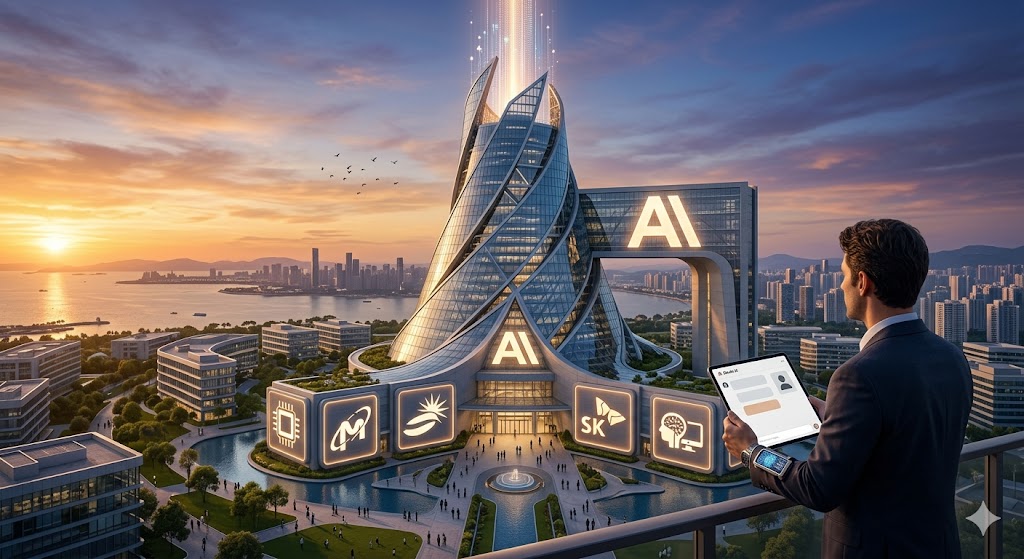
Some numbers you have to read twice. On Thursday, May 28, 2026, the AI company Anthropic — maker of the Claude language model — closed a funding round of $65 billion. Post-money valuation: $965 billion. Just shy of a trillion. With that, Anthropic became, overnight, the most valuable private technology company in the world — overtaking long-time rival OpenAI, last valued at $852 billion in March.
But the truly interesting story isn’t in the headline. It sits further down in the announcement — and it explains why the shares of three chipmakers are rising in Seoul and on Wall Street today. Let’s pull apart both stories: the obvious one and the hidden one.
Daniel’s Take: Why I’m writing this article differently
A quick disclosure up front, because it’s relevant to this article. This entire platform — Butterfly Market Insider, the articles, the stock pages, the tools — is built in large part with Claude, Anthropic’s model. When I write about the $965 billion valuation, I’m writing about a tool I use every day. That doesn’t make me a neutral observer, but it gives me an angle a pure market analyst doesn’t have: I see firsthand why companies pay for this software. More on that below. First, the facts.
The obvious story: a valuation that breaks every record
Let’s start with the bare number. $965 billion. To put it in context: that’s more than the market cap of most Fortune 50 companies. If Anthropic were publicly listed today, it would rank among the twenty most valuable companies in the world — and it’s a company that released its first product just over three years ago.
The speed is unprecedented. In February 2026 — just three months ago — Anthropic was valued at $380 billion. The new round nearly triples that figure. According to PitchBook data cited by the Wall Street Journal, Anthropic’s valuation has climbed faster than that of any company in venture-capital history. The $965 billion mark was reached roughly three years and two months after the first Claude product launched.
The round — a Series H, which is itself remarkable, since few startups ever get that far into the alphabet — was led by Altimeter Capital, Dragoneer, Greenoaks, and Sequoia Capital. Co-lead investors included Capital Group, Coatue, D1 Capital Partners, Singapore’s sovereign wealth fund GIC, ICONIQ, and XN. They were joined by institutional heavyweights: Baillie Gifford, Blackstone, Brookfield, D.E. Shaw Ventures, DST Global, and Fidelity. This isn’t hype capital from fortune-seekers — this is the who’s who of global institutional money management.
Why a private valuation should matter to you as an investor
Anthropic isn’t publicly listed. You can’t buy the stock. So why is this relevant to a retail investor? For three reasons.
First, because a $965 billion valuation of a private company recalibrates the entire publicly traded AI sector. If the private market is willing to pay nearly a trillion for an AI-model company, that sets a reference point for valuing Microsoft, Google, Nvidia, and every other name with AI exposure.
Second, because the round signals an IPO. According to several investors and bankers familiar with the company, Anthropic’s pursuit of private capital coincides with preparations for a public listing. This Series H may be the last private round before going public. Both Anthropic and OpenAI plan to tap the public market, possibly as soon as this year. For you, that means a potentially historic IPO is on the horizon.
Third — and this is the real core of this article — because the investor list tells you which publicly traded stocks benefit from this boom. And here’s where the hidden story comes in.
The hidden story: three chipmakers buy in
In the announcement, further down where most headlines stop looking, are three names that are unusual for a funding round of this kind: Micron Technology, Samsung Electronics, and SK Hynix. The three largest memory-chip manufacturers in the world joined the round as “strategic infrastructure partners.”
This is new. For the first time, memory makers are taking direct stakes in an AI-model company. Anthropic describes the three as firms whose technology is central to the world’s supply of memory, storage, and logic chips. And this is exactly where the signal lies.
Why would a memory-chip maker buy into the very company that’s supposed to buy its chips? The answer is defensive and offensive at once. Defensive: Micron and SK Hynix gain insight into the future memory requirements of AI models — they want to know what specifications the next generation of memory must have before the competition does. Offensive: they secure a first-mover advantage in defining the next memory standards.
And with Samsung there’s even more behind it. Of the three partners, only Samsung owns a standalone foundry division — the ability to manufacture logic chips on contract. Anthropic’s announcement explicitly mentions “logic chips,” whose manufacturing depends on foundry processes. Industry observers read this to mean that the collaboration between Anthropic and Samsung could extend beyond pure memory procurement — possibly into contract chip manufacturing. Anthropic hasn’t commented further, but the mere possibility lifted Samsung’s stock in Seoul on Friday.
The compute land grab: ten gigawatts
What does Anthropic need $65 billion for? The answer is computing power — on a scale that defies imagination. In recent weeks, the company has signed a series of compute agreements:
With Amazon: access to up to five gigawatts of new capacity. Amazon had announced in April it would invest up to $25 billion in Anthropic — in return, Anthropic commits to spending more than $100 billion over the next ten years on Amazon’s cloud technology. $5 billion from Amazon alone is part of the current round.
With Google and Broadcom: a further five gigawatts of capacity for next-generation TPUs — Google’s own AI-accelerator chips.
With SpaceX: access to GPU capacity in the Colossus 1 and Colossus 2 data centers.
In total: up to ten gigawatts of new AI computing capacity. For comparison — that’s equivalent to the output of several large nuclear power plants, solely to train and run AI models. Claude runs on Amazon Web Services, Google Cloud, and Microsoft Azure, with AWS remaining Anthropic’s primary cloud and training partner.
These numbers are the real proof that the AI capex wave we wrote about this week with Dell and Snowflake isn’t a flash in the pan. When a single company contractually locks in ten gigawatts of computing power, that’s a demand signal that runs through the entire supply chain — from Nvidia through the memory makers to the energy utilities.
Anthropic vs. OpenAI: the duel of the giants
With this round, the hierarchy flips. OpenAI, the company behind ChatGPT, was long considered the undisputed market leader. The last known OpenAI valuation was $852 billion in late March. Anthropic, founded in 2021 by former OpenAI staff, has now overtaken it at $965 billion.
This is more than a status symbol. Both companies are preparing for public listings — possibly this year — in order to finance the very computing resources that power their services. Whichever goes public as the more valuable company has an advantage in raising capital. And that in turn decides who can afford more computing power in the coming years — the decisive factor in the AI race.
The revenue reality: $47 billion run-rate
What separates this valuation from a pure hype bubble is the revenue behind it. According to Anthropic CFO Krishna Rao, annualized run-rate revenue crossed the $47 billion mark earlier this month. The company expects to post its first operating profit in the second quarter.
To gauge the speed: a year ago, annualized revenue was still in the single-digit billions. This is one of the fastest revenue ramps corporate history has ever seen. The main driver is enterprise-customer adoption — and a product that has become a standard in developer circles: Claude Code, the tool programmers (and solo founders like me) use to build software.
A $965 billion valuation against $47 billion in revenue gives a ratio of roughly 20. That’s high — but not absurdly high for a company that has multiplied its revenue within twelve months and stands at the threshold of profitability. The question isn’t whether the growth is real. The question is whether it continues at this pace.
Daniel’s Take, extended: What I see at the front line
Now the angle I promised. I build this platform almost entirely with Claude. The articles you read, the 570-plus stock pages, the tools, the data pipelines — much of it is created in collaboration with Claude Code, often overnight in automated queues. I’m a single person in Austria, running a platform that a few years ago would have required a small team.
This is the actual thesis behind the $47 billion in revenue. Anthropic isn’t selling a gimmick. It’s selling something that genuinely multiplies the productivity of individuals and small teams. When I pay monthly for access and it lets me do alone what otherwise would require employees, then for me this software isn’t an expense — it’s a lever. Multiply that by hundreds of thousands of companies and developers, and you understand where the revenue comes from.
But — and this is the honest flip side — I also see the dependence. When my entire output rests on a single provider’s tool, then its pricing, availability, and strategic direction are a risk to me. This exact dependency pattern, multiplied across the whole economy, is simultaneously Anthropic’s greatest strength and the biggest systemic risk of the entire AI valuation wave. The companies paying today are locked in tomorrow. That’s bullish for Anthropic — and it’s precisely why, as an investor, you should keep an eye on the concentration of this market.
What this means mathematically
Let’s run the chain. Anthropic locks in ten gigawatts of computing power. That computing power consists of chips — Nvidia GPUs, Google/Broadcom TPUs, and within each of these systems sits an enormous amount of memory from Micron, Samsung, and SK Hynix. That’s exactly why the memory makers are buying in: they’re securing not just a financial stake, but a seat at the table in defining what they’ll be selling.
For an investor, this yields a concrete map. The direct beneficiaries of this one round aren’t just Anthropic itself (private, not tradable), but the publicly listed supply chain: the memory makers (Micron is U.S.-listed and tradable), the accelerator-chip designers, the cloud providers Amazon, Google, and Microsoft, and the energy and infrastructure companies that have to supply ten gigawatts in the first place.
Three scenarios
Scenario 1 — The IPO comes and ignites (~45%): Anthropic goes public this year, possibly simultaneously with or shortly after OpenAI. If the $965 billion valuation holds up in the public market, it validates the entire AI valuation structure and propels the supply chain further. Bullish for memory, chips, cloud.
Scenario 2 — The IPO comes, but the market is skeptical (~35%): Anthropic goes public, but public investors value it more cautiously than the private market. A downward revision of the valuation would be a warning signal for the whole sector — even if the operating business stays strong. Volatility across the chain.
Scenario 3 — Delay or cooldown (~20%): The IPO is delayed, or AI capex demand cools faster than expected. Then the ten-gigawatt contracts and the high valuations prove premature. The strategists who warned of “froth” this week would be proven right.
What smart money is doing
The institutional participation in this round is itself the smart-money signal. When Blackstone, Fidelity, Baillie Gifford, and a sovereign fund like GIC join a Series H at nearly a trillion in valuation, that says: the world’s most patient and largest capital managers believe there’s still upside here — even after the tripling in three months.
At the same time, what we observed this week persists: experienced public-market investors like Druckenmiller and Tepper are positioned in energy — and energy is exactly what ten gigawatts of computing power consumes. Smart money isn’t betting directly on the AI models, but on the shovels and the electricity for the gold rush.
What investors should concretely do
- Play the supply chain, not the hype: You can’t buy Anthropic. But the publicly traded beneficiaries of AI infrastructure — memory makers, cloud providers, energy utilities — are tradable. Ask of every name: is this company selling shovels in this gold rush?
- Keep the IPO on the watchlist, but don’t buy blind: When Anthropic or OpenAI go public, the hype will be enormous. The first trading day rarely means the best entry price. Patience beats FOMO.
- Understand concentration risk: A large part of 2026’s market gains hangs on a handful of AI-related names. Check how heavily your own portfolio depends on this one theme.
- Chip valuations with caution: Micron has eight-folded in twelve months. The memory makers’ Anthropic stake is bullish long-term — but the short-term price has already priced much of it in.
- Plan for taxes: Gains from U.S. stocks like Micron are subject to capital gains tax in your jurisdiction plus possible U.S. withholding. Calculate net.
The honest bottom line
$965 billion for a company that had its first product three years ago. That’s either the fastest legitimate value creation in economic history — or the clearest symptom of a valuation euphoria that doesn’t yet have a name. It’s probably both at once.
What can’t be argued away: the revenue is real, the demand is real, and the fact that the world’s three largest memory makers are buying in not just as suppliers but as shareholders shows how deep this wave reaches into real industry. This isn’t a crypto phenomenon without substance. This deals in physical chips, real data centers, and gigawatts of electricity.
The question for you as an investor isn’t whether AI changes the world — it already is, I experience it daily building this platform. The question is whether today’s valuations correctly price future profits or have run miles ahead of them. At $965 billion for a private company, the answer is probably: a bit of both. And it’s precisely in that “a bit of both” that all the risk and all the opportunity of the coming years lie.
Try TradingView Free for 30 Days
Plus get a $15 discount on your first subscription through this link.
Read more in our topic hub: Topic Hub: AI Stocks Investing 2026