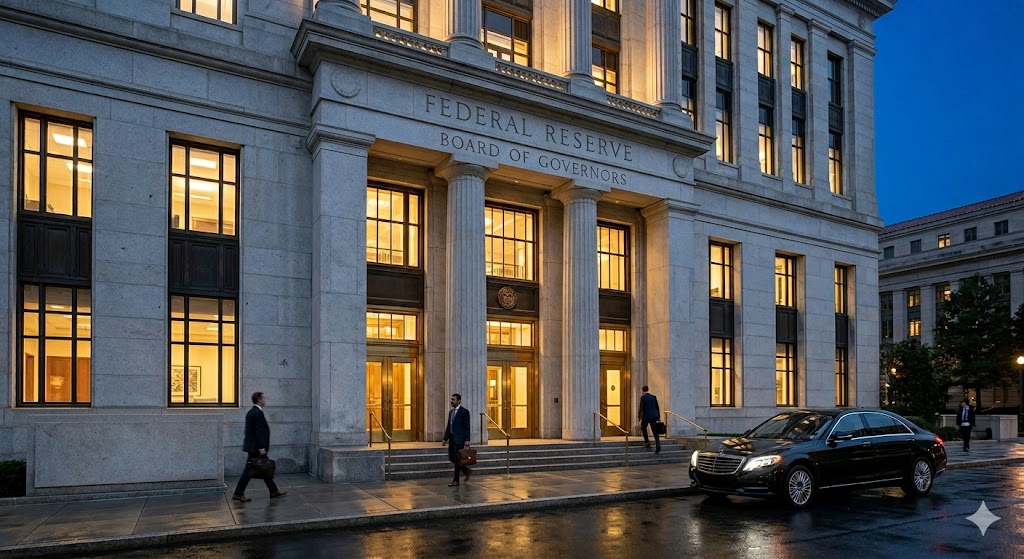
It was Kevin Warsh’s first appearance as Chair of the Federal Reserve — and it ended as the worst debut Fed day for a new chair since February 1994. The S&P 500 fell 1.21 percent on Wednesday to close at 7,420.10, the Nasdaq Composite slid 1.34 percent to 26,021.66, and the Dow Jones Industrial Average shed 507 points or 0.98 percent to finish at 51,492.55. Bespoke Investment Group calculated that no new Fed chair has posted a weaker S&P 500 close on his own first meeting day in more than three decades. BMInsider warned over the weekend that this hawkish scenario was on the table — by Wednesday evening, reality landed at the most aggressive end of the spectrum.
The headline read harmless: the Fed kept the federal funds target range at 3.50 to 3.75 percent with a unanimous vote — exactly what futures markets had priced at 98 percent probability. The real signal came from the revised Summary of Economic Projections, from a dramatically shrunk policy statement, and from a press conference in which Warsh openly questioned the central communication tool he inherited from Jerome Powell. For investors who have spent the year betting on a fourth-quarter rate cut, the message was a cold splash of water.
The Dot Plot Shock: Nine of Eighteen Want to Hike
The Summary of Economic Projections is the real earthquake. In the March release, the median dot for the end of 2026 sat at 3.4 percent, implying a 25-basis-point cut. The June median jumped to 3.8 percent. That is not just a 40-basis-point repricing of the median expectation. It is a full reversal of direction: instead of a coming cut, the dots now imply at least one hike before December.
Nine of the eighteen FOMC participants now see at least one rate increase by year-end, and six see two. Eight expect rates to stay put, and one outlying dove still pencils in a cut. That distribution is split more sharply than at any point in this cycle — and the market has to live with the fact that the probability of a hike on October 28 or December 16 is no longer academic. Fed funds futures by Wednesday evening had fully priced one quarter-point increase by year-end, a roughly 35-basis-point move from before the meeting.
Equally striking: the inflation projection moved higher. The median 2026 PCE forecast rose to 3.6 percent, a massive jump from the 2.7 percent the Fed pencilled in March. With that, the central bank is officially acknowledging that May’s 4.2 percent CPI print was not a one-off — tariffs, wage costs and energy are pushing structurally again. Anyone betting on a quick return to the two-percent path got an honest read on where the FOMC actually stands.
Warsh Refuses to Submit a Dot
The most unusual moment of the press conference came when a reporter asked where Warsh himself sits on the dot plot. The answer: he did not submit one. The chair of the most powerful central bank on the planet publicly abstained from the instrument that has shaped market expectations since 2012. Warsh said he considers the SEP in its current form unhelpful for policy and that one of the five new task forces he announced will examine whether to scrap or rebuild it.
That is more than a stylistic break. It is a direct dismantling of the Powell legacy. Powell elevated forward guidance through the SEP and the press conference into the central monetary tool of his tenure. Warsh signals he wants to reform or even eliminate it. For Wall Street strategists who have spent a decade calibrating their models against the dots, that is a piece of information with a half-life of probably one meeting. Anyone using the plot as an anchor now knows the anchor is loosening.
114 Words Instead of 300: The Shortest Statement in Decades
The official statement, which has typically run 300 to 350 words, came in this time at roughly 114 to 130 words — depending on how one counts the bullet sections. The entire forward-guidance paragraph is gone. Standard phrases like “patient”, “data-dependent” or the usual line that “further action may be appropriate” are nowhere to be found. Warsh told the press conference that the statement is “a bit shorter, a bit simpler and dispenses with older language.”
For anyone who has built a career parsing Fed text line by line, that change strips away the most reliable forward signal of the cycle. The bond-trader argot in which every removed or added half-sentence triggered billion-dollar moves is dead. In its place is a central bank that makes its decision and leaves it at that. For investors the consequence is two-sided: less noise between meetings, but also less warning before the big pivots.
Five Task Forces: Warsh Rewires the Fed
Beyond the meeting itself, Warsh announced five working groups expected to report by the fall or year-end. The topics: first, communications — meaning the statement, the dot plot and the press conference format. Second, the Fed’s balance sheet, which is still in its run-off phase. Third, the data sources the Fed relies on — a direct jab at the repeatedly revised BLS payroll numbers. Fourth, productivity and the labor market, with a clear eye on the structural impact of AI and immigration. Fifth, the inflation framework itself, meaning the average-inflation-targeting regime introduced in 2020.
That is the most ambitious internal reform the Fed has undertaken since the Global Financial Crisis. And it comes from a chair nominated by President Trump with the explicit political mandate to make the central bank leaner and faster. The fact that Warsh announced all of it within his first 48 hours in the role tells markets one thing clearly: this Fed will change, and the change will be fundamental.
The Market Reaction in Numbers
Wednesday’s selling was broad but concentrated in rate-sensitive segments. Semiconductors took it on the chin, because the longest-duration cash flows are most exposed to higher discount rates — the Philadelphia Semiconductor Index underperformed the broad market by a wide margin. Software and cloud names dropped meaningfully. Inside the Dow, Microsoft, Nvidia and Salesforce led the index lower. Banks held up better, because a higher terminal rate protects the net-interest margin, but even there gains were modest.
The bond market told the story even more cleanly. The two-year Treasury yield, the cleanest mirror of Fed expectations, jumped 16 basis points to 4.208 percent. The ten-year yield climbed to 4.46 percent, the highest level since mid-May. The dollar index DXY rose noticeably, and EUR/USD slipped below 1.07. Gold, which had run toward 4,300 dollars an ounce, reversed and closed near 4,275 — short-term real yields are the natural kryptonite of any zero-coupon hedge.
Bitcoin, which had already decoupled from the equity highs of the prior week, slid further. The narrative that crypto hedges inflationary pressure only holds while real rates stay low. Warsh’s message — that the Fed would rather fight inflation with another hike than with patience — cuts the legs out from under that thesis.
What U.S. Investors Need to Watch Now
For dollar-based investors, the playbook just shifted. The October 28 and December 16 FOMC meetings now carry real hike risk, and pricing across the Treasury curve will keep adjusting. The first inflection point is the June CPI release on July 10. If headline inflation comes in below the May 4.2 percent print and core CPI eases from 3.1 percent, expect the dot plot to be partially repriced lower before the next meeting. If CPI surprises higher, the market will start to price a second hike — and the December 16 meeting becomes the most consequential of the year.
Sector allocation matters more than usual. Higher-for-longer rates favor regional banks, energy and consumer staples that already pay solid dividends; they punish unprofitable growth, high-multiple software and any cash-burning narrative stocks. Within mega-cap tech, the relative trade favors names with massive free cash flow — Apple, Microsoft, Alphabet — over the high-multiple AI infrastructure plays that have run the most. For Magnificent Seven holders, the question is whether the AI capex story can sustain its premium against a real ten-year above 4.4 percent. Nvidia is the swing trade.
Earnings start mattering again the second week of July. JPMorgan, Wells Fargo and Citigroup kick off the bank season, and their net-interest-income guidance will reveal whether the higher-for-longer scenario actually flows through to bank profits. If it does, financials become the rotation winner. If not, the hawkish dot plot looks more like a policy mistake than a forecast.
The Risks and Counter-Arguments
Before declaring the Warsh pivot a permanent regime change, it is worth checking the open risks. First: the dot plot has been a famously unreliable indicator. In December 2023, the median dot showed three cuts for 2024 — fewer arrived. In June 2024 the median saw two hikes for 2025, and a single cut came. The dots show today’s mood, not tomorrow’s outcome.
Second: Warsh himself did not lock in. By refusing to submit a dot, he keeps every option open. It is entirely possible that the chair is internally softer than the median of his colleagues — and that on October 28 or December 16 he simply doesn’t muster the majority for a hike if the data have rolled over by then.
Third: the May CPI print was partly driven by a statistical base effect, and underlying core inflation stood at 3.1 percent. If June CPI comes in at 3.8 or 3.9 percent on July 10, the June 17 dot plot will look stale within four weeks. The Fed reacts to data, not to dots — and that is precisely the subtext of Warsh’s statement edit.
Looking Ahead: Juneteenth Pause and the July Calendar
One quirk of this week: U.S. markets are closed on Friday, June 19, for Juneteenth. Thursday, June 18, is the last full session before the long weekend. Liquidity is likely to thin out, and many traders will square positions before the break — that thin-liquidity layer often exaggerates moves that are already in motion fundamentally. Anyone planning to carry long exposure into Friday should be aware of gap risk on Monday’s reopen.
July will decide whether Warsh actually delivers. The core dates are clear: June CPI on July 10, June PCE — the Fed’s preferred gauge — on July 31. Sandwiched between them is the Q2 earnings season, which kicks off with the big U.S. banks in the second week of July. If inflation cools surprisingly and earnings hold up, the hawkish dot plot can be repriced within four weeks. If not, markets will need to accept a terminal rate above 4 percent — and that is a valuation question for every single multiple.
What June 17, 2026 has done definitively is make clear that the Powell era of forward guidance is over. Anyone trading equities can no longer rely on the Fed to telegraph its big turns reliably between meetings. What counts now are the data — and the question of how a chair behaves who, at his very first press conference, would rather tear down the dot plot than submit a single point of his own.
Try TradingView Free for 30 Days
Plus get a $15 discount on your first subscription through this link.
Read more in our topic hub: Topic Hub: Fed Policy, Rates & Bonds 2026