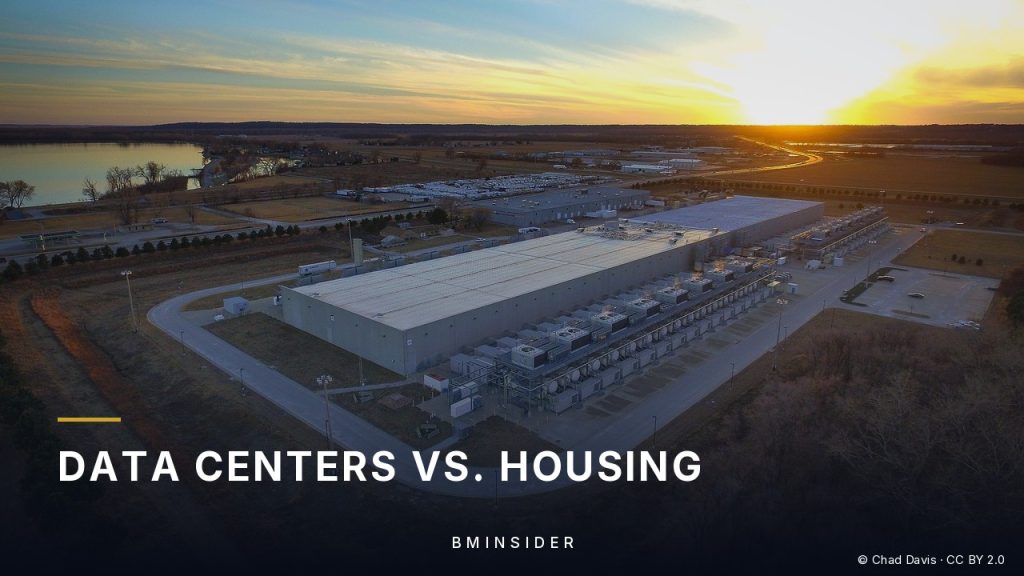
Two numbers four billion dollars apart, and yet they mark a turning point. In the second quarter of 2026, the United States invested $752 billion, adjusted for inflation, in information-processing equipment — servers, computers, networking gear, the guts of every data center. Residential investment in the same quarter came to $748 billion. For the first time in the history of the national accounts, the line labeled “computers” sits above the line labeled “housing.” Adam Shapiro, a vice president at the Federal Reserve Bank of San Francisco, laid the two series from the Bureau of Economic Analysis on top of each other and published the crossover over the weekend. His comment was brief: “The AI investment boom is massive.” Wall Street did not read that as a warning on Monday morning but as confirmation — Nasdaq-100 futures led the rally, up around one percent, while oil fell for a fourth straight session and Brent slipped below $101. But the number explains more than a single session. It explains why the Dow just had its worst week since March while the Nasdaq still gained. It explains why Lennar is printing 52-week lows while Hochtief raises guidance. And it explains why the Fed’s first rate hike since 2023 bounces off one half of the economy and lands squarely on the other.
What the two lines actually measure
Before the figure hardens into a slogan, the definitions deserve a look, because they are narrower than the headline suggests. “Information-processing equipment” in the BEA taxonomy is a subcategory of nonresidential equipment investment: computers and peripherals, communications equipment, instruments, other IT hardware. The buildings that house this hardware — the actual data-center halls with their cooling towers and substations — are booked elsewhere, under nonresidential structures. Software, itself a multi-hundred-billion-dollar line, sits under intellectual-property products. The $752 billion is therefore only the hardware layer of the AI build-out, not the whole build-out. Add the halls and the software and the total is considerably larger.
On the other side, “private residential fixed investment” is fairly comprehensive: new single-family and multifamily construction, renovations, brokers’ commissions on sales of existing homes. At $748 billion it is roughly 18 percent below its early-2021 peak, when zero rates and pandemic demand pushed the sector above $900 billion. Hardware investment has risen by about half over the same span. The crossover is not the fluke of a single quarter but the product of five years in which one line fell while the other climbed.
A second caveat concerns the phrase “adjusted for inflation.” The BEA quality-adjusts computer investment: a server that delivers twice the compute of its predecessor at the same price counts as twice the real investment. Falling prices per unit of computation inflate the real series relative to the nominal one. That is methodologically correct — the economy really is getting more compute — but it means the nominal dollars actually leaving hyperscaler bank accounts are not identical to the $752 billion. For the question of who gets paid on the stock market, the nominal money is what counts anyway. And that can be pinned down more precisely.
470, 870, 1,300: the capex staircase of the six hyperscalers
S&P Global Ratings added up the investment budgets of the six largest operators at the end of August — Alphabet, Amazon, Microsoft, Meta, Oracle and SpaceX, which with its orbital data-center plans now plays in the same league. The result reads like a staircase: $470 billion in 2025, an expected $870 billion this year, more than $1.3 trillion in 2027. The step from 2026 to 2027 alone roughly equals the entire 2025 budget. By company, Alphabet leads with about $357 billion projected for 2027, followed by Amazon at $319 billion, SpaceX at $197 billion, Microsoft at $189 billion, Meta at $164 billion and Oracle at $95 billion.
The real point of the S&P report, however, is not on the capex line but on the cash-flow line beneath it. Five of the six companies, on the rating agency’s models, will report negative free operating cash flow in 2027 — spending more on infrastructure than the running business brings in. Alphabet at minus $83 billion, Amazon at minus $60 billion, Oracle at minus $42 billion, SpaceX at minus $114 billion. Only Microsoft, the sole AAA-rated name in the group, stays positive at around $34 billion. The gap is filled with bonds, leases, joint ventures, special-purpose vehicles and residual-value guarantees — instruments that are less visible on the balance sheet than plain debt. Microsoft has built up $329 billion in future lease obligations, Meta $279 billion. S&P names 2028 as the inflection point at which revenue should accelerate and capex growth should moderate. The word “should” carries a lot of weight there.
Why the rate hits one line and misses the other
Shapiro’s second observation is the more important one for investors: housing is the most rate-sensitive sector in the economy, while AI investment has so far been almost rate-insensitive. That is not theory; it is observable. The Fed raised the funds rate to 4.00 percent on September 16, its first hike since 2023. The 10-year Treasury yield had already crossed five percent the week before, its highest level since July 2007. The 30-year mortgage costs 6.95 percent according to Freddie Mac, up from 6.76 percent a week earlier. Housing starts fell 2.6 percent in August to an annual rate of 1.275 million units.
And the hyperscalers? Alphabet raised $80 billion in a stock offering in June, Oracle is funding $95 billion of capex through prepayments and a share sale, and SoftBank is exploring a junk-bond sale of more than $11 billion to finance its OpenAI stake. None of these companies has canceled a data center because the 10-year yields five percent. The reason is simple: a homebuyer amortizes over 30 years and has no alternative to a mortgage. A hyperscaler assumes a five-year useful life for a GPU cluster and fears one thing above all — that the competitor gets the cluster first. The Motley Fool’s take on the S&P report captures the boardroom logic: not committing the capital would be the greater risk, because you would fall behind a technology that could very well change society. Whether that is right will become clear in 2028. Until then, demand for servers, transformers and cooling systems is as good as written into contracts.
The losers of the reallocation: Lennar, D.R. Horton and the builders
Anyone who wants to see what the lower line looks like on a stock chart need only look at the numbers Lennar reported last week. Adjusted earnings of $1.23 per share against a $1.29 consensus, revenue of $8.05 billion against $8.32 billion expected — and that against estimates that had already been cut. Gross margin on home sales stands at 15.8 percent; in 2022 it was close to 30. To sell at all, Lennar is offering buyer incentives worth 12 percent of the sales price — rate buydowns, closing-cost credits, upgrades. The stock fell to $76.07, a new 52-week low, more than 25 percent below where it started the year and over 40 percent below its level twelve months ago.
D.R. Horton, the industry leader, reported essentially zero revenue growth last quarter and a cancellation rate of 20 percent, up from 17 percent a year earlier — one buyer in five walks away between contract and closing, usually because the financing falls through. PulteGroup’s revenue fell nearly ten percent. The median price of a new home is $410,700; at a 6.95 percent mortgage rate that translates into a monthly payment the median household simply cannot carry. Then there is the competition from existing stock: in Florida alone, roughly 147,000 resale homes are on the market. The builders are not just competing with the rate; they are competing with their own customers from three years ago, who now want to sell.
That is the mechanism behind last week’s Dow weakness: the price-weighted index is packed with industrial, financial and consumer names tied to the rate — Home Depot, Caterpillar, the banks, the insurers. The Nasdaq is packed with companies that either spend the capex or collect it. Two indices, two lines, one country.
The winners: who collects the $870 billion
On the receiving end the numbers are a mirror image. Vertiv, the specialist in data-center power and cooling, raised its 2026 revenue guidance to $13.5–14.0 billion; the second quarter brought 24 percent revenue growth to $3.27 billion at an adjusted operating margin of 22.6 percent, with a backlog above $15 billion. Eaton, the electrical-equipment group, grew quarterly revenue 21 percent to $8.5 billion and beat its own earnings guidance. Both companies get paid on every data center that gets built, regardless of whether it is ever fully utilized — the transformers and cooling loops are invoiced before the first query hits the language model.
And the construction side is growing even faster than the hardware: according to ConstructConnect data, data-center projects worth $81.5 billion broke ground in the first half of 2026 alone, more than the $72.5 billion for all of 2025 and more than triple the 2024 figure. January alone brought $25.5 billion, a monthly record. The average facility now approaches 700,000 square feet, double the 2022 figure. Roughly 1,500 further projects are in planning. Median construction costs per project are up 17 percent — and that is the flip side for housing: the electricians, concrete finishers and steel erectors working on a $700 million server hall in Virginia are missing from a townhouse development in Texas.
The picks-and-shovels trade beyond the S&P 500
The clearest way to own the upper line without owning the return-on-capital risk is the builders of the halls, and the biggest of those is not American. Hochtief, the German construction group whose U.S. subsidiary Turner is North America’s largest data-center contractor, raised its 2026 profit guidance in the summer: operational net profit rose 35 percent to €480 million in the first half, and the order backlog grew 23 percent to a record €84.8 billion — about two years of revenue. Data centers now account for 42 percent of Turner’s backlog; more than €21.6 billion of data-center orders came in over the last twelve months, double the prior year. Recent wins include Meta sites in the U.S. and Canada and an NTT facility in Berlin. Hochtief earns construction margins on exactly the curve Shapiro describes, without betting on whether the GPUs ever pay for themselves.
The same logic runs through the equipment chain: Siemens Energy in Munich with transformers and gas turbines to power the campuses, Schneider Electric in Paris as Europe’s answer to Vertiv and Eaton, ABB in Zurich, Infineon with power semiconductors for in-rack distribution, ASML at the top of the chip stack. Alongside the obvious U.S. names — Nvidia, Broadcom, Arista, Caterpillar’s generator business, the utilities Dominion and Constellation — that is a long list of companies whose revenue is contracted before the hyperscalers know whether the models will be profitable. The catch is that none of them is a secret anymore. Vertiv, Eaton, Siemens Energy and Hochtief have their multi-bagger years behind them, and each is now judged on whether order intake grows double digits again next quarter. The moment a growth rate drops from 50 percent to 30 percent is often more painful for the stock than any rate hike — even though 30 percent growth would count as a triumph in any other industry.
Europe, meanwhile, lacks the upper line almost entirely. European hyperscaler budgets are a fraction of the American ones, and the large data-center projects in Frankfurt, Dublin or Berlin are predominantly financed by U.S. companies. Europe builds the halls and ships the turbines — someone else carries the bet on the return. The housing side looks different too: German building permits rose 1.9 percent in July and 12.9 percent year-to-date, a recovery from a very low base, tied to a European Central Bank that is in no mood to hike. The reallocation from homes to computers is, for now, an American phenomenon.
The risks: overcapacity, politics and the voter
The S&P report does not end in applause but in a watch list: monetization of AI investment, durability of demand, overcapacity risk, and the treatment of contractual commitments as debt-like obligations. If demand lags the build-out, overcapacity follows — and unlike an empty house, which can still be sold in ten years, a GPU cluster is technically obsolete after five. The depreciation math is merciless. That is exactly why last week’s signals from the delayed OpenAI IPO and from SoftBank were received so nervously: every delay on the revenue side pushes the 2028 inflection point back, while the capex commitments stay where they are.
The second risk is political and new. An NBC News poll of 1,000 registered voters conducted September 11–15 found that 64 percent would be less likely to vote for a candidate who backed building a data center in their community — 51 percent “much less likely.” Only 11 percent saw it as a plus. An Economist/YouGov survey in late August found nearly two-thirds opposed to a data center in their own community. Granted, only two percent of voters name data centers as the country’s most pressing issue, far behind inflation and the cost of living at 28 percent. But the two are connected: data centers push up local power prices, consume water and — see above — pull construction workers away from housing. Six weeks before the midterms, that is an argument governors and county boards hear. Permitting, tariff structures and water rights cannot stop the build-out, but they can make it slower and dearer. For Hochtief and Vertiv, delay is a backlog that lasts longer; for Alphabet and Amazon, it is a return that arrives later.
The third risk is the most ordinary: valuation. The market has priced the suppliers for perfection and the hyperscalers for 2028. Neither price leaves much room for the third estimate of second-quarter GDP, due this week, to revise the crossover away — but it leaves even less room for a quarter in which the capex guidance is merely maintained rather than raised.
Bottom line: the number is a condition, not an event
752 versus 748 is not news to trade on Tuesday. It describes a condition that has been forming for years and that this week’s third BEA estimate for the second quarter will either confirm or shift by a few billion. The condition is this: the United States now invests more, in real terms, in computing than in homes, and the investors in computing do not care about the interest rate, while the investors in homes cannot care about anything else. The Fed, which on September 16 hiked against expectations rather than against prices, can push the lower line further down with its policy rate. It cannot reach the upper one — there, six boards of directors and their fear of finishing second make the decisions.
For investors that yields an uncomfortable but clear taxonomy. Those who believe in 2028, the inflection point at which the models start paying for the halls, buy the hyperscalers and carry the cash-flow risk. Those who believe only in the construction, not the return, buy the suppliers — Hochtief, Vertiv, Eaton, Siemens Energy — and accept the valuation. And those who buy the lower line, the homebuilders at 52-week lows, are not betting on houses but on the Fed cutting again in 2027. All three bets are legitimate. Only one of them was rewarded with a one-percent Nasdaq gain on Monday morning — and it is also the most expensive. Anyone reading the weekend’s number as a signal should read it this way: not as proof that the AI bet pays off, but as proof that it is large enough to crowd out everything else. That is the reason to take the risk seriously — and the reason the suppliers still deliver the better return per unit of nervousness than the operators.
Try TradingView Free for 30 Days
Plus get a $15 discount on your first subscription through this link.