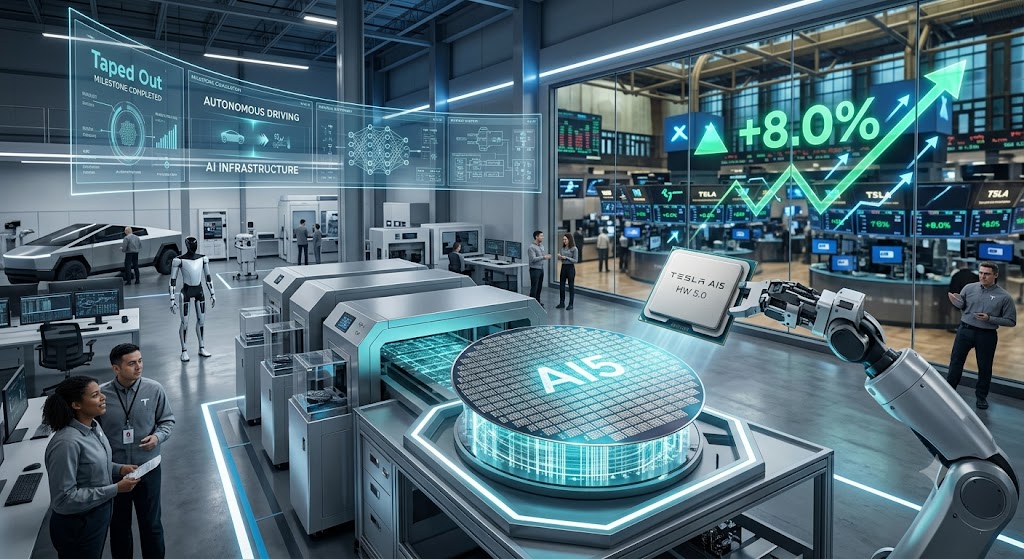
Elon Musk did not unveil a new car, a cheaper Model, or another robotaxi city. He announced a chip. And with a single post confirming that Tesla’s next-generation AI5 processor had “taped out,” the stock did something it had not managed in weeks: it ripped higher by roughly 8 percent in a single session, its sharpest one-day gain in more than a month, capping a rally of about 13 percent across three trading days. For a company whose bull case has quietly shifted from selling electric vehicles to selling artificial intelligence on wheels, the market’s message was unmistakable. This was the milestone Tesla investors had actually been waiting for.
The timing was telling. The announcement landed just as Wall Street closed out its best quarter since 2020, with the S&P 500 up nearly 15 percent and the Nasdaq up more than 21 percent for the three months, and just as a fresh rotation back into semiconductors lifted chip names across the board. Into that risk-hungry tape, Tesla dropped a story that ties it directly to the most powerful narrative in the market — custom silicon for artificial intelligence — and traders responded accordingly. But behind the price action sits a genuinely consequential engineering and strategic step, one worth understanding beyond the ticker.
What “tape-out” actually means
To most investors, “tape-out” sounds like jargon, and it is easy to dismiss. It is not. Tape-out is the moment a chip’s design is frozen and handed to a foundry to be manufactured — the point at which years of architecture, layout and verification work become a physical blueprint ready for the fab. The name is a holdover from the era when finished designs were literally written to magnetic tape. It is the single most nerve-wracking gate in the entire chip-development cycle, because a modern processor can cost tens of millions of dollars to send through a leading-edge production line, and a serious error means starting large parts of that process again.
So when Musk publicly thanked Tesla’s silicon team, along with Samsung Electronics and Taiwan Semiconductor Manufacturing, for getting AI5 “into production,” he was signalling that Tesla has cleared the hardest internal hurdle for its most important chip. Tape-out is not the same as shipping — high-volume vehicles running the new chip are still a long way off — but it converts a roadmap promise into a manufacturable reality. Markets reward that transition from slide-deck to silicon, and this time they did so emphatically.
The numbers behind the hype
AI5 is built on a 3-nanometer process, a substantial jump from the older node behind today’s AI4 hardware. Musk has claimed the new chip could be as much as 40 times more capable than its predecessor in real-world inference workloads — a headline figure that blends raw compute with software efficiency and memory improvements. Strip out the marketing and the grounded engineering targets are still striking: roughly 8 to 10 times the raw compute of AI4, on the order of nine times the memory capacity, and around five times the memory bandwidth. In a self-driving system, bandwidth and memory often matter as much as raw math, because the car must fuse camera feeds and run large neural networks in real time.
The strategic point is that Tesla designs these chips itself, tuned specifically for its own neural networks rather than bought off the shelf as general-purpose accelerators. That is the same vertical-integration playbook that Apple used with its A-series and M-series silicon, and that Amazon, Google and Microsoft now pursue in their data centres. Owning the design lets Tesla optimise cost, power draw and performance for exactly one workload — driving, and increasingly, robotics — while reducing its dependence on outside suppliers whose chips are designed for everyone.
A dual-foundry bet across two continents
Perhaps the most underappreciated part of the story is manufacturing. Tesla is not relying on a single fab. AI5 uses a dual-foundry model: TSMC will produce the chip first in Taiwan and then at its expanding Arizona campus, while Samsung is being brought into the next phase. In mid-2025 Tesla signed a roughly 16.5 billion dollar deal with Samsung — running through the end of 2033 — to manufacture its chips in the United States, and Samsung’s giant new fab in Taylor, Texas, is being tooled up substantially for Tesla’s next-generation AI6 processor on a leading-edge 2-nanometer, gate-all-around process.
Splitting production across two of the only three companies on earth capable of leading-edge chipmaking does two things. It hedges supply risk in an industry where a single fab hiccup can freeze an entire product line, and it leans into the political tailwind favouring domestically produced semiconductors. For a firm that ships millions of computers on wheels every year, securing guaranteed leading-edge capacity is arguably as strategic as the chip design itself.
From carmaker to AI company
The reason a chip tape-out can move a mega-cap stock by 8 percent is that Tesla’s valuation long ago stopped being about cars. The market prices the company as a bet on autonomy, robotics and artificial intelligence, and every one of those bets runs on this silicon. AI5 is aimed primarily at Full Self-Driving and the robotaxi fleet Tesla is scaling. AI6 is designed as an all-in-one chip meant to stretch from powering driver-assistance in vehicles, to the brain of the Optimus humanoid robot, all the way to high-performance AI training in data centres — the same silicon family spanning a 40,000-dollar car and a billion-dollar compute cluster.
Musk framed the tape-out as a beginning rather than an end, noting that AI6, a third-generation Dojo training chip and other projects are already in development, and that AI6 itself could tape out as early as December. If that cadence holds, Tesla would be iterating custom AI silicon at a pace few companies outside the largest cloud providers can match — and doing so vertically, from the transistor to the fleet. That is the thesis the surge is pricing: not a better car, but a self-reinforcing AI hardware-and-data flywheel.
The economics are what make this more than a science project. A robotaxi network lives or dies on the cost and capability of the computer inside each vehicle, and on the energy it burns to run inference every second the car is moving. By designing AI5 for exactly that job, Tesla can chase a lower cost per vehicle, lower power draw, and higher effective performance than it could by buying a general-purpose accelerator built to satisfy every customer. If the fleet scales, that per-unit advantage compounds across millions of cars and, eventually, humanoid robots — each of them a node generating the real-world data that trains the next model, which then demands the next chip. Silicon, software and data become a single loop rather than three separate line items, and that loop is precisely what a pure carmaker cannot replicate.
Ripples across the chip complex
Tesla’s news did not happen in a vacuum. It landed amid a broad semiconductor rebound after a bruising stretch, with equipment makers and memory names leading and the wider chip index posting strong gains. The AI5 story reinforces a theme that has been reshaping the sector all year: the largest technology companies increasingly want to design their own accelerators rather than buy every chip from a single dominant supplier. That “build versus buy” tension is a double-edged sword for the incumbents. It validates enormous demand for AI compute — bullish for the foundries and for the equipment ecosystem that any custom-silicon program depends on — while raising longer-term questions about pricing power for merchant chip vendors.
The clearest winners from a wave of custom silicon are the foundries and their toolmakers: TSMC and Samsung, who fabricate the chips, and the makers of lithography, deposition and testing gear whose orders scale with every new node. American investors watching this rotation are weighing whether the next leg of the AI trade belongs less to any single accelerator vendor and more to the picks-and-shovels layer beneath the entire industry — and Tesla, improbably, is now part of that conversation.
It also sharpens a question that has hung over the market’s most valuable chip franchise all year. Nvidia’s dominance rests on selling the same powerful accelerators to nearly everyone, but its largest customers — the hyperscalers, and now an automaker — increasingly have both the scale and the motive to design around it for their own narrow workloads. None of this dents near-term demand; if anything, custom-silicon programs deepen it, because every one of them still needs a foundry, advanced packaging, high-bandwidth memory and the same lithography and test equipment. The subtler shift is in bargaining power and margins over the back half of the decade, as more of the world’s most demanding compute buyers bring at least part of their chip design in-house. Tesla joining that club is one more data point in a trend that was already reshaping how investors value the entire semiconductor stack.
Risks, and reasons for caution
For all the excitement, sober investors should keep several caveats front of mind. First, tape-out is not revenue. AI5 is expected to reach high-volume output only in 2027, meaning the financial payoff is years away and dependent on flawless execution at bleeding-edge nodes where yields are never guaranteed. Second, Musk’s track record on timelines is famously optimistic; markets have repriced “coming soon” promises before, and a December AI6 tape-out is a target, not a certainty. Third, the competitive field is not standing still — established autonomy-chip and accelerator suppliers are iterating fast, and Tesla’s advantage rests on software and data as much as on the silicon itself.
Fourth, and hardest to ignore, is valuation. Tesla trades at a multiple that already assumes autonomy and robotics will work at scale, which means a great deal of the good news is priced in before a single AI5-powered robotaxi turns a profit. A tape-out validates the roadmap; it does not de-risk the business model, the regulatory path for driverless fleets, or the still-unproven economics of a humanoid robot. Investors who chased the 8 percent pop are, in effect, paying today for cash flows that depend on flawless execution years out. That can absolutely work — vertical integration has rewarded patient Apple and Amazon shareholders handsomely — but it leaves little margin for the delays and disappointments that have punctuated Tesla’s history. A breakthrough on silicon is necessary for the bull case; it is nowhere near sufficient on its own.
There is also the macro backdrop. The rally that carried this news came against a hawkish Federal Reserve under new chair Kevin Warsh, who has bluntly warned that inflation remains “too high” and has stripped away the forward guidance markets rely on. Rising yields and the risk of higher-for-longer policy are precisely the conditions that punish long-duration growth stories like Tesla, whose value sits far in the future. A single strong labour-market print or a hot inflation reading could compress exactly the multiples that a chip breakthrough just expanded. Enthusiasm about 2027 silicon has to survive a 2026 rate cycle first.
The bottom line
Strip away the noise and the AI5 tape-out is a real inflection: Tesla has turned its most ambitious in-house chip from a plan into a manufacturable product, locked in leading-edge capacity across two foundries and two continents, and reaffirmed a roadmap that treats custom silicon as the spine of its entire autonomy-and-robotics ambition. That is why a chip announcement, of all things, delivered the stock’s best day in over a month. Whether the surge marks the start of a durable re-rating or another burst of Tesla optimism that the calendar eventually tests will depend on execution between now and 2027 — and on whether a hawkish Fed lets high-growth dreams breathe. For now, the market has decided that the story of Tesla as an artificial-intelligence company just got a great deal more credible.
Try TradingView Free for 30 Days
Plus get a $15 discount on your first subscription through this link.