
This is BMInsider PRO content
You're reading a Deep Dive — our most in-depth research. Unlock full access to all analyses, Smart Money breakdowns & more.
Unlock BMInsider PRO →One-time payment · instant access · no account needed
When Intel CFO David Zinsner says on the earnings call "demand continues to run ahead of supply for all our businesses," that's more than an operational update. It's the explicit confirmation of what's been happening across the entire semiconductor supply chain for two years: the world is building AI infrastructure faster than the physical preconditions for it can be created. This gap is not cyclical. It is structural. And it will not disappear in a quarter.
This analysis examines the six critical stages of the semiconductor supply chain, identifies the bottlenecks, and names the companies that have structurally won — and the ones the market narrative has not yet priced in.
Stage 1: The lithography monopoly
Every advanced chip production begins at a Dutch company with about 38,000 employees: ASML. The EUV (Extreme Ultraviolet) lithography machines required for any chip below 7nm exist only there. Not "primarily." Not "mostly." Exclusively.
ASML shipped about 50 EUV systems in 2025 — and produces a maximum of 60 per year. Each machine costs $200–380 million, has a lead time of 18–24 months, and weighs 180 tons. The next generation, High-NA EUV ($400 million+, even more complex), is just ramping up.
Why this matters: when TSMC, Samsung, or Intel want to double capacity, they have to wait for ASML. The entire AI boom physically hangs on this bottleneck. ASML stock trades at a forward P/E of ~32 — high in historical context, but justified for a de-facto monopoly with structural demand.
Risk: 25–30% of ASML revenue comes from China. Tightened US export controls would burden the equity story — even with signed contracts, regulatory intervention can be enforced.
Stage 2: The wafer producers
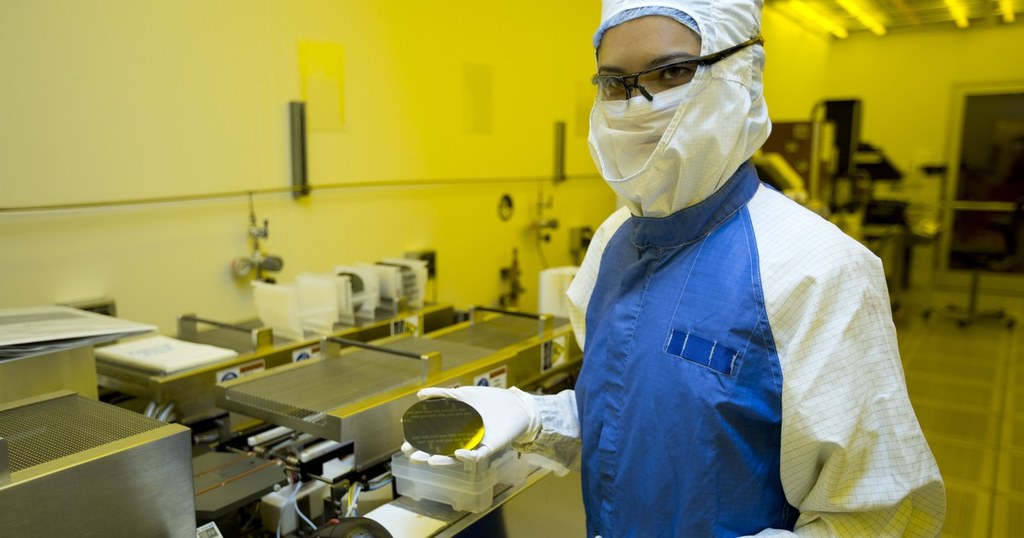
Before any chip can be built, a silicon wafer is needed. The 300mm wafer market is dominated by four companies: Shin-Etsu (Japan), SUMCO (Japan), Siltronic (Germany), GlobalWafers (Taiwan). Together about 90% market share.
Wafer prices have risen about 35% since 2024. That's the inflation no one sees — it happens two stages before the end product. Capacity expansion takes 3–5 years, and the market systematically underestimates how little flexibility exists at this stage.
Siltronic is the most accessible stock in this group for European investors. The valuation at forward P/E ~14 is cheap relative to the strategic position.
Stage 3: The foundry consolidation
Leading-edge chip manufacturing is consolidating around three players: TSMC (well over 60% market share at advanced nodes), Samsung Foundry (~10%), Intel Foundry (now ramping, but suddenly relevant with the 18A process).
TSMC remains the default pick — Q1 2026 record margins, AI-chip boom fully behind it. But the concentration risks (Taiwan geopolitics, single largest customer Apple at ~22% of revenue) are real. The stock has traded sideways since year-start because the market is pricing these risks.
Intel Foundry is the most controversial bet in the chain. Until the Q1 2026 beat, the thesis was "Intel can't do it." Now: $5.4 billion foundry revenue (+16%), 200+ OEM designs on 18A, Tesla/SpaceX validation. The market still isn't pricing in that Intel Foundry becomes a real second US player in 2027. The next catalyst is the Q3 2026 earnings call (yields update for 18A) — accumulation until then, reaction afterwards.
Samsung Foundry is the textbook underperformer story: market share shrinking, customers migrating to TSMC. No investable case here.
Stage 4: Specialty chemicals and materials
An often overlooked stage: photoresist (light-sensitive coating), specialty gases, CMP slurries (polishing suspensions). Three Japanese companies dominate the critical sub-markets: Tokyo Ohka Kogyo, JSR (now private), Shin-Etsu Chemical.
For investable liquidity: Entegris (USA, NASDAQ:ENTG) is the global player for specialty chemicals and wafer handling. Forward P/E ~22, EBITDA margin >25%. This stock is treated by the market as a "second-tier tech beneficiary" — it's actually first tier.
Stage 5: Test and packaging equipment
Every produced chip has to be tested, cut, packaged. Advanced packaging (CoWoS, HBM stacking for AI chips) is the most acute bottleneck in the chain. NVIDIA CEO Jensen Huang has publicly stated that packaging capacity is their biggest limiter — not wafers.
Main beneficiaries: ASE Technology (Taiwan), Amkor Technology (NASDAQ:AMKR). Amkor received a $2 billion order for US packaging capacity from TSMC in 2025 — this becomes commercially effective in 2026/27 and is not yet fully priced in the stock.
Test equipment: Teradyne (NASDAQ:TER) and Advantest (Japan) — duopoly for high-end test systems. Both benefit structurally from rising chip complexity (more tests per chip).
Stage 6: HBM and memory
High-Bandwidth Memory (HBM) is the second acute bottleneck after packaging. Every NVIDIA H100 or Blackwell chip needs HBM3/HBM3e — dominated by SK Hynix (~55% market share), Micron (~25%), Samsung (~20%).
SK Hynix is the focused HBM bet, but hard to access for European investors. Micron (NASDAQ:MU) is the Western proxy — forward P/E ~13, HBM revenue growing >100% annually. The stock has been muted in 2026 because the standard DRAM segment is cyclically burdened — that turns in 2027.
Synthesis: Three portfolio constructions
Defensive setup (3 positions): ASML, TSMC, Micron. Three market leaders in three different stages, low idiosyncratic risk, high correlation but different sub-drivers. Expected return: market + 3–5% annually over 3 years, significantly lower drawdowns than a single chip stock.
Growth setup (5 positions): ASML, Intel, Amkor, Entegris, Micron. Mix of market leaders and disproportionate beneficiaries of structural bottlenecks. Higher volatility, but greater upside if the supply chain shortage lasts longer than the market is pricing.
Asymmetric bet (2 positions): Intel, Amkor. Both not yet fully priced, both with clear catalysts in the next 4–6 quarters. Highest risk, highest potential return. Keep position size smaller.
The two risks that can break everything
First: Taiwan-China escalation. If TSMC production fails for even three months, the entire chain collapses. No hedge is large enough.
Second: A real recession in the US and Europe simultaneously. AI capex won't disappear cyclically, but the pace can slow from "everyone build as fast as possible" to "digest existing inventory first." That would compress valuations massively.
Both risks are not predictable — but both justify never holding more than 25% of the portfolio in a single sub-sector concentration.
What this analysis does not replace
A deep dive identifies the structure of the opportunity, not the entry point. Most of the stocks named here trade at or near multi-year highs. Position building over multiple tranches, ideally distributed over 3–6 months, reduces the risk of unfavorable entries.
Investors wanting to examine individual positions in more detail will find full analyses with valuation models, risk scenarios, and price targets in our 100X Insider Reports.