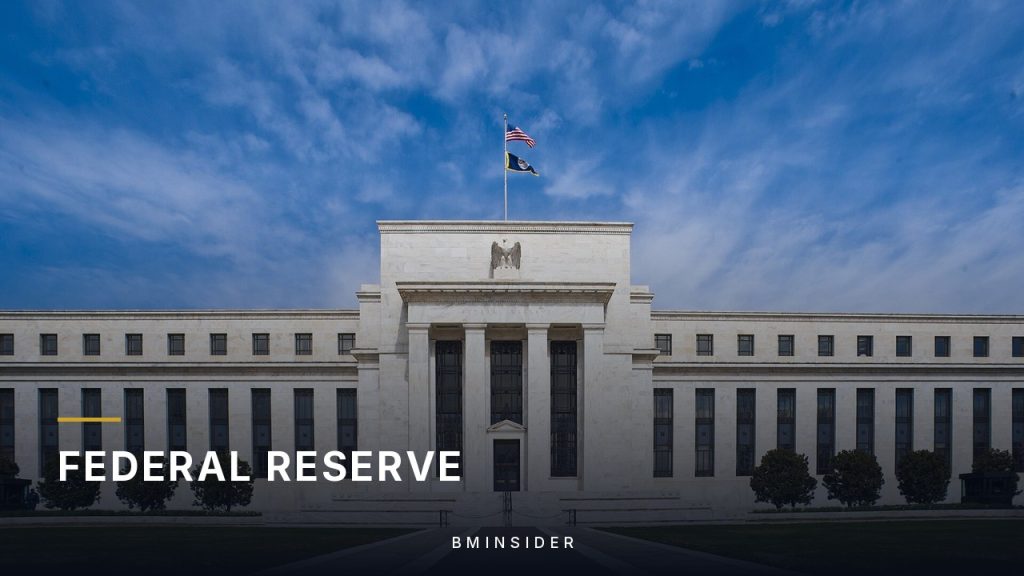
At 2:00 p.m. Eastern on Wednesday, the Federal Reserve raised its policy rate for the first time since July 26, 2023: a quarter point, to a range of 3.75 to 4.00 percent, on a 12–0 vote. The hike itself surprised nobody; futures had priced it at 92 percent that morning. What hit the market arrived half an hour later. Kevin Warsh, chair since May 22, read an opening statement containing a phrase that, in central-bank English, is a warning: today’s action would “support a timelier return” to the 2 percent goal. Timelier means faster than it would get there on its own. And then, with no hedge at all: “The plain fact is that inflation is too high and has been for too long.”
The Dow Jones Industrial Average closed down 631 points, or 1.21 percent, at 51,461.90, with Goldman Sachs leading the index lower and banks and energy names filling out the bottom of the table. The S&P 500 lost 0.45 percent. The Nasdaq Composite closed down 0.01 percent, which is to say unchanged. The 10-year Treasury yield ended the evening at 5.016 percent, up 2 basis points on the day and back above a level it last held in 2007. That is the first oddity of the day: the first rate hike in three years lands on the stocks with the oldest business models and leaves the ones with the richest valuations untouched. The second oddity is in the inflation data the Fed is supposedly hiking against.
The Number the Fed Is Not Hiking Against
Core consumer prices, excluding food and energy, rose 2.4 percent in the twelve months through August. That is the lowest core CPI reading since March 2021, a tenth below July, published by the Bureau of Labor Statistics on September 11, five days before the meeting. Anyone who knows only that number thinks Wednesday was a mistake: a central bank that lifts its policy rate to 4 percent with core inflation at 2.4 percent is fighting a problem that is solving itself.
But that is not the number the Fed watches. Headline CPI stood at 3.4 percent in August, dragged up by gasoline, which has been pulling the basket higher ever since the Iran war put Brent above $100. The Fed’s preferred gauge, the personal consumption expenditures price index, ran at 3.7 percent in July, its core measure at 3.3 percent; both figures date from August 26, and the August readings do not arrive until September 30. In its own projections released Wednesday, the committee expects PCE inflation of 3.7 percent for 2026 and 2.3 percent for 2027. Core inflation, on the Fed’s own math, does not get back to 2 percent until 2029.
Warsh offered a third lens in the press conference that explains the decision better than any single index: inflation has been running above target for more than five years, and “too many categories” are still posting increases above 3 percent, on a six-month basis as well as a twelve-month basis. That is not an argument about the level of inflation. It is an argument about its duration. A central bank that misses its target for five years does not lose control of prices; it loses control of the expectation that it controls prices. And that expectation does not show up in core CPI. It shows up in the 10-year yield.
Five Percent at the Long End: Where the Hike Was Actually Addressed
The Treasury curve on Wednesday evening looked like this: 2-year 4.74 percent, 10-year 5.01 percent, 20-year 5.39 percent. The 10- and 20-year yields sit at levels not seen since mid-2007. Against a policy rate of 4 percent, that is a steep curve, and the gap between what the Fed sets and what the market demands for ten years has a name: the inflation premium. The bond market is paying itself for not trusting a central bank that has been above target since 2021.
Warsh named that premium himself on Wednesday. Asked why long rates are so high, he listed three causes: the strength of the economy, competition for capital from the AI build-out, and geopolitics, meaning the Iran war. None of the three is something a central bank can remove. What it can remove is the fourth, unspoken one: doubt about its resolve. Diane Swonk, chief economist at KPMG, compressed the logic into a sentence on Wednesday: a hike now could lower long-term rates later, because restoring faith in the 2 percent target lets the inflation premium fall.
That is the test for this hike, and it will not be read off the funds rate. It will be read off the 10-year. If Warsh is right, the yield falls over the coming weeks even as the policy rate rises, because the premium shrinks. If he is wrong, it keeps climbing, because the market reads the hike as confirmation that the Fed is behind. On Wednesday evening the verdict was a draw: plus 2 basis points. Immediately after the statement, yields across the 2-, 10- and 30-year had actually fallen 1 to 5 basis points, before the press conference pulled them back up. The word “timelier” cost the market more than the hike did.
Eighteen Dots, and the One That Matters Is Missing
The committee’s rate projections shifted the picture more than the move itself. For year-end 2026, twelve of eighteen participants see one more quarter-point hike, four see two more, and only two see none. Sixteen of eighteen, then: at least one more, most likely in October or December. The median for end-2026 is 4.1 percent, and for end-2027 it is also 4.1 percent: fourteen participants expect a range of 4.00 to 4.50 percent at the end of next year, and only four see cuts by then. In June the projections had contained one hike in 2026 and one cut in 2027. The cut is gone.
And then there is the dot that is not there. For the second straight meeting, Warsh declined to submit his own rate forecast. He has argued the dot plot is unhelpful in conducting monetary policy and that the Fed should offer less guidance on the future path of rates. This is more than a quirk. The chair of the world’s most powerful central bank leaves the chart the market reads most closely without his view, on the day it comes out at its most hawkish. Anyone trading the dots is trading the opinions of seventeen people and guessing at the eighteenth. The market guessed on Wednesday that Warsh sits above the median rather than below it. His remark that he would be “hard-pressed to describe broad financial conditions as restrictive” supports that guess.
The rest of the projections are, for a hiking central bank, remarkably relaxed: real GDP growth of 2.3 percent this year and 2.4 percent next; unemployment at 4.1 percent in both years, which the Fed itself describes as consistent with full employment. August retail sales, released the same morning, rose 1.2 percent against a 0.9 percent forecast, after a 0.5 percent drop in July. Warsh called activity “solid.” That is the second half of the message: the Fed is not hiking because it has to slow the economy. It is hiking because it can afford to.
Why the Dow Fell and the Nasdaq Did Not
A Dow down 1.2 percent next to a Nasdaq down 0.01 percent, on the same day, from the same central bank, tells you whom a rate hike hurts in 2026. Not the growth stocks whose valuations supposedly hang on the discount rate. The companies that work with the rate. Goldman Sachs led the Dow lower; banks were broadly red. The reason sits in the same curve the Fed is trying to fix: a bank that borrows short and lends long earns the slope, and when the central bank lifts the short end to push down the long end, that slope is exactly what shrinks. Add the investment-banking effect BMInsider walked through on Tuesday using Bank of America: at 5 percent yields, issuance and M&A dry up, and fees are the first thing to go. Goldman reports in mid-October; it will be the first to show what a flatter curve costs in a single quarter.
Energy, the second losing group, fell for a different reason: with Brent above $100 it had been the summer’s winner, and it is what an investor sells to book gains without changing the shape of the portfolio. Boeing lost 3.7 percent, but on its own news, after saying it would take longer than expected to stabilize 737 MAX production. That is a Dow problem, not a Fed problem.
And the Nasdaq? The last three months explain more than Wednesday does. The IGV software ETF is up 15 percent over that stretch, Microsoft and Palantir roughly 30 percent each, while the SOXX semiconductor ETF is down 17 percent. Software companies hold net cash, earn more on it when rates rise, and finance nothing. Chipmakers and their customers build fabs and data centers on borrowed money, and the invoice for that is written by the 10-year yield. The Nasdaq is no longer one rate trade; it is two: one that collects the rate and one that pays it. On Wednesday they cancelled each other out.
Who Pays and Who Collects in a U.S. Portfolio
For American investors the sorting runs through the household balance sheet before it reaches the brokerage account. Mortgage rates key off the 10-year, not the funds rate, and the 10-year did not move; anyone who was hoping the Fed’s first meeting of the cycle would bring relief on a 30-year fixed got neither relief nor punishment, which is why the homebuilders are less of a Fed trade this year than the banks. Money-market funds and Treasury bills, on the other hand, reprice within days: the 2-year at 4.74 percent and a funds rate at 4 percent mean cash pays more than it has at any point since 2023, and it pays it with no duration at all. That is the quiet competitor for every dividend stock in the market, and it just got a raise.
Among the banks, the distinction is between balance sheets and fee machines. JPMorgan and Bank of America carry the deposit franchises that benefit when the short end rises; Goldman and Morgan Stanley live on the capital-markets fees that a 5 percent 10-year suffocates, which is why Goldman led the Dow lower and not JPMorgan. Utilities and REITs are the other side of the ledger, refinancing zero-rate debt at 5 percent and passing what they can to regulators and tenants. The AI build-out sits in the middle: hyperscalers with cash on hand keep spending, and the suppliers whose customers borrow to build are the ones the SOXX has been marking down for three months. Across the Atlantic the pattern is the same with different names. The European Central Bank raised its deposit rate to 2.50 percent on September 10, its second hike since the war began, with Christine Lagarde calling it “a no brainer”; Bunds yield about 3.53 percent, near a fifteen-year high, French OATs above 4.5 percent, and the U.K. 10-year gilt 5.34 percent, higher than the Treasury. Two central banks are hiking into the same oil price, both carrying the memory of 2021 and 2022, when they spent a year calling a price surge transitory.
The Case Against: A Central Bank Hiking Into Oil
The critique of Wednesday is as old as the Fed, and Europe supplies the precedents. The ECB raised rates against oil shocks in July 2008 and again in April and July 2011, and both times had to reverse within months because the energy price choked demand on its own. A core CPI of 2.4 percent is exactly the signal those critics cite: strip out energy and American inflation is at target, and energy is not something the Fed controls. The 1.2 percent jump in retail sales is nominal; part of it is gasoline that got more expensive, not consumption that grew.
The Fed’s own forecast hands the critics material too. If PCE inflation falls, by the committee’s own estimate, from 3.7 percent this year to 2.3 percent next year, why does the policy rate sit unchanged at 4.1 percent through the end of 2027? Warsh’s answer is expectations; the answer from the four participants penciling in cuts for 2027 is caution. Four of eighteen is not a faction. It is the start of one.
Then there is the political front. The president has spent months demanding cuts, and his adviser Kevin Hassett said Wednesday that Trump would “not be super happy about it” but would defend Warsh’s independence “above all.” Warsh, asked about Washington, answered with a line that cuts both ways: “Independence is a two-way street.” And: “We stay in our lane. We’ll let people that do trade policy and fiscal policy stay in their lane too.” A central bank that hikes against the stated wishes of the president who appointed its chair buys credibility in the bond market. Whether it gets to keep it is not the bond market’s decision.
What to Watch From Here
The next date is fixed: October 27–28. Futures give that meeting a 51 percent chance of another quarter point and 49 percent of a pause, a coin flip the data will settle. On September 30 the August PCE numbers land; if core PCE is still at 3.3 percent while core CPI sits at 2.4 percent, the argument over which of the two is telling the truth will dominate the October meeting. In mid-October the banks report, and Goldman will be the first to put a dollar figure on a flatter curve.
The real gauge, though, remains the 10-year. It closed Wednesday at 5.016 percent. If it sits below 4.8 percent in four weeks, the Fed has lowered the long end by raising the short end, and Swonk was right: the premium fell because the market believes the central bank again. If it sits above 5.2 percent, the market has read the hike as an admission that the Fed is five years late, and October brings the next one. Equities have already sorted their answer to that test: those with cash sit it out; those that work the curve pay for it. And anyone looking at futures on Thursday morning sees the Dow up 0.7 percent, the S&P 500 up 0.8 percent and the Nasdaq-100 up 1.1 percent: the market is buying the dip, and it is buying it first, again, where the rate hurts least.
Try TradingView Free for 30 Days
Plus get a $15 discount on your first subscription through this link.
Read more in our topic hub: Topic Hub: Fed Policy, Rates & Bonds 2026